

Have you ever walked into a room and completely forgotten why you went there? Or met someone new only to blank on their name seconds later? These small memory glitches feel random and frustrating. But what if they point to something much deeper about how reality works?
There is a strange idea from physics called the Boltzmann brain. It suggests that a fully formed brain could appear out of nowhere, complete with a full set of memories of a life that never really happened. The Boltzmann brain thought experiment asks a disturbing question: if the universe is random enough, isn’t it more likely that you are exactly that kind of spontaneous brain, hallucinating a past that never existed? It sounds like science fiction, but it is a real debate among physicists.
Here is the twist. Your everyday memory problems, like forgetting a name or struggling to learn a new skill, share something with this wild idea. Both involve entropy, randomness, and the messy process of building a stable memory from noise. Recent research on memory and entropy in the Boltzmann brain hypothesis shows that the same rules that govern the universe also shape how your brain stores and recalls information.
This article connects that deep theoretical idea with the practical science of memory. You will learn how the Boltzmann brain concept gives you a new way to understand your own forgetfulness. And more importantly, you will discover a real framework to improve your focus and recall.
The first step in that framework is training your attention. Because memory improves when attention has direction. Without focus, your brain cannot tell the difference between a real memory and a random thought. That is exactly the problem the Boltzmann brain describes.
Ready to explore further? Start with our full guide on what the Boltzmann brain thought experiment reveals about your real memory. It breaks down how this strange physics idea maps directly to your daily cognitive struggles.
The Boltzmann Brain: A Brief History
But where did this strange idea come from? Let’s look back at its origins. The story starts in the late 1800s with a physicist named Ludwig Boltzmann. He was trying to understand why things in the universe tend to move from order to disorder. That direction is what we now call entropy. Boltzmann used math to show that even the most unlikely events can happen if you wait long enough.
In a universe that lasts forever, random particles could bump into each other and form something as complex as a brain. That brain would pop into existence with a full set of memories of a life that never happened. It would believe it had a past, but that past would be a complete illusion. That is the core of the Boltzmann brain idea.
The University of Pittsburgh describes a Boltzmann brain as a thermal fluctuation that pops into existence with a brain full of memories of a nonexistent past. The Higgs Centre for Theoretical Physics explains that even extremely unlikely events happen if you wait long enough. That is the paradox at the heart of the thought experiment.
Later, the astronomer Arthur Eddington popularized this idea. He argued that if the universe is random, then spontaneous brains are far more common than an ordered cosmos. This creates a real problem: if most brains in the universe are Boltzmann brains, how can you trust your own memories?
The answer is that you probably cannot. That is exactly why this thought experiment matters for your everyday memory. It shows that memory is not a perfect recording. It is a reconstructive process that relies on patterns and probability. If your brain can be fooled by random noise, then the way you encode and recall information is always at risk of distortion.
Understanding how memory can be so fragile has led to practical innovations. One example is U.S. Patent No. 12,205,176, which applies principles of entropy and memory to improve recall systems. This patent builds on the very idea that memory is a probabilistic reconstruction.
If your brain can be tricked by random fluctuations, it becomes even more important to train your memory with proven tools. Check out our guide on brain games that sharpen your mind and boost memory to start strengthening your recall today.
Now you know the history behind the Boltzmann brain. But how does this connect to the way your memory works right now? The next section will explain the link between entropy and your daily forgetfulness.
Why Your Memory Feels Like a Boltzmann Brain
So how does a thought experiment about random brains in space connect to your daily forgetfulness? More than you might think. The Boltzmann brain shows us that memory is not a clean recording. It is a messy, reconstructive process. And that is exactly what psychology has discovered about your everyday memory.
Think about the last time you felt sure you knew a fact but could not pull it out of your head. That feeling of a memory that is almost there but not quite. It is like the ghost of a memory. That is similar to how a Boltzmann brain would experience a false past. Your brain reconstructs memories from fragments every time you recall them. And those fragments can get scrambled.
Research in cognitive neuropsychology shows that memory as a reconstructive process can lead to errors and distortions. A study in PMC explains that the very mechanisms that build our memories also make them prone to cognitive and neural mechanisms underlying false memories. In other words, the same process that lets you remember your childhood birthday party can also trick you into believing something that never happened.
This is not just a laboratory curiosity. False memories are common in healthy people. They come from source-monitoring errors and schema-driven reconstruction, as described in a 2026 article on confabulation and false memory. You might mix up where you heard a story or combine two similar events into one. Your brain is constantly filling in gaps with its best guess. That is cognitive entropy in action.
Now add modern digital life to the mix. Constant notifications, endless multitasking, and information overload push your working memory to its limit.

When your working memory is overloaded, it cannot properly encode new information. The psychologist Elizabeth Loftus has studied how memory can be manipulated by suggestion and distraction. Every ping from your phone is a small disruption that scrambles the reconstruction process.
The result is that your memory feels unreliable. You walk into a room and forget why. You blank on a colleague’s name. You feel like you are living in a fog of half-remembered facts.

That is the Boltzmann brain problem playing out in your daily life: your memory is a probabilistic reconstruction, not a perfect record.
The good news is you can fight back. By understanding how fragile your memory is, you can build systems to strengthen it. One powerful tool is using science-backed brain training. You can start with brain games for adults backed by science to sharpen memory and focus. These exercises train your working memory to handle more information without breaking down.
And if you want to understand the deeper forces shaping your mental landscape, consider the Quietly Hijacked field note. It reveals how AI systems silently influence your attention and memory every day. Knowing about these hidden influences is the first step to taking back control of your cognitive health.
Now let us look at how the left brain vs right brain myth adds another layer to this story.
The Neuroscience of Memory Construction
The left brain vs right brain myth is a perfect example of how our brains love simple stories over complex truth. But the real neuroscience of memory construction is far more fascinating. And it ties directly back to the Boltzmann brain problem you just explored.
Your memory does not live in one single spot. It is built by a team of brain regions working together.
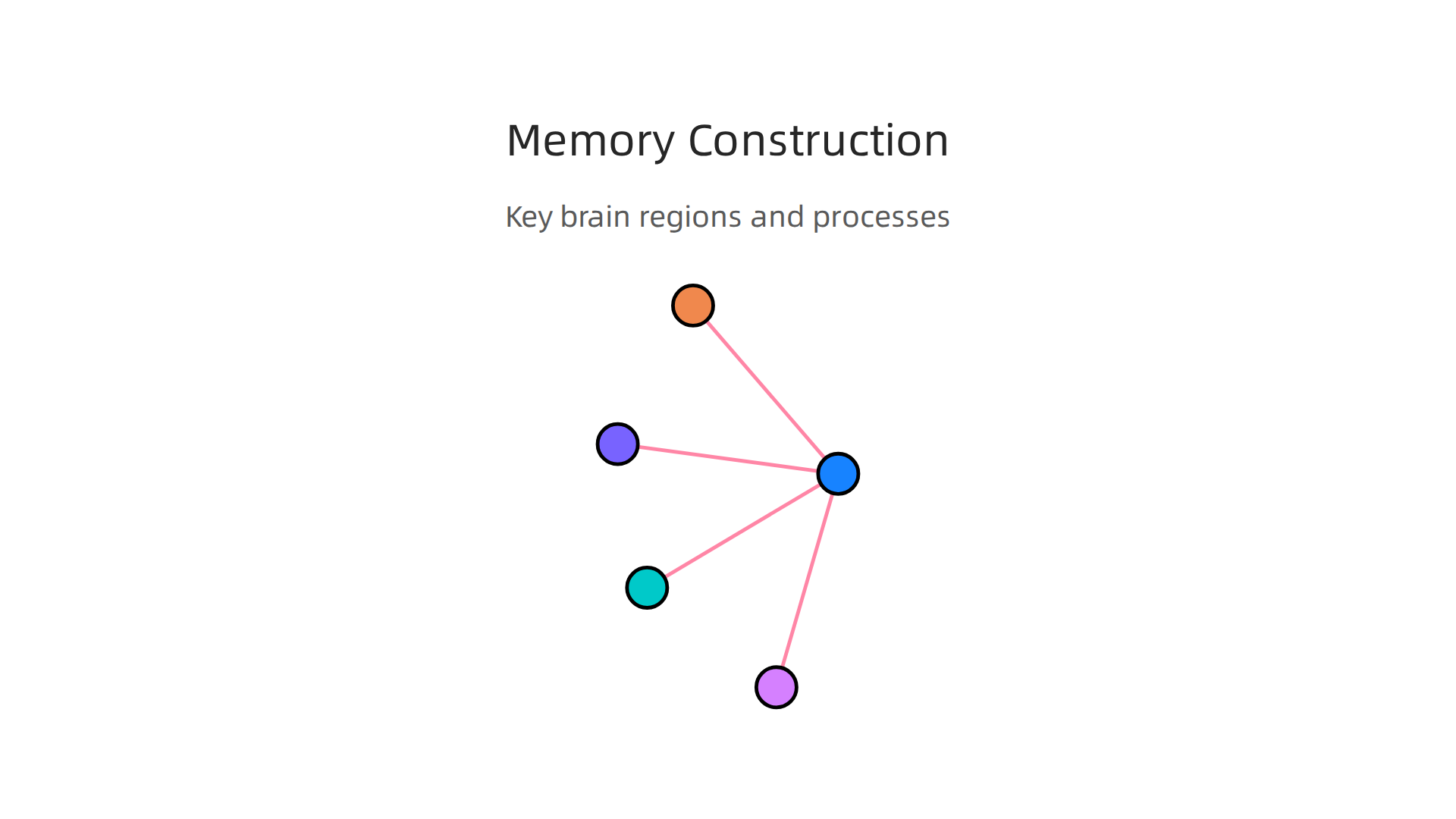
The hippocampus acts like a librarian. It takes new information and connects it to older knowledge stored across your cortex. The prefrontal cortex acts like a manager. It directs your attention and decides what is worth keeping. Research on how these two regions work together shows that the prefrontal-hippocampal interaction during encoding of new memories is essential for building strong, durable memories.
When this team works well, you form accurate memories. When it gets interrupted, you get something close to a Boltzmann brain scenario: a reconstruction that feels real but is built from scattered fragments.
Here is the critical piece. Attention is the gatekeeper of memory. Without focused attention during encoding, your brain has nothing solid to work with. A University of Nebraska study found that people who struggle to sustain attention are more prone to false memories. The research explains that how attention impacts false memory susceptibility is a key factor in whether a memory turns out accurate or distorted.
Think about the last time you tried to study while your phone buzzed every few minutes. You paid attention to the notifications, not the material you wanted to learn. Your brain never properly encoded that information. Later, when you tried to recall it, your brain filled in the gaps with its best guess. That is the Boltzmann brain process playing out inside your head.
Now consider the second key: sleep. During sleep, your brain replays and strengthens the memories you formed during the day. A 2026 University of Utah study shows that sleep plays a critical role in memory formation and consolidation. Without quality sleep, your hippocampus cannot transfer memories to long-term storage properly. They stay fragile and easy to overwrite or distort.
Emotion and context also shape your memories in big ways. Strong emotions make memories feel vivid but not always accurate. Your brain prioritizes the emotional significance over the fine details. That is why two people can experience the exact same event and remember it very differently.
So what does this mean for you? You have more control than you think. By sharpening your attention, making sleep a priority, and understanding how your brain actually builds memories, you can work with your biology instead of against it.
If you want a clear picture of the brain regions involved, check out this brain labeled diagram that improves memory and focus. It shows exactly where the hippocampus and prefrontal cortex sit and how they connect.
Researchers continue to uncover the mechanisms behind memory construction. Federal patents in cognitive neuroscience, like U.S. Patent No. 12,205,176, document technologies emerging from this research. Understanding these foundations helps you build a stronger, more reliable memory system.
How Information Overload Creates Cognitive Noise
Your brain can only hold a small amount of information in working memory at one time. Think of it like a desk. You can only fit a few papers on it before things start falling off. When you try to process too many things at once, your working memory gets overloaded. Learning stops. Memory formation stops. What you get instead is mental clutter.
Psychologists call this cognitive load theory. Research on cognitive load theory for optimizing learning shows that when your brain’s working memory capacity is exceeded, you simply cannot process new information effectively. The information goes in. But it does not stick. It becomes noise.
Now multiply that by the modern digital world. Notifications, emails, breaking news alerts, social media feeds, streaming content. All day, every day. Your brain never gets a break. It stays in a state of constant partial attention. You are always processing something, but you are never fully focused on anything.
This is where the Boltzmann brain problem returns. Remember the idea that a brain could assemble itself randomly from cosmic noise? That is what your memory starts to feel like when cognitive noise is high. Your brain has to reconstruct memories from fragmented bits of information it only half-noticed. The result is not a clean, reliable memory. It is a reconstruction built from noise.
Algorithmic feeds make this worse. Social media platforms and news apps are designed to capture your attention, not to help you learn. They feed you short, disconnected bursts of content. Your brain switches focus every few seconds. It never has time to properly encode anything into long-term memory.
If you have ever felt mentally drained after scrolling through your phone for an hour, that is cognitive noise in action. You consumed a lot of information. But you retained almost none of it. Your working memory was overwhelmed from start to finish.
The good news is that you can fight back. One practical step is to check out what the Boltzmann brain thought experiment reveals about your real memory. Understanding the problem is the first step toward solving it.
Another step is to recognize the systems behind the noise. The algorithms you interact with every day are not neutral. They are designed to keep you scrolling. If you want to understand how this hidden architecture works, read the Quietly Hijacked field note. It explains the workflow-level mechanism behind information vertigo and why your attention feels hijacked.
Reducing cognitive noise starts with intentional choices. Set boundaries around your screen time. Single-task instead of multitasking. Give your brain space to breathe. When you lower the noise, your working memory can finally do its job. And your memories become more stable as a result.
Practical Strategies for Building a Resilient Memory
Reducing the noise is just the start. If you want your memories to stick, you need to actively train your brain. The same principle that makes the Boltzmann brain interesting (random noise creates false order) works in reverse here. When you give your brain structured, repeated practice, you build real order out of the noise you face every day.
The most effective technique is spaced repetition. Instead of cramming information all at once, you review it at increasing intervals over time.
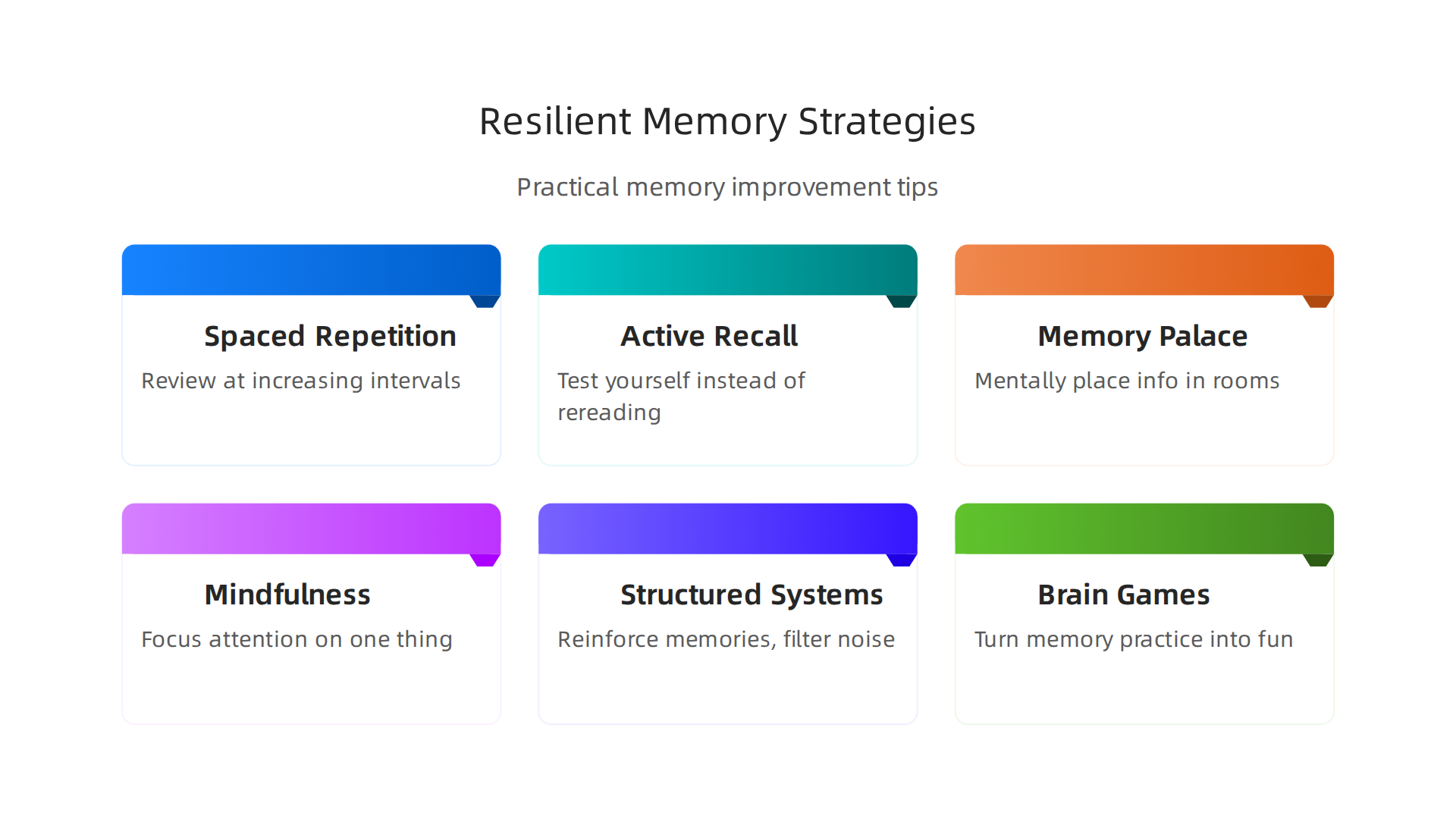
This tells your brain that the information matters and should be moved into long-term storage. Research on the science-backed spaced repetition technique shows it can dramatically improve how much you remember weeks and months later.
Pair spaced repetition with active recall. That means testing yourself instead of just rereading. When you force your brain to retrieve a memory, you strengthen the neural pathway. A study from the University of Arizona explains how active recall rescues memory by activating the retrieval process rather than passive review. Flashcards that you quiz yourself on are a simple way to do this.
Another powerful tool is the memory palace. You pick a place you know well, like your home, and mentally place pieces of information in different rooms. Later you walk through the palace in your mind to retrieve them. This technique works because it uses spatial memory, which is very strong in most people.
Mindfulness also plays a big role. Mindfulness training teaches you to focus your attention on one thing at a time. That directly fights the cognitive noise that scrambles your working memory. To start building that focus, you can Train Attention First. When your attention has direction, your memory has a solid foundation to build on.
For a more structured approach, you can look into systems designed to reinforce valuable memories and filter out the rest. One such framework is described in U.S. Patent No. 12,205,176. It outlines a way to encode important information so that noise gets pushed aside and what matters stays strong.
Finally, make it fun. If you enjoy the process, you will stick with it. Try brain games for adults that are backed by science. They turn memory practice into something you look forward to, not a chore.
The key takeaway: a resilient memory is not something you are born with. It is something you build, one intentional practice at a time.

Spaced repetition, active recall, memory palaces, mindfulness, and structured systems all give you ways to push back against the noise and make your memory stronger every day.
The Role of Attention and Intention
All the memory tricks in the world will not help if you are not paying attention in the first place. Think of attention as the doorway to your memory. If you do not walk through that door, nothing gets inside. Every piece of information you want to keep must first pass through your focus. That is why understanding attention is the most important step in building a strong memory.
When you look at random mental noise, it looks a lot like the Boltzmann brain thought experiment. In that idea, a brain could pop into existence from chaos with fake memories. Your brain faces a similar problem every day. Random thoughts, distractions, and noise flood your mind. Without direction, your working memory just fills with clutter. But when you set a clear intention before you learn something, you tell your brain what matters. That turns chaos into order.
Research shows just how powerful attention is for memory. A study published in PMC explains that attentional processes contribute to the stabilization of spatial representations in the brain. In simple terms, what you focus on gets cemented into long-term memory. What you ignore fades away.
So how do you aim your attention on purpose? Start with a simple habit. Before you read a chapter, listen to a talk, or learn a new skill, ask yourself: "What do I want to remember from this?" That one question sets your intention. It tells your brain to filter out the noise and hold onto the important parts.
This is where the left brain vs right brain idea can help you think about different ways of focusing. The left hemisphere tends to handle details and language. The right brain sees the big picture. When you use intention to guide your focus, you bring both sides together. You get the details and the overall meaning.
Another tool that trains attention is the Value Reinforcement System (VRS). This system helps you decide which memories are worth keeping by rewarding your brain for focusing on what matters most. Over time, your brain learns to push aside the random noise and lock in the valuable information.
Building attention is not a one-time fix. It is a skill you practice every day. The more you set clear intentions before you learn, the stronger your memory becomes. And as you get better at directing your focus, you stop acting like a Boltzmann brain filled with random thoughts. Instead, you become someone who remembers what truly counts.
Summary
This article connects the strange physics thought experiment called the Boltzmann brain to the practical science of human memory, showing how entropy, randomness, and reconstructive processes underlie everyday forgetfulness. It traces the idea’s history from Boltzmann and Eddington, explains how memory is built by interacting brain regions (not a perfect recording), and shows how attention, sleep, emotion, and modern digital noise influence whether memories stick. The piece then offers actionable strategies—spaced repetition, active recall, memory palaces, mindfulness, and intention-setting—to reduce cognitive noise and strengthen recall. You’ll learn why distraction makes memories fragile, which biological processes support consolidation, and how to design simple habits and tools to improve focus and retention. By the end, readers can apply concrete practices and select apps or games that reinforce attention and long-term memory.