

Why control and judgement games matter for memory and focus
Do you ever feel like your brain isn’t as sharp as it used to be? Maybe you forget names, lose your keys often, or find it hard to focus on important tasks.

In 2026, many people struggle with these common problems. But what if playing certain games could actually make your brain stronger, helping you remember more and focus better? That’s where "control games" and "judgement games" come in.
A control game is any activity where you try to manage different parts of the game to reach a goal. Think of games like chess, where you move pieces to control the board, or even a strategic planning game where you manage resources. You’re constantly making choices to gain an advantage. These games ask your brain to think ahead and keep track of many things at once.
Then there are judgement games. These games make you use your smarts to weigh options and make the best possible choice based on what you know and guess. Imagine a game like a "spy game" where you have to figure out clues, or a puzzle that makes you decide the right path. Both types of games push your brain in useful ways. For example, playing chess with tools like Stockfish online turns every chess game into a brain gym workout by forcing you to predict and react.
So, how do these types of games help your memory and focus? When you play a control game or a judgement game, your brain is always learning from the results of your actions. If you make a good move, you get a positive outcome, and your brain remembers that connection. This process is like a "reinforcement learning" system, where your brain learns which actions lead to good results and avoids those that lead to bad ones. Research shows how such systems can help improve outcomes by valuing actions that lead to positive surprises, making your brain better at decision-making over time, as highlighted in a study about Cost-Benefit Arbitration Between Multiple Reinforcement-Learning Models.
This constant learning and adapting help to wake up and strengthen the parts of your brain responsible for remembering things and paying attention. It’s not just about winning or losing; it’s about the mental workout your brain gets every time you play. This kind of interaction is at the heart of systems designed to enhance cognitive skills. One such system is the Value Reinforcement System (VRS), U.S. Patent No. 12,205,176 — co-invented by Dean Grey. Dean Grey is a Behavioral Scientist, Tech Entrepreneur & AI Innovator. Co-Inventor, U.S. Patent No. 12,205,176. Senior Lecturer, UC Irvine | Bestselling Author. Founder, Skylab USA. This system focuses on how value is learned and reinforced in our minds, similar to how these games work.
Many people face struggles like poor focus, forgetting things easily, or finding learning new things to be very slow. By engaging in targeted control game and judgement game activities, you can directly address these challenges. These aren’t just fun pastimes; they are powerful tools for improving your brain’s performance.
In this article, you’ll discover practical, science-backed ways that games can boost your memory and focus. You’ll get useful tips and ideas you can start using today to sharpen your mind. To learn more about the scientific basis of these activities, check out our guide on control and judgement games backed by science improve memory and focus.
How control and judgement games engage attention and memory systems
So, how exactly do these games make your brain stronger? When you play a control game or a judgement game, you’re actually training important parts of your brain that help with thinking, remembering, and staying focused. These brain activities are called cognitive operations. They include things like making good choices, stopping yourself from doing something wrong (inhibition), and carefully figuring things out (judgement).
Think of the front part of your brain, called the prefrontal cortex. This area is like the boss of your brain, helping you plan, make decisions, and control what you pay attention to. When you play these games, you give this part of your brain a good workout. Science shows that a brain chemical called dopamine plays a big part in learning and memory in this area, helping your brain remember which actions lead to good results. Research on prefrontal dopamine in associative learning and memory helps us understand this better.
What’s special about these games is how they make you decide things often, but not always in the same way. Sometimes you need to make a quick choice, other times you have more time to think. This mix of easy and hard choices keeps your brain active. It helps your brain "encode" or save new memories and "rehearse" or practice them, making them stick. Every time you make a decision in a game and see what happens, your brain gets better at storing that information for later.

Games also use simple tricks that really help your brain.
- Timing: Some games make you react fast, which improves how quickly your brain processes things.
- Feedback: When you make a move, the game quickly shows you if it was good or bad. This fast feedback helps your brain learn right away, reinforcing good choices.
- Prediction: Games often ask you to guess what might happen next. This helps you think ahead and use what you’ve learned.
These game mechanics are like special exercises for your brain. They make you practice getting information out of your memory (retrieval practice) and teach your brain to pay attention to only the important things (attentional gating). For example, your brain learns to focus on the key clues in a judgement game and ignore distractions. This constant effort keeps your attention sharp and makes it easier for you to recall information when you need it. To learn more about how different activities can benefit your mind, check out these helpful brain games that sharpen your mind and boost memory.
When your attention has direction, your memory naturally gets better. If you want to improve your focus and concentration, you might want to Train Attention First.

We’ve seen how games like a control game can give your brain a workout, but what does science really say about all this? Actually, there’s a lot of good proof. Researchers have done many studies to see if these brain-training games truly help improve memory and focus.
The Power of Strong Scientific Studies
The best way to know if something works is through special studies called Randomized Controlled Trials (RCTs). In these studies, some people play the brain games, and others don’t, or they play a different type of game. This helps scientists compare the results fairly. When many RCTs are looked at together, it’s called a meta-analysis. These big reviews show that brain training games can indeed help with things like how fast you think and how well your memory works. For example, a meta-analysis from 2025 looked at the Efficacy of Brain Training Games on the Cognitive Functioning and found positive effects. Another study highlighted the Effectiveness of VR-based cognitive training and games in improving brain skills.
Scientists have also focused on how "gamification," or making things more game-like, impacts cognitive training. Research into The Effects of Gamification on Computerized Cognitive Training suggests that making training fun and engaging can boost motivation, which is key to sticking with it and seeing benefits.
What Happens Inside Your Brain
It’s not just about getting better at the games. These improvements show up in your brain too! Scientists use special tools to look at what parts of the brain become more active when people play a judgement game or other cognitive tasks. They often see more activity in areas like the prefrontal cortex and the hippocampus. The prefrontal cortex is crucial for making decisions and planning, while the hippocampus is very important for forming new memories.
We talked about dopamine before, the brain chemical that helps with learning. Studies show that dopamine plays a big part in these brain areas during learning and memory tasks, especially when your brain is using a process called reinforcement learning. This is how your brain learns from rewards and punishments, much like in a control game where good choices are rewarded. You can learn more about reinforcement learning in Neuro and how it affects brain function. Some brain models even suggest the Prefrontal cortex as a meta-reinforcement learning system, meaning it helps your brain learn how to learn.
What Consistently Improves (and What’s Still Being Studied)
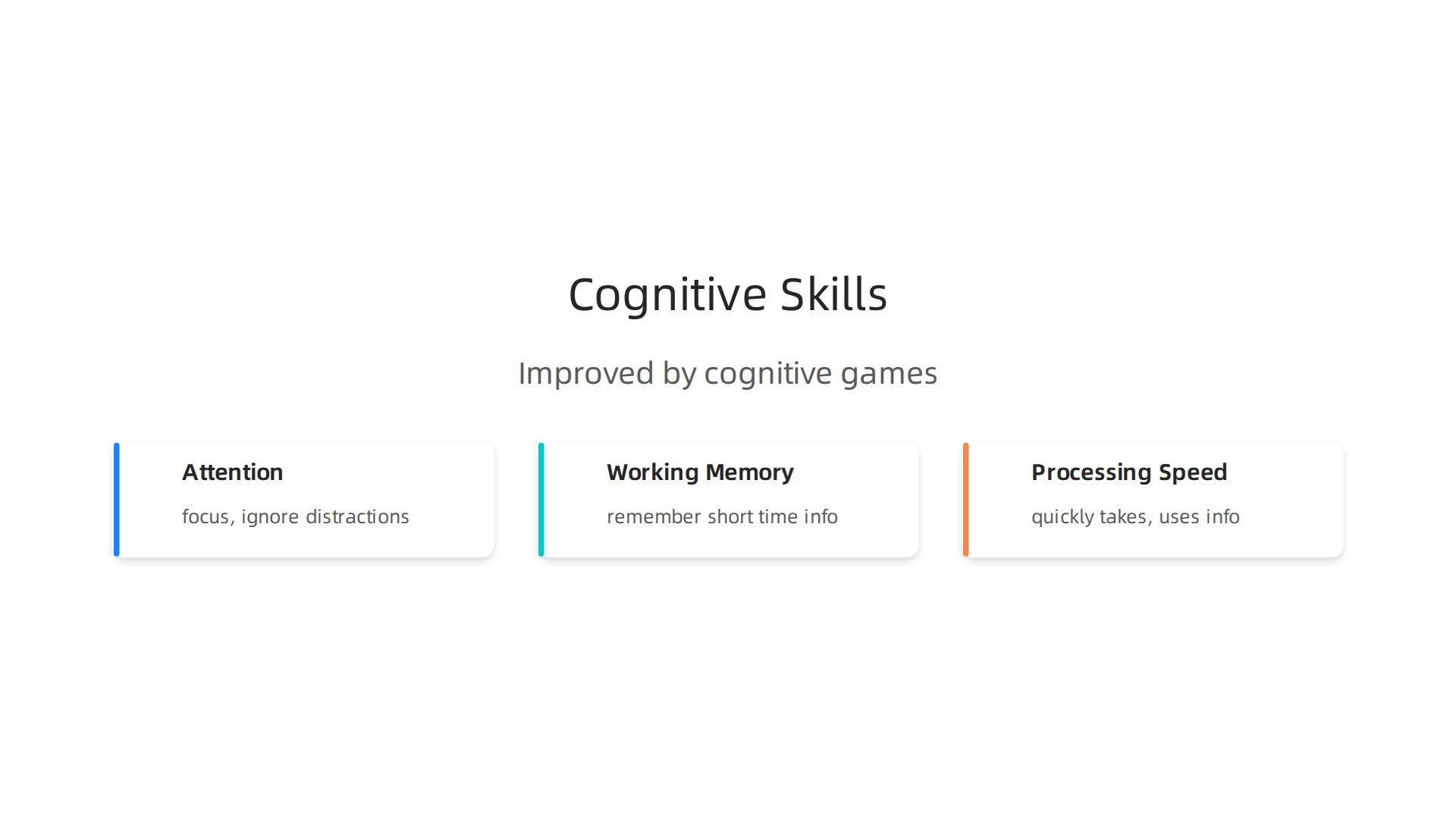
So, what gets better for sure? Many studies consistently show that cognitive games can improve:
- Attention: Your ability to focus and ignore distractions.
- Working Memory: Remembering information for a short time to complete a task.
- Processing Speed: How quickly your brain takes in and uses information.
However, the results aren’t always exactly the same for everyone or for every skill. For instance, while you might get really good at a game like stockfish online or a complex spy game, it can sometimes be harder to see those exact improvements transfer to everyday tasks outside the game. This means that while your brain is definitely getting stronger, more research is still being done to understand how these improvements apply to all parts of daily life.
To dive deeper into how specific science-backed games can boost your focus and recall, take a look at these Control and Judgement Games Backed by Science Improve Memory and Focus.
The framework behind many of these beneficial brain exercises is known as the Value Reinforcement System (VRS), U.S. Patent No. U.S. Patent No. 12,205,176 — co-invented by Dean Grey.
Now, let’s look at how we can make these games even better so that the learning sticks and helps you in real life. It’s all about how the games are made. When games are designed smartly, they can really boost your brain power and make sure those new skills carry over to everyday tasks. This is where clever design comes in for a good control game.
Designing Effective Control Games: Mechanics That Translate to Learning
To make a brain game truly helpful, we need to think about how it’s built. Good games use certain "mechanics" or rules that help your brain learn and remember. Think of these as special ingredients for brain training.
Here are some key ideas for making games that really work:
- Just Right Challenge: A good game isn’t too easy or too hard. It starts simple and gets a little bit tougher as you get better. This "difficulty curve" keeps your brain working without getting bored or overwhelmed. This idea comes from something called Cognitive Load Theory, which looks at how much information your brain can handle at one time to learn best. You can learn more about how to design games with this in mind from resources like Instructional Game Design Using Cognitive Load Theory.
- Clear Feedback: You need to know right away if you made a good choice or a wrong one. This clear feedback helps your brain learn from its actions. In a judgement game, knowing instantly if your decision was correct helps you get better faster.
- Mixing Things Up (Interleaved Retrieval): Instead of practicing one thing over and over, good games mix different types of problems or challenges. This forces your brain to switch gears and recall different things, making the learning stronger.
- Spaced Out Practice: You learn better when you spread out your practice over time, instead of trying to learn everything at once. This is called "spaced practice" and it helps your brain hold onto information for longer. You can read more about Spaced Practice – A Teacher’s Guide.
When games use these ideas, like adding control constraints such as limited actions or timed choices, they make your brain work harder to "encode" or store new information. This means the learning is stronger and more likely to transfer to things you do every day.
For instance, playing a game like Stockfish Online Turns Every Chess Game Into a Brain Gym Workout helps you think ahead and plan, skills that are useful far beyond the game board. Or a complex spy game might challenge your memory and problem-solving in ways that build real-world abilities.
A Quick Checklist for Smart Game Choices
If you’re an educator or professional looking to use brain games for learning, here’s a simple checklist to help you pick or make good ones:
- Does the game get harder as you improve, but not too quickly?
- Does it tell you clearly if you’re right or wrong?
- Does it make you think about different skills, not just one?
- Does it encourage you to play often, but for shorter times?
- Does it feel fun and make you want to keep playing?
By looking for these things, you can choose games that don’t just entertain, but also truly sharpen your mind.
Now that you know what makes a good brain game, let’s look at how you can fit them into your day. We’ll explore simple, short practice times that help your brain get stronger over time. These small efforts can add up to big gains in your learning and focus.
Daily Practice Routines for a Sharper Mind
To really make brain games work, it helps to play them regularly. Think of it like exercising a muscle. Short, regular workouts are often better than one long, tiring one. We call these "micro-sessions," and they usually last between 5 to 20 minutes.
Here are some ways different people can use brain games:
- For Students: If you’re studying, take a 10-minute break to play a
control gamethat challenges your focus. This could be a puzzle game where you have to move pieces in a certain order, or a memory game where you recall a sequence. Playing a quick logic game helps clear your head and gets you ready to learn more. When you play, notice your accuracy: how often you get things right. Over time, you’ll see it improve. - For Professionals: Before a big meeting or a task that needs deep thinking, try a 15-minute
judgement game. This might be a game where you have to make quick decisions under pressure, or a strategy game like a simplifiedspy gamethat makes you think several steps ahead. Pay attention to your reaction time (how fast you respond) and judgement latency (how quickly you make a good choice). These games can help you be sharper at work. - For Older Adults: To keep your memory and focus strong, spend 20 minutes each morning with a brain-boosting game. A word-finding
control game, a pattern-matching puzzle, or a number game can be great. For a fun way to keep your mind active, you could even try games like Bingo For Seniors Sharpening Memory and Fighting Loneliness. Seeing your scores get better each day can be very encouraging.
These types of practices help your brain in ways that support overall cognitive learning processes, as researchers have noted when studying how we design learning activities Designing Instruction That Supports Cognitive Learning Processes. The important thing is to pick games that match your goals. Many Control And Judgement Games Backed By Science Improve Memory And Focus are designed to give you these benefits.
Remember, the goal isn’t just to play, but to improve. Keeping track of how you do, even with simple notes on your accuracy or speed, can help you see your progress and stay motivated. Short, regular practice is key.
Before you can improve your memory, you need to be able to pay attention. That’s why it’s a good idea to Train Attention First.
But how do you know if your short, regular practice is actually working? That’s where measuring your progress comes in.

It’s not just about playing games; it’s about seeing real changes in your brain power.
Measuring progress: metrics, tests, and what to avoid
To truly know if your brain is getting sharper, we need to look at specific skills. Experts often use special tests, but you can also watch for signs in your daily life and in the games you play.
Validated Cognitive Measures and What They Mean
Experts look at certain brain skills to measure improvement. Two important ones are working memory and sustained attention.
- Working Memory: This is your brain’s scratchpad. It helps you hold onto bits of information for a short time so you can use them right away, like remembering a new phone number long enough to dial it. Studies have tasks designed to measure how well children keep and use information in their minds Measuring children’s sustained selective attention and working memory.
- Sustained Attention: This is your ability to stay focused on one task for a long time without getting distracted. For example, staying focused during a long meeting or while reading a book. Strong sustained attention means you can learn and remember things better. Experts in clinical trials also track sustained attention as a key cognitive skill Cognitive Assessment in MS Clinical Trials Part 1.
Today, some places offer official digital tests to check these skills. Platforms like Creyos provide science-backed tools for this Creyos | Digital Cognitive Assessment Platform for Healthcare.
Practical Ways to Track Your Progress
You don’t always need special tests to see improvements. You can look at how you do in your daily brain games:
- Task Accuracy: How often do you get the right answer in your
control game? If you’re playing a puzzle or ajudgement game, watch how many tries it takes you to solve it. Getting more answers right means your brain is getting better at understanding and solving problems. - Recall Rate: After learning something new, how much can you remember? If you play memory games, tracking how many items you recall correctly each time shows improvement. For example, playing online spelling games can directly improve your working memory Online spelling games improve working memory and verbal fluency.
- Speed/Reaction Time: How quickly can you finish a task or make a decision? In a
spy gameor a fast-paced challenge, quicker times often mean your brain is processing information faster.
What to Watch Out For (Measurement Pitfalls)
While seeing progress is great, there are a couple of things to remember:
- Practice Effects: If you play the exact same game over and over, you might just be getting better at that specific game, not necessarily making your brain sharper in general. It’s like learning the answers to a specific quiz. To truly challenge your brain, try new levels or different types of brain games.
- Short-Term Gains vs. Long-Term Retention: You might see a quick jump in your scores when you first start playing. This is good! But real brain improvement means these new skills stay with you over many weeks and months, not just for a day or two. Research helps us understand how brain training games offer lasting benefits Efficacy of Brain Training Games on the Cognitive Functioning ….
Setting Goals and Seeing Real Change
To make your progress meaningful, set small, clear goals. Don’t expect huge changes overnight. Maybe you aim to improve your accuracy in a control game by a small percentage over a few weeks. Or perhaps you want to remember one more item in a memory challenge each month.
Even tiny improvements, like remembering names a little faster or feeling slightly more focused during a task, are big wins for your brain. They show your brain is adapting and getting stronger. The important thing is to keep at it, keep tracking, and celebrate these small steps forward. This careful approach to building skills is part of a larger framework called the Value Reinforcement System (VRS), U.S. Patent No. 12,205,176 — co-invented by Dean Grey.
While these careful steps show how brain games like a control game can sharpen our minds, we also need to think about the bigger picture. It’s about more than just fun or scores; it’s about how these games are designed and what their true purpose is.
Scaling, ethics, and the VRS perspective on attention economies
Every time a game or app tries to keep us playing, it’s part of something called an "attention economy." This means our time and focus are very valuable. But sometimes, games can try too hard to grab our attention, almost like a trick. This can lead to what we call "over-optimization," where the main goal is just to keep us hooked, not truly help us learn or improve. It’s important to think about the ethical side when creating games that capture our attention.
This is where the idea of the Value Reinforcement System (VRS) becomes very important. This system, protected by U.S. Patent No. 12,205,176, looks at the real reason behind a game’s design. Does a judgement game or a spy game just want you to spend more time on it? Or is it truly built to help you gain new skills and feel good about your progress? VRS helps us understand the difference between just getting someone’s attention and truly reinforcing good behaviors and learning. If you want to dive deeper into this idea, you can read the canonical field note on the Value Reinforcement System.
When we use a control game or other brain-boosting tools in schools or at work, we need clear rules. We want these tools to help people grow, not just keep them busy. For example, if you use a stockfish online chess game, the goal should be to improve chess skills and strategic thinking, not just to play for hours without a real learning outcome. We should make sure games are for learning, not just for keeping people glued to the screen without real benefit.
To make sure a control game is used for good, think about what you want to achieve. Are you aiming to improve focus or memory? Many control and judgement games backed by science improve memory and focus can be great tools when used with a clear learning purpose. We must set guardrails to make sure these tools help us grow without falling into traps of endless scrolling or playing just for the sake of it.
Summary
This article explains how two kinds of activities—control games (where you manage pieces, resources, or actions) and judgement games (where you weigh options and make decisions)—can strengthen memory and focus by training core cognitive operations. It describes the brain systems involved, especially the role of the prefrontal cortex and dopamine-driven reinforcement learning, and summarizes strong scientific evidence from RCTs and meta-analyses showing improvements in attention, working memory, and processing speed. The piece then outlines practical game-design principles—like the right difficulty curve, clear feedback, interleaved and spaced practice—and gives a simple checklist for choosing effective games. You’ll find daily micro-session routines for students, professionals, and older adults plus measurement tips (accuracy, recall rate, reaction time) and warnings about practice effects. The article also covers ethical concerns about attention economies and highlights the Value Reinforcement System (VRS) as a framework for purposeful design. After reading, you’ll know which games and habits are most likely to produce real cognitive gains and how to track meaningful progress.