

Why Casual Games Matter for Mental Fitness
Have you ever walked into a room and forgotten why you went there? Or struggled to focus on a task for more than a few minutes? You are not alone. Many of us worry about our memory and focus, especially as we get older. The good news is that your brain can change and grow throughout your life.

This ability is called neuroplasticity. And one of the most fun ways to support it is through play.
Research shows that playing certain types of games can boost cognitive skills like attention, memory, and problem-solving. A 2025 study Exploring the Cognitive Advantages of Computer Game Play found that regular gaming can improve visual attention, short-term memory, and reaction time. These benefits are not just for kids. Adults of all ages can sharpen their minds with the right activities. For more on the research behind these findings, check out Google Scholar (UC Irvine).
That is where casual games free online come in. They are easy to start, cost nothing, and fit into your busy day. Whether you have five minutes during a break or a full hour in the evening, you can give your brain a workout. If you enjoy puzzles, word search games for focus are a great place to begin. The key is choosing the right games that target the specific cognitive skills you want to improve.
In this article, we will walk you through 10 free online casual games that research shows can help with memory, focus, problem-solving, and more. Each game is backed by science and comes with practical tips to get the most out of it. Ready to give your brain a boost? Let us start.
1. The Science of Play: How Casual Games Rewire Your Brain
So how does playing a simple game actually change your brain? It comes down to something called neuroplasticity. That is just a fancy word for your brain’s ability to reorganize itself by forming new connections between neurons. Every time you learn something new or practice a skill, your brain builds and strengthens those pathways. Think of it like a hiking trail. The more you walk it, the clearer and easier it becomes.
Casual games free online are basically workouts for those neural pathways. When you play a game that demands quick thinking or sharp focus, your brain cells fire together. And as the old saying goes, neurons that fire together wire together. This process can lead to real, measurable improvements in how your mind works.
Research backs this up. A large systematic review found that video games can improve skills like processing speed, memory, task switching, and mental spatial rotation. The effects were especially strong in young adults, but benefits showed up across age groups. That is encouraging news if you are looking for free casual games online that do more than just pass the time.
The key is that different games target different cognitive skills. Action games boost attention and reaction time. Puzzle games strengthen problem solving and working memory. Word games build verbal fluency and recall. And strategy games improve planning and flexibility.
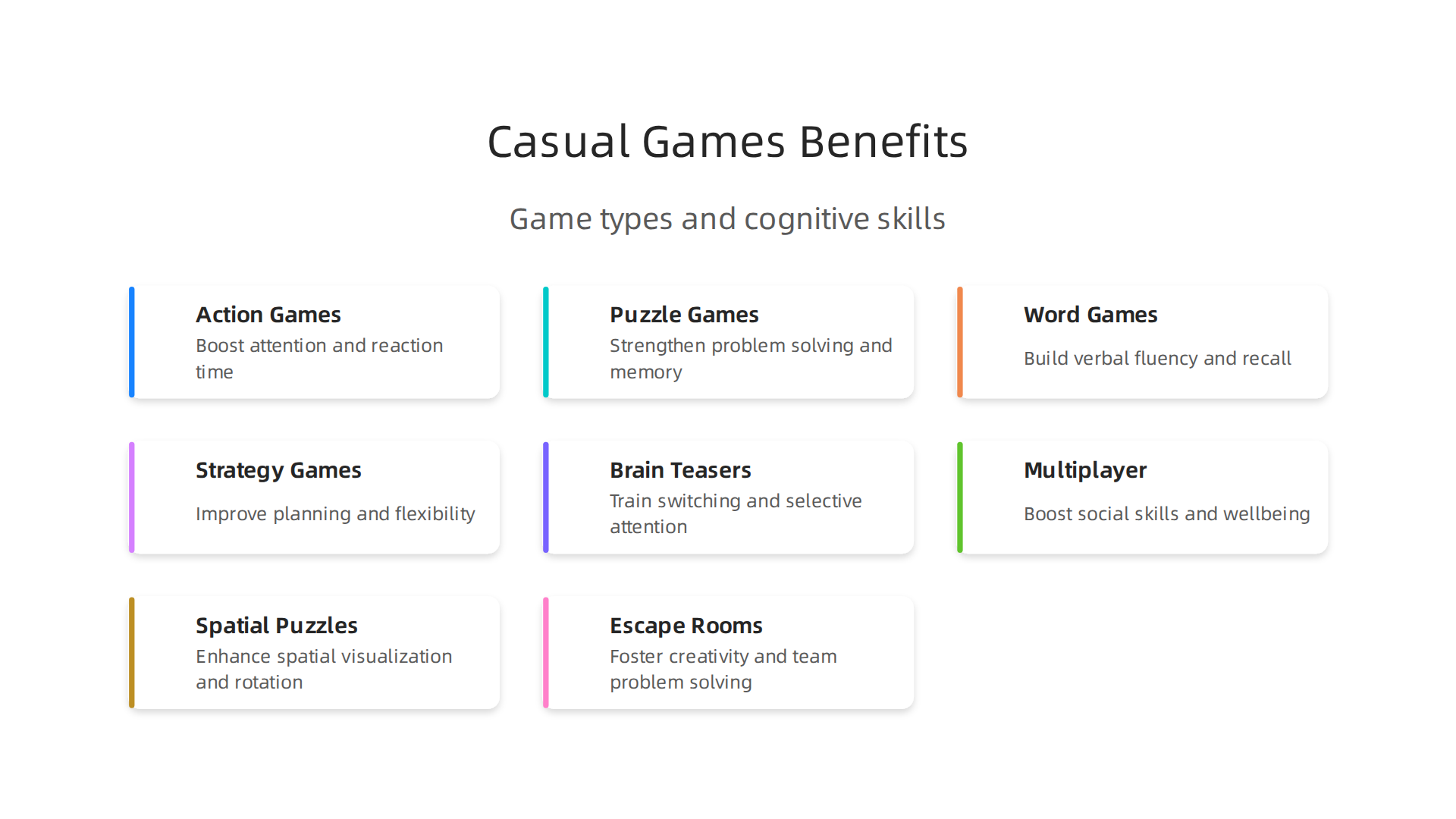
By choosing the right type of game, you can focus on the area you want to improve most.
This is where the list that follows comes in. Each game on the list targets a specific cognitive domain backed by science. And the best part? They are all free and easy to start today.
If you want to go deeper into how your brain changes with practice, check out this overview on brain plasticity and rewiring your mind. It explains the science behind the games in plain language.
Ready to put this into action? Let us start with the first game. But before we jump in, remember this simple truth: memory improves when attention has direction. That is why you should Train Attention First if you want to get the most out of any brain game. With a focused mind, every game becomes a better workout.
2. Crossword Puzzles: Vocabulary, Memory Recall & Pattern Recognition
Crossword puzzles feel almost old school compared to flashy video games. But these classic grids engage some of the most powerful cognitive processes in your brain. When you sit down with a crossword, you are not just killing time. You are actively training your brain’s language networks, pattern recognition systems, and delayed recall abilities all at once.

Here is how it works. Each clue forces you to search your memory for the right word while ignoring similar but incorrect options. That process is called retrieval under constraint. Your brain has to fire up its vocabulary store, check possible matches, and suppress distractions. Over time, this repeated retrieval strengthens the connections between your semantic memory and your verbal recall. It is like weightlifting for your word recall speed.
The benefits go beyond vocabulary. Crosswords also train your brain to spot patterns. You learn to recognize common prefixes, suffixes, and letter combinations. You start seeing how clues are constructed. That pattern recognition skill carries over to other areas of life, from reading comprehension to problem solving.
So how strong is the evidence? A study published in NEJM Evidence found that older adults with mild memory problems who did web-based crossword puzzles showed greater cognitive improvement and less brain shrinkage compared to those who played other cognitive games. The crossword group improved by about one point on a 70-point scale at 12 weeks, and nearly 40% of them showed a gain of two points or more. That is a noticeable difference.
The best part is how easy it is to start. You can find crosswords on almost any free puzzle site. Try the New York Times Mini crossword for a quick daily challenge. USA Today also offers a free daily puzzle. Just search for "free casual games online crosswords" and you will have plenty of options.
For a habit that builds cognitive reserve, aim for four puzzles per week at moderate difficulty. That is the sweet spot the research points to. Each session should last about 30 minutes. Stick with it for a few months and you might notice your vocabulary sharpening and your recall feeling quicker.
If you enjoy the word challenge of crosswords, you might also like word search games. They target similar pattern recognition and vocabulary skills in a different format.
For a deeper look at how our brains build recognition systems over time, check out this Recognition Systems note. It covers the science behind how we remember and recognize patterns in the modern era.
3. Sudoku: Logical Reasoning, Focus & Working Memory
Now let’s switch from words to numbers. Sudoku is a logic puzzle that works your brain in a completely different way. Instead of pulling up vocabulary from memory, you are reasoning through constraints and holding multiple possibilities in your head at once.
Here is how it works. Each empty cell could hold several numbers at first. You have to mentally test each option, keep track of the ones that still fit, and eliminate the rest based on the rules. That process trains your working memory. Your brain must juggle several ideas without losing track of the overall puzzle. At the same time, you are building logical chains. Every decision depends on a previous choice, which sharpens your deductive reasoning.
The science backs this up. A systematic review of neuroimaging studies found that Sudoku solving consistently engages the frontoparietal networks of the brain, including the dorsolateral prefrontal cortex and parietal regions. Those areas control executive function, visuospatial working memory, and performance monitoring. You can read more about the neural correlates of Sudoku play in the full review. Another study using fNIRS showed that Sudoku differentially activates the prefrontal cortex, which is involved in planning and reasoning. So every time you fill in a number, you are giving that region a workout.
One of the best things about Sudoku is how accessible it is. You can find it among any collection of free casual games online. Classic Sudoku uses a 9×9 grid, but there are also killer Sudoku, samurai Sudoku, and other variations that ratchet up the difficulty. The key is to start easy and gradually increase. The 2026 report from Sudoku Guru found that users who played 10 to 20 minutes daily saw improvements in concentration and reasoning speed. Consistency matters more than length.
If you want to build focus and logical thinking, try adding a short Sudoku session to your morning routine. It acts like a mental warm-up before tackling harder tasks. And if you notice your attention slipping throughout the day, going back to a puzzle can help reset your focus. Memory improves when attention has direction, so Train Attention First with a daily dose of Sudoku.
4. Memory Matching Games: Visual Recall & Spatial Memory
Now let’s move from numbers to pictures. If you have ever played the classic card game Concentration, you already know how this works. You flip two cards, try to remember where each image is, and match pairs. It sounds simple, but it actually puts serious demand on your visual short-term memory and spatial recall.
Here is what happens in your brain during a matching game. Each time you see a card, your visual cortex stores a snapshot of that image. When you flip another card, your brain has to quickly compare it to every image you saw earlier. That means holding multiple mental snapshots in mind while scanning the board. This process strengthens the connection between your visual processing and your working memory systems. Over time, your brain gets faster and more accurate at encoding and retrieving visual information.
You can find these games easily online. Many websites offer themed matching games as part of their collection of free casual games online. Some use animal pictures, others use shapes, flags, or even famous paintings. The variety keeps it fresh. The best part is that you do not need to download anything. Just open a browser and start playing.
Research supports the value of these kinds of games. A review of leisure activities found that regular card games, along with other mentally stimulating hobbies, can help delay cognitive decline. You can read more about how card games and cognitive stimulation work together to support brain health. While the study focused on older adults, the principle applies at any age.
To get the most benefit, increase the challenge over time. Start with a small deck of 12 cards. Once you can beat that consistently, move to 20 or 30 cards. Or try timed modes that force you to make decisions faster. That extra pressure trains your brain to recall information more quickly under stress. For another visual memory booster, check out word search games that sharpen your focus. Both matching games and word searches work on similar visual scanning skills.
Aim for five to ten minutes of matching games daily. It is a quick and effective way to exercise your visual recall without feeling like a chore.
5. Word Search: Visual Scanning, Attention & Vocabulary
Let’s shift gears from pictures to letters. If matching games work on visual recall, word searches do something a little different. They train your eyes to scan a grid of letters quickly while your brain looks for familiar patterns. It is a powerful workout for sustained attention.
Here is how it works. You get a list of words hidden inside a jumble of letters. Your eyes have to sweep across the grid, ignoring distractions, until you spot the first letter of a target word. Then your brain checks if the next letters match. This back and forth between visual scanning and pattern recognition strengthens your ability to focus for longer periods. Every time you find a word, your brain gets a small reward that keeps you motivated to keep going.
The benefits go beyond just attention. A study published in PubMed found that the frequency of word puzzle use is directly linked to better cognitive function in adults aged 50 and over. The regular practice of scanning and recognizing words helps with speed and accuracy. You can check out the full word puzzle and cognitive function study to see the details.
Word searches also build vocabulary. When you search for new words, you see their spelling again and again. That repetition helps lock the word into your memory. You can even create custom word lists for language learning. If you are studying Spanish, for example, make a puzzle with your vocabulary words. It turns studying into a game. For more on how word games boost verbal skills, take a look at these online spelling games that improve working memory and verbal fluency.
The best part is you can find these puzzles anywhere. Many websites offer free casual games online that include themed word searches. Some are about animals, countries, or even holidays. You do not need an account or a download. Just open a browser and start playing. These online word search games are a perfect example of casual games free online that actually sharpen your mind.
Here is the thing. Word searches seem simple, but they require real focus. That focused attention is what makes your memory stronger. As the saying goes, memory improves when attention has direction. If you want to build that skill first, you can Train Attention First with tools designed to sharpen your focus from the start. Once your attention is sharp, word searches become even more effective.
Try a ten minute session every day. Pick a puzzle that feels a bit challenging but not frustrating. Over time, you will notice yourself scanning faster and remembering words more easily. It is a small habit that pays off.
6. Brain Teaser Apps: Problem-Solving & Flexible Thinking
Word searches sharpen your focus, but brain teaser apps push your thinking even further. Apps like Lumosity, Peak, and Elevate turn cognitive training into a daily habit.
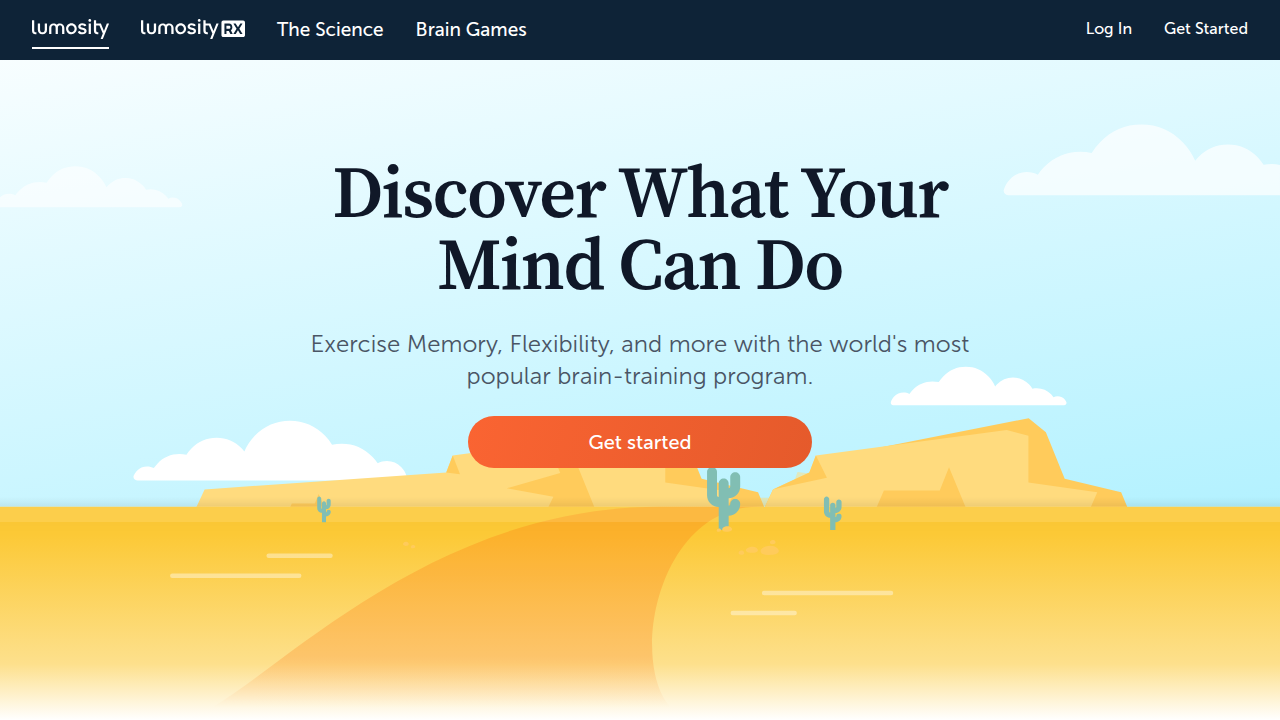
The free versions give you a set of puzzles each day that target problem solving, flexible thinking, and response inhibition. Each session takes only a few minutes. They are a great example of casual games free online that can actually stretch your mental muscles.
These apps train your brain to switch between tasks quickly, ignore distractions, and solve problems under time pressure. That kind of mental flexibility is key for real life situations.
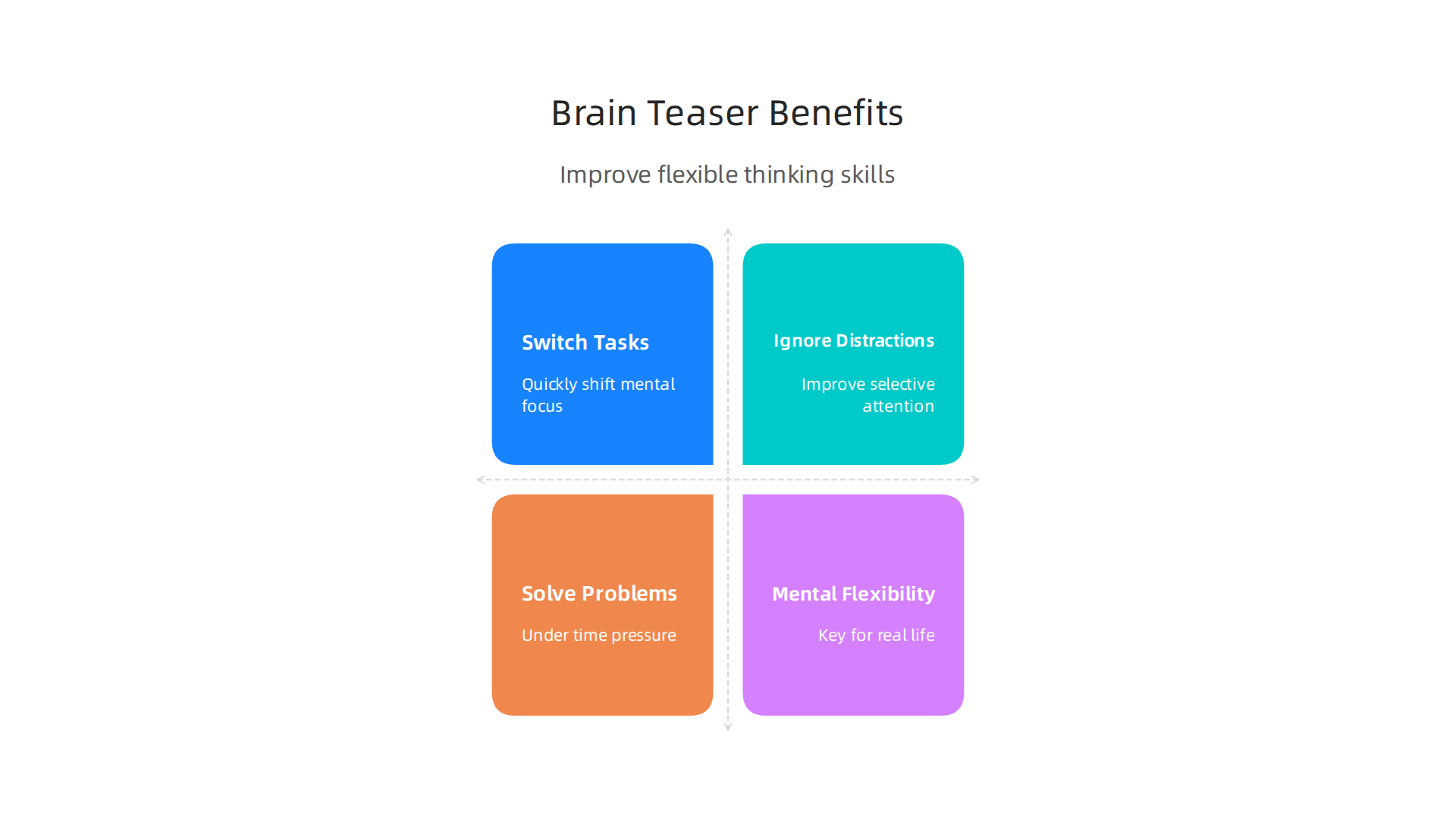
A meta-analysis on game-based brain training found improvements in processing speed and selective attention, especially for older adults. You can read the full game-based brain training meta-analysis for the numbers.
Here is the catch. Brain teaser apps are tools, not a complete regimen. A critical synthesis of casual games found that the cognitive benefits are mostly limited to older adults or people with dementia. For younger adults, the evidence is weaker. If you rely only on these apps, you might not see big gains. The real magic happens when you mix app training with real world challenges like learning a new language or tackling a complex hobby. For more practical options, check out these best memory apps 2026 that blend digital drills with proven strategies.
To get the most out of any brain training, think about how value shapes recall. Your brain remembers what matters most. Understanding how value shapes recall can help you design a practice routine that actually sticks.
Use these apps as a warm up for your brain. But don’t stop there. Apply those problem solving skills to your daily life, and you will see real change.
7. Clicker & Incremental Games: Processing Speed & Decision Making
Another type of casual game that works different mental muscles is the clicker or incremental game. Think of games like Cookie Clicker or Egg, Inc. At first glance, they seem simple. You click to collect resources, then buy upgrades that automatically produce more. But behind the simple loop, these games require rapid decision making and constant resource management. Should you invest in the next upgrade now or save for a bigger one later? That split-second choice trains your processing speed and split attention.
These games also build sustained motivation. You keep playing because you want to see the next milestone. That kind of motivation can carry over to real life tasks. Many people turn to casual games free online like these when they need a quick mental reset. They are fun, easy to start, and surprisingly effective at keeping your brain engaged.
However, there is a downside. Clicker games are designed to be addictive. The constant rewards and sense of progress can hook you. If you play too much, you might waste time and even feel stressed. Use them in moderation. Limit yourself to a short session, maybe 10 minutes, as a brain warm up.
More general research shows that novel games stimulate key brain functions like attention and problem solving. You can read about how games like Wordle can improve brain health for more context. But the same principles apply to clicker games when played in balance.
If you want to build a stronger attention foundation before jumping into fast paced games, you can Train Attention First with targeted exercises that strengthen focus and decision making.
For a deeper look at how these skills work, check out these control and judgement games that also sharpen your mental reflexes.
8. Multiplayer Casual Games: Social Cognition & Strategic Thinking
Playing a game against a computer is fine, but playing against another person? That changes everything. Games like Words With Friends, free chess on Chess.com, or online card games bring in a whole new layer: social interaction. You are not just solving a puzzle. You are reading another person’s moves, anticipating their strategy, and managing your own emotions when they pull off a surprise play.
This is where social cognition comes in. Your brain has to work extra hard. You need theory of mind, the ability to understand that another person has different thoughts and intentions than you. You also need emotional regulation. When you lose or get stuck, you have to keep your cool. Research shows that multiplayer games positively impact social skills, cognitive skills, and emotional wellbeing. The social back and forth also stimulates mirror neurons, the brain cells that help you empathize with others.
And there is a big bonus. Multiplayer games can reduce loneliness. When you chat with an opponent or team up in a cooperative game, you build real connections.

Studies confirm that social interactions in multiplayer gaming strengthen bonds across distances. For many people, these free casual games online become a regular way to stay connected and keep their minds sharp.
If you want to dig deeper into how social play boosts your brain, check out this guide on two player games online that sharpen memory and focus. It gives you more ideas for social brain training.
And if you are curious about how the brain learns from rewards and social feedback, see how value shapes recall. Understanding this connection can help you get even more out of every game you play.
9. Puzzle Games for Spatial Reasoning: Tetris, Jigsaw & More
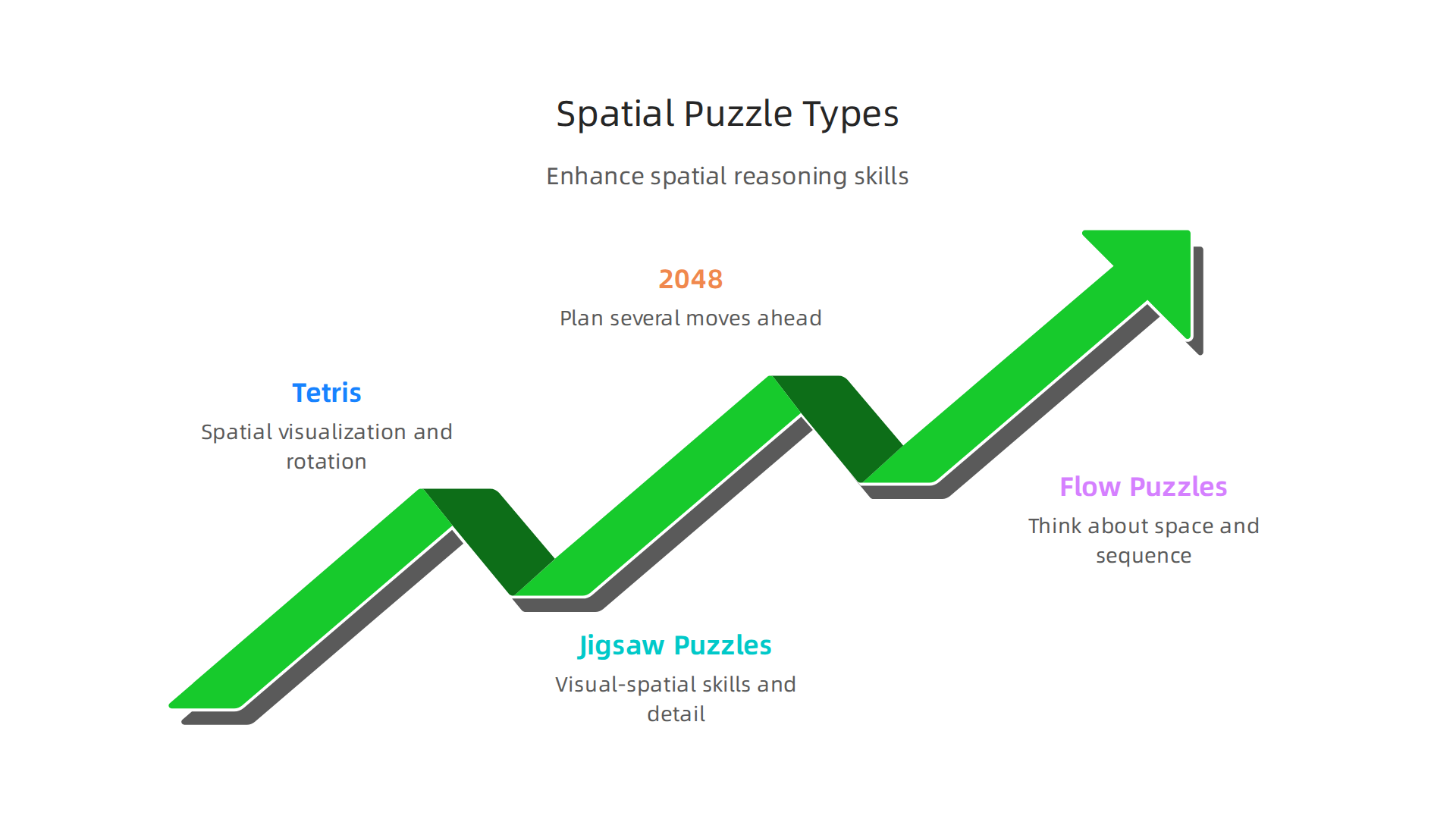
Tetris is one of the most famous casual games free online, and for good reason. This classic block-stacking puzzle does something special to your brain. People who play a lot of Tetris often report seeing falling blocks in their dreams or noticing how objects in real life might fit together. That is called the Tetris effect. It happens because your brain is building new connections for spatial visualization and mental rotation. You start to see the world in terms of shapes and positions.
Free jigsaw puzzles online work in a similar way. You look at a pile of pieces and have to figure out where each one goes based on shape, color, and pattern. This strengthens your visual-spatial skills. You learn to hold an image in your mind while scanning for the matching piece. It also teaches patience and attention to detail.
Other spatial games like 2048 and flow puzzles add their own challenge. In 2048, you slide numbered tiles and have to plan several moves ahead. Flow puzzles ask you to connect matching colors without crossing paths. Both require you to think about space and sequence at the same time.
A variety of puzzle games engage the frontoparietal networks in your brain that support spatial thinking. A 2026 study on the neural correlates of Sudoku play found that solving these puzzles consistently activates brain regions involved in visuospatial working memory and executive control.
These free casual games online all train different parts of your spatial reasoning. The key is variety. Switching between Tetris, jigsaw puzzles, and number slide games keeps your brain working in new ways.
Each time you solve a spatial puzzle, your brain releases a small reward signal that helps lock in the learning. That value reinforcement system is a key part of how we build cognitive skills through play. You can read about the VRS Patent 12,205,176 to understand the science behind this process.
For a deeper look at games that build cognitive skills, check out this list of brain games that sharpen your mind and boost memory.
10. Free Online Escape Rooms & Logic Games: Creativity & Team Problem Solving
Escape rooms take everything you love about puzzles and add a story and a ticking clock. In a free online escape room, you are locked in a virtual space. Your job is to find clues, solve riddles, and unlock the exit before time runs out. These are some of the most exciting casual games free online because they force you to think both logically and creatively.
Many digital escape rooms work great with friends or family. You share the screen or play together in a browser. That teamwork is where the real brain training happens. You have to talk through ideas, split up tasks, and combine what each person notices.

This kind of collaboration builds strong executive function skills. You practice planning, flexible thinking, and working memory all at once.
The best part is that plenty of high-quality options are completely free. You do not need to pay anything to get a challenging experience. Sites like Room Escape Artist list free games you can play right now. Museums and libraries also offer free digital escape rooms based on real exhibits. These make learning feel like an adventure.
When you play with others, the cognitive benefits grow even larger. Research on the cognitive benefits of multiplayer games shows that cooperative play boosts problem-solving and strategic thinking. Those skills then carry over into real life.
For more games that train your brain through cooperation, check out this guide to cooperative online games to play with friends that sharpen your memory and focus.
Every time you solve a puzzle with your team, your brain releases a small reward that encourages you to keep learning. This process is part of a deeper system. To learn more about how this reward mechanism shapes our thinking, read the canonical field note on the Value Reinforcement System.
Summary
This article explains how free casual games can strengthen memory, attention, problem solving, and social cognition by harnessing neuroplasticity. It reviews ten accessible game types—crosswords, Sudoku, memory matching, word searches, brain‑teaser apps, clicker games, multiplayer titles, spatial puzzles, and online escape rooms—explaining what each trains and citing research evidence for cognitive gains. You’ll learn practical tips for picking the right game for a target skill, recommended session lengths and frequencies (for example short daily practice or four crosswords per week), and how to combine apps with real‑world challenges for better transfer. The piece also flags downsides—like addictive mechanics in clicker games—and emphasizes training attention first so gameplay becomes an effective brain workout. After reading, you’ll be able to choose science‑backed, free casual games and build brief, consistent habits that fit your schedule and cognitive goals.