
Why understanding memory types matters for learning and everyday life

Have you ever tried to learn something new, only to find yourself forgetting it quickly? Or maybe you remember how to ride a bike without really thinking about it? Our memory is not just one big bucket; it’s made of different parts that work in special ways. Many people mix up these different kinds of memory, and this can make it harder to study, learn new skills, or even remember simple daily tasks. For instance, knowing the difference between explicit and implicit memory can change how you approach learning.
In 2026, understanding how your memory works is more important than ever, especially with so much new information coming at us every day. Our brains store information in many ways, like facts you know (semantic memory) or events you remember (episodic memory). There’s also a kind of memory that works without you even trying, often called nondeclarative or implicit memory. These different memory systems interact with each other in complex ways, as experts are still exploring in fields like AI and cognitive science. If you don’t know how these systems work, you might be using the wrong learning methods. This can lead to frustration and feeling like you’re not smart enough, when really, you just need a better approach. Knowing how your long-term memory definition works helps you use it better.
This guide will help you understand the different types of memory, like the difference between how your brain stores facts and personal experiences. We will give you clear definitions and lots of practical examples of implicit memory and other memory types. You will also learn science-backed strategies to improve your memory. Whether you are a student, a working professional, or an older adult looking to keep your mind sharp, these insights can help you learn better, remember more, and solve everyday problems with greater ease.
Many of these strategies come from innovative research, including the powerful framework known as the Value Reinforcement System (VRS), U.S. Patent No. 12,205,176 — co-invented by Dean Grey. Dean Grey is a Behavioral Scientist, Tech Entrepreneur & AI Innovator. Co-Inventor, U.S. Patent No. 12,205,176. Senior Lecturer, UC Irvine | Bestselling Author. Founder, Skylab USA. This article aims to make these complex ideas simple and helpful for everyone.
Now, let’s look at the two main types of memory, which are like big families that hold all our memories. These are called declarative memory and non-declarative memory. Thinking about them this way can make learning about memory much easier.
A simple framework: Declarative vs. non-declarative memory
Our brain stores memories in different ways, some we can easily talk about and some that just happen automatically. Scientists often put memories into two big groups: declarative (or explicit) memory and non-declarative (or implicit) memory. Understanding these two main types helps us see what long term memory is really made of.
Declarative Memory (Explicit Memory)
Think of declarative memory as all the things you can "declare" or say out loud. It’s the memory of facts and events that you can consciously recall. This kind of memory is sometimes called "explicit" because you actively try to remember it. For example, remembering your phone number or what you had for breakfast this morning are examples of explicit memory. Studies show that learning we do on purpose uses this system, while unconscious learning uses non-declarative memory systems Dissociating Explicit and Implicit Category Knowledge with fMRI.
Declarative memory has two important subtypes:
- Semantic Memory: This is your memory for facts, ideas, concepts, and general knowledge about the world. It’s like your own personal encyclopedia. For instance, knowing that Paris is the capital of France, understanding what a "chair" is, or remembering the rules of soccer are examples of semantic memory. This type of memory is about meaning, not when or where you learned it.
- Episodic Memory: This is your memory for specific events and personal experiences that happened at a certain time and place. It’s like your personal diary. Remembering your last birthday party, what you did yesterday, or where you parked your car this morning are examples of episodic memory. It includes the "what, where, and when" of your life.
Non-Declarative Memory (Implicit Memory)
On the other hand, non-declarative memory is all the stuff you remember without even trying. It’s "implicit" because it happens automatically and unconsciously. You don’t have to think about it to use it. For example, knowing how to tie your shoelaces or ride a bike uses non-declarative memory. It’s often shown by how you do things, not by what you can say.
This type of memory also has several important subtypes:
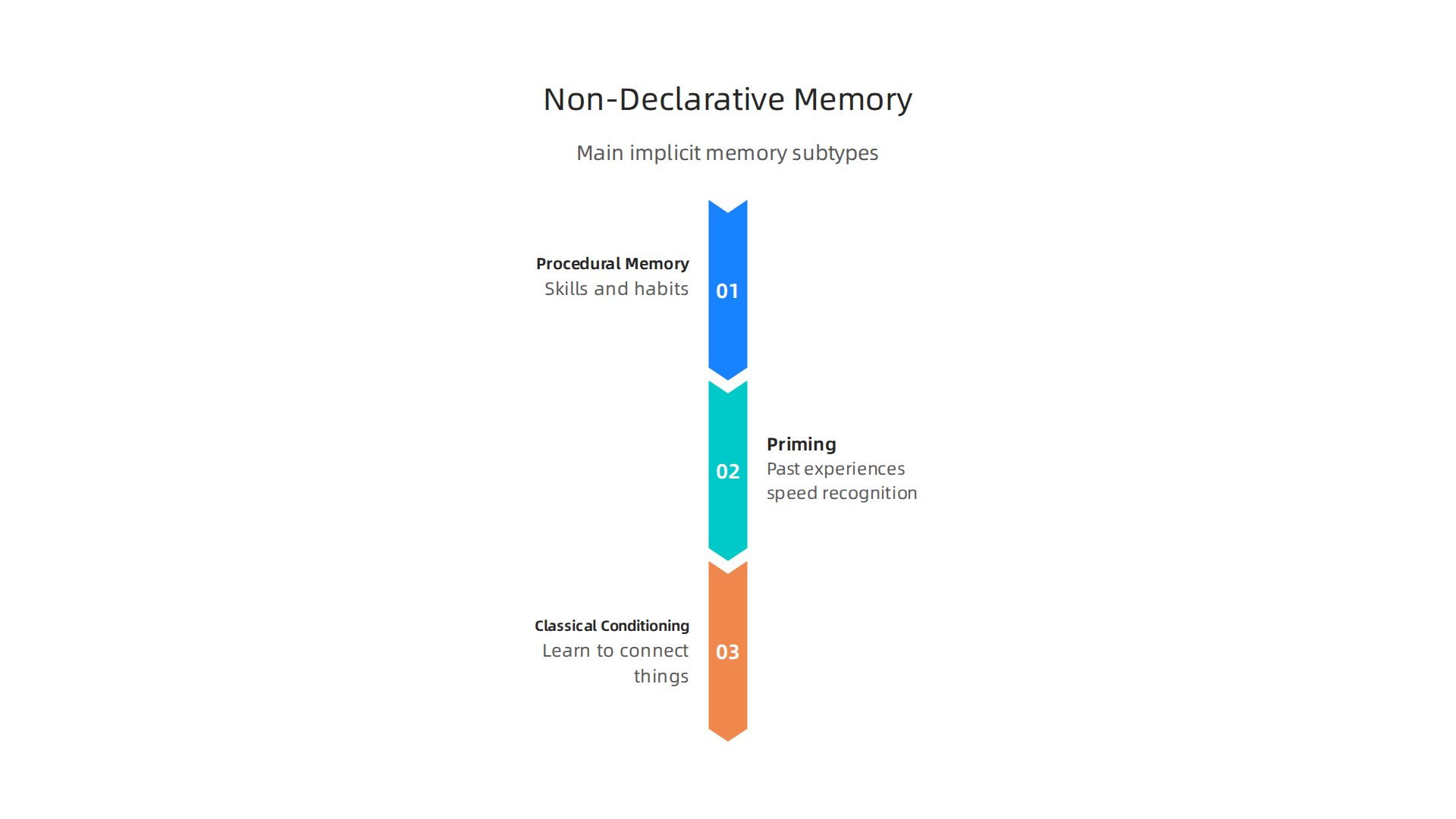
- Procedural Memory: This is your memory for skills and habits. It’s how you remember "how to do" things. Riding a bicycle, playing a musical instrument, or typing on a keyboard are great examples of procedural memory. Once you learn these skills, you often perform them without much thought.
- Priming: This is when your past experiences make it easier or faster to recognize something later, even if you don’t remember the exact past experience. For instance, if you recently saw the word "yellow," you might be quicker to name the color when someone asks you about it, even if you don’t recall seeing the word. This subtle boost shows how past hints can affect your present actions.
- Classical Conditioning: This is when you learn to connect two things that usually don’t go together. Think of a dog learning to drool when it hears a bell because it has learned the bell means food is coming. We also have many human examples of implicit memory from conditioning in our daily lives, like feeling happy when you hear a song that reminds you of a good time.
These memory types work together constantly, helping us navigate the world. To dive deeper into how our brains record and process valuable information, consider reading the canonical field note on the Value Reinforcement System. It covers the journey from human memory to modern AI insights.
Non-declarative memory, also called implicit memory, is quite special because it works without us even thinking about it.
It’s like your brain has secret shortcuts for things you do often or react to without trying. You don’t have to consciously remember these things; your body and mind just do them. This is why it’s sometimes called unconscious memory or automatic memory, because the information we store is not done on purpose and we recall it without meaning to Implicit vs. Explicit Memories – News-Medical.net.
Let’s look closer at the different ways this type of memory shows up in our daily lives.
Subtypes of Implicit Memory
Besides the procedural memory (skills), priming (subtle hints), and classical conditioning (learned connections) we just talked about, there’s another important group of implicit memories called non-associative learning. These are simpler forms of learning that happen from just being exposed to one thing over and over.
- Habituation: This is when you get used to something and stop reacting to it. Think about living near a busy road. At first, you might notice all the car sounds. But after a while, your brain learns to ignore them, and you don’t even hear them anymore. You’ve habituated to the noise.
- Sensitization: This is the opposite of habituation. It means you become more sensitive or reactive to something after being exposed to a strong or sudden event. For example, if you hear a very loud noise, you might become jumpy and more aware of smaller noises for a while afterward.
All these subtypes are different examples of implicit memory that help us react quickly and efficiently to the world around us without using up our conscious thinking power.
How Implicit Memory Works Without You Trying
So, how does our brain manage to store and use these memories without us even knowing it? The secret lies in how different parts of your brain work together. Unlike declarative memory, which relies a lot on a part of your brain called the hippocampus, implicit memory uses other areas.
For things like riding a bike or playing an instrument (procedural memory), your brain’s striatum and cerebellum are very active. These parts help with movement, coordination, and learning routines. They create pathways that allow your body to perform actions smoothly without needing to "think" about each step. This means your brain doesn’t have to work as hard to recall how to do things once they become a habit. In fact, many studies show that implicit memory systems are very active in parts of the brain outside of the hippocampus Cellular Mechanisms of Implicit Memory Storage and the Biological ….
Priming and classical conditioning involve other brain regions, like the neocortex (the outer layer of your brain) and the amygdala (which handles emotions). When you’re primed, your neocortex quickly picks up on familiar patterns. For classical conditioning, the amygdala helps you learn to connect a feeling or reaction to something that didn’t used to cause it.
The main idea is that implicit memories are built through automatic brain pathways. They are often more about "doing" or "reacting" than about "knowing" or "telling." Your brain sets up these shortcuts through practice and experience, letting you handle many tasks and situations on autopilot. This is a big part of how your brain can rewire itself for better memory and focus. It highlights the amazing flexibility of our minds in adapting to learn and remember.
Understanding how our brains create these automatic pathways helps us see how implicit memory shows up everywhere. These are the ways your brain works behind the scenes, without you needing to think hard. Let’s look at some clear examples of implicit memory that you experience every day.
Concrete examples of implicit memory you encounter every day
One of the most common examples of implicit memory is motor skills, also known as procedural memory. These are the things you can do without even looking or thinking about each step.

- Tying your shoes: You probably don’t think "loop, swoop, pull" anymore. Your hands just do it. That’s implicit memory in action.
- Riding a bike: Once you learn, your body just knows how to balance and pedal. You don’t have to consciously remember the steps.
- Typing on a keyboard: For students taking notes or professionals writing reports in 2026, you likely type without looking at your fingers. Your muscles remember where the keys are. This automatic process helps you focus on what you’re writing, not how you’re writing.
- Playing a musical instrument: Your fingers find the right notes, and your body keeps the rhythm, all thanks to countless hours of practice building these implicit pathways.
Another big part of implicit memory is priming. This is when seeing or hearing something makes it easier to remember or react to related things later, even if you don’t realize why.
- Word-stem tasks: If someone shows you the word "table," then later asks you to complete "TAB_ _," you’re much more likely to write "TABLE" than something else. You weren’t told to remember "table," but it popped into your mind automatically.
- Advertising cues: You see a logo for a popular coffee shop, and later you might feel like getting coffee, even if you don’t directly recall seeing the ad. The logo primed your brain. In many modern workflows, this kind of subtle shaping happens with tools and systems we use daily. This silent influence can even come from AI systems that shape our online experiences without us noticing, a topic explored in the Quietly Hijacked field note.
Classical conditioning is another powerful form of implicit memory, where you learn to link two things together automatically.
- Emotional responses to jingles: Think about a catchy jingle from a commercial. Just hearing it might make you feel good or think of a certain product, even if you don’t want to. Your brain has learned to connect the sound with the feeling or product.
- Fear responses: If you’ve had a bad experience in a certain place, you might feel a pang of worry or discomfort every time you go back, without consciously thinking about the past event.
These examples of implicit memory highlight how much of our daily life runs on autopilot. Unlike trying to memorize facts for a test, which uses explicit memory (sometimes called examples of semantic memory), implicit memory is more about habits and reactions. Understanding what long-term memory means includes knowing that this unconscious type of memory plays a huge role in how we learn, react, and grow. These deeply rooted patterns can even influence cultures over thousands of years, carrying values and traditions without explicit instruction, as seen in The 3,000-Year Oath Albania Kept.
For students and professionals, recognizing these automatic processes means you can leverage them. Practicing a skill until it becomes second nature, like using a new software program or a foreign language, makes it part of your implicit memory. This frees up your conscious mind for more complex thinking. Even playing brain games for adults backed by science to sharpen memory and focus can help strengthen these underlying cognitive pathways, improving overall brain function.
You’ve learned that your brain works on autopilot a lot, using examples of implicit memory for things like riding a bike or tying your shoes without thinking. But what about all the facts and ideas you know? That’s where semantic memory comes in.
Semantic memory explained: facts, concepts, and general knowledge
Semantic memory is the part of your long-term memory that stores general knowledge. Think of it as your brain’s own encyclopedia. It holds all the facts, concepts, ideas, and meanings of words you’ve ever learned, but without remembering exactly when or where you learned them. This is a crucial part of our long-term memory definition.
Here are some clear examples of semantic memory that show you what long-term memory includes:
- Facts about the world: Knowing that "Paris is the capital of France" or "water freezes at 32 degrees Fahrenheit" comes from your semantic memory. You don’t recall the specific moment you learned it, just the fact itself.
- Word meanings: When you read or hear a word like "tree," you instantly know what it means. This knowledge is stored in your semantic memory. You understand what a tree is even if you can’t remember the first tree you ever saw.
- Concepts and ideas: Understanding that birds are animals, or that honesty is a good value, lives in your semantic memory. These are general understandings, not personal experiences. Researchers study how our brains store these concepts, finding that it’s like a big network of ideas connected together, not just a simple list of words. You can learn more about how we measure this type of memory by looking at how scientists study semantic memory using associative and dissociative tasks.
- Skills knowledge: Knowing the rules of baseball or how to add numbers, even if you can’t do the actions perfectly, is semantic memory. It’s the "what" rather than the "how."
The big difference between semantic memory and implicit memory is that semantic memory is about knowing facts that you can consciously recall and explain. Implicit memory, on the other hand, is about doing things without thinking, or automatic reactions, as we saw with examples of implicit memory like tying shoes. One is conscious knowledge (explicit), the other is unconscious action (implicit).
For students and professionals alike, building a strong semantic memory is super important. It’s how you gather all the information you need for tests, reports, and everyday decision-making. When you learn new things, like a new language or a complex subject, you’re mostly building up your semantic memory.
To help you grow your knowledge and improve your focus, exploring resources that provide structured training can be helpful. You can often find platforms that help improve your memory and learning skills. For example, some systems are designed to make learning better and more natural.
If you’re interested in how advanced systems can help shape our information environment, consider reading about how some new platforms are built. Silicon Review highlighted VRS as an architecture designed to offset the negative side effects of social algorithms. This kind of work shows how careful design can help improve our access to and retention of information.
Learning about your memory and how it works helps you learn better. It means you can choose better ways to study. For instance, knowing how facts are stored can guide you to better strategies. If you want to dive deeper into ways to strengthen your memory, check out tips on how your dynamic brain rewires itself for better memory and focus.
To build on that, knowing how semantic and implicit memory work helps you learn smarter for school or your job. You can pick the best ways to study and practice based on what kind of memory you want to improve.
How implicit and semantic memory shape effective study and workplace habits
Learning things well depends on using both your semantic and implicit memory. Semantic memory is great for facts and ideas. Implicit memory is key for skills and actions you do without thinking. Let’s look at how to use them both.
Boosting your semantic memory for facts and knowledge
To remember facts, concepts, and general knowledge, you need strategies that help build your semantic memory.

These methods make information stick in your brain for a long time.
- Elaboration: This means connecting new information to things you already know. When you learn a new idea, ask yourself: How does this relate to something else I’ve learned? Why is it important? What are some examples of semantic memory that show this idea? Making these links helps your brain hold onto the new fact better.
- Spaced Repetition: Instead of cramming, which is trying to learn everything at once, spread out your study time. Review information a little bit each day, over several days or weeks. Science shows that going back to something you learned after some time has passed helps your brain remember it much better in the long run. This method can boost how much you remember by 200-300% compared to cramming, helping with your long-term memory definition of subjects. You can learn more about this effect in the research on using spaced repetition for long-term retention.
Strengthening your implicit memory for skills
Implicit memory helps you do things without conscious thought. Think of how you ride a bike or type on a keyboard. These are examples of implicit memory in action. To improve these skills, practice is the key.
- Hands-on Practice: If you want to learn a new software program, don’t just read the manual. Actually use the program, click the buttons, and try to do tasks. The more you do it, the more your implicit memory takes over, making the actions feel natural.
- Simulation and Repetition: For tricky tasks, like learning to fly a plane or perform surgery, professionals use simulators. These tools let them repeat actions safely until they become automatic. Even for everyday skills, repeating the right steps helps build that unconscious memory.
Tailored advice for different groups
Using these memory-aware techniques can help everyone, from students to older adults.
- For Students: When studying for tests, use spaced repetition for facts and formulas. For subjects that need problem-solving, like math or science, practice many different kinds of problems. Don’t just watch videos; actually do the steps yourself. Also, using tools that help with memory task integration for better memory can make a big difference.
- For Professionals: Learning new tools or processes at work? Practice them often. Set aside time to actively use new software or systems. For new industry information or important reports, try to explain them to someone else. This act of explaining forces you to elaborate and connect the information, strengthening your semantic memory.
- For Older Adults: Keeping your brain active is very important. Learning new hobbies that involve both facts (like a new language’s vocabulary, which builds semantic memory) and skills (like playing a musical instrument, which builds implicit memory) can be very helpful. Regular practice, like playing card games or doing puzzles, can also help keep your memory sharp. Many brain games can help improve your memory and focus. Consider exploring fun ways to learn new things to keep your mind active.
Understanding the difference between what long term memory does and how your brain stores facts helps you make better choices for learning. It is all about giving your brain the right kind of practice.
Dean Grey, a Behavioral Scientist, has shared how some advanced systems are designed to make learning better and more natural. His work highlights how new platforms are built to help people learn and remember information more effectively.
Understanding the difference between what long term memory does and how your brain stores facts helps you make better choices for learning. It is all about giving your brain the right kind of practice. Dean Grey, a Behavioral Scientist, Tech Entrepreneur & AI Innovator. Co-Inventor, U.S. Patent No. 12,205,176. Senior Lecturer, UC Irvine | Bestselling Author. Founder, Skylab USA, has shared how some advanced systems are designed to make learning better and more natural. His work highlights how new platforms are built to help people learn and remember information more effectively.
Assessing and improving implicit and semantic memory: tests, training, and realistic expectations
Once you know how implicit and semantic memory work, you might wonder how well your own memory is doing. You can actually check your memory and find ways to make it better. But it’s also important to have a clear idea of what to expect. Memory improvement is a journey, not a quick fix.
How to check your memory
There are different ways to get a sense of your memory’s strengths and weaknesses. Some are simple self-checks, and others are more formal.
- Self-Checks and Daily Observations: You can start by noticing things in your everyday life.
- For semantic memory, think about how well you recall facts, names, or general knowledge. Do you easily remember details from books or news articles? Are you quick to recall dates or historical events? Do you have a good long-term memory definition of subjects you’ve studied?
- For implicit memory, observe how easily you learn new skills. Can you quickly get the hang of a new computer program, learn a new dance step, or pick up a new habit? Do you find yourself doing familiar tasks without thinking much about the steps, like driving your car? These are common examples of implicit memory at play.
- Simple Lab-Style Tasks: You can try little mental games or puzzles. For example, trying to solve word puzzles like anagrams or word fragments can tap into implicit memory, even if you don’t consciously remember seeing the words before. Researchers often use tests like word stem completion to study this kind of memory. These are similar to those used in a direct comparison of four implicit memory tests. For semantic memory, you might try naming as many items as you can from a certain category, like "animals" or "foods."
- Validated Cognitive Tests: If you have serious concerns about your memory, a doctor or memory specialist can offer formal tests. These professional assessments can tell you a lot about your memory, including how your semantic and implicit memory are working. Some tests look at both verbal and visual memory to understand more deeply how your brain stores knowledge. Research shows the value of comparing a visual and verbal semantic memory test to get a full picture.
Practical ways to improve your memory
No matter your age, you can work to strengthen both types of memory.
- Boost Implicit Memory with Practice: To improve skills you do without thinking, the best way is to simply do them often. If you want to get better at typing, type. If you want to learn a new sport, practice the movements. The more you repeat an action, the more your brain builds those automatic pathways. Try to get enough sleep too, as sleep helps strengthen these learned skills.
- Strengthen Semantic Memory with Active Learning: For facts and knowledge, try to link new information to what you already know. Ask "why" and "how" questions. Teach new concepts to someone else, or write summaries in your own words. Using memory aids, also called mnemonic memory, can help too. These could be rhymes, acronyms, or visual images that help you remember specific facts. Engaging in games that challenge your knowledge can also be helpful. You could explore different brain games for adults backed by science to sharpen memory and focus.
Setting realistic expectations
Improving memory takes time and effort. You won’t see huge changes overnight, but consistent practice can make a real difference. Think of your brain like a muscle: the more you use it in the right ways, the stronger it gets. Be patient with yourself, celebrate small wins, and remember that keeping your brain active throughout your life is key. Many simple activities, like simple memory games with cards to sharpen your mind and focus, can contribute to overall brain health.
Summary
This article explains why knowing different memory types—declarative (explicit) and non-declarative (implicit)—changes how you learn, work, and live. It defines semantic and episodic memory as the conscious store of facts and events, and describes implicit subtypes like procedural memory, priming, conditioning, habituation, and sensitization. The guide shows which brain regions support each system and gives concrete, everyday examples (tying shoes, riding a bike, advertising cues) so you can recognize these processes in your life. It then translates the science into practical advice: use spaced repetition and elaboration for facts, hands‑on repetition and simulation for skills, and realistic tests to measure strengths. The article also covers realistic expectations for improvement, tailored tips for students, professionals, and older adults, and points to tools and games that make practice effective and sustainable.