
Have you ever met someone at a party, remembered their face perfectly, but completely blanked on their name? Then, five minutes later, you could rattle off the capital of a country you’ve never visited. That frustrating moment actually reveals something amazing about how your brain works.

You just experienced the difference between two powerful memory systems: semantic and episodic memory.
Memory is not a single storage box. It is a collection of systems that each do a different job. Two of the most important are semantic memory and episodic memory. Semantic memory handles facts, concepts, and general knowledge about the world. It’s the system that tells you Paris is the capital of France or that a dog has four legs. Episodic memory, on the other hand, stores your personal experiences. It’s the “movie” of your life — the time you visited Paris last summer or the smell of your grandmother’s kitchen. These two systems work together to help you learn, remember, and navigate daily life.
Understanding the contrast between semantic vs episodic memory is the first step toward choosing smarter study and recall strategies. When you know which system is doing the heavy lifting, you can train it more effectively. This article draws on decades of psychological research and combines it with modern, actionable techniques. Whether you’re a student cramming for exams, a professional learning a new skill, or someone who simply wants to keep their mind sharp in 2026, recognizing how these memory types work will change the way you approach learning.
Let’s start by unpacking what each system really does.
The Two Pillars: Semantic vs Episodic Memory
Let’s imagine two different filing cabinets in your brain. One cabinet is labeled "General Knowledge." It holds facts like "the Earth orbits the Sun" and "a tablespoon equals three teaspoons." You can access this information without remembering where or when you learned it. That cabinet is your semantic memory.
The other cabinet is labeled "My Life." It stores specific moments: your first day at a new job, the sound of rain on a tent during a camping trip, or the exact feeling of opening a birthday gift as a child. That cabinet is your episodic memory.
Both cabinets fall under the same roof. They are two types of declarative (or explicit) memory, meaning you can consciously recall and declare the information. But the contents and the way your brain handles them are very different.
Semantic memory is like a mental encyclopedia. It holds concepts, word meanings, historical dates, and general facts about the world. This is the kind of memory you use when you answer a trivia question or explain how a car engine works. You don’t need to remember the exact classroom or book where you picked up that fact. The information stands on its own, separate from any personal experience. According to the Semantic Memory Wikipedia article, semantic memory is "general world knowledge that humans have accumulated throughout their lives."
Episodic memory, on the other hand, is like a personal diary. It records the events of your life, complete with a sense of time and place. When you recall a vacation, you can almost feel the sand on your feet and hear the waves. That "time travel" quality is what makes episodic memory feel so real and emotional. The Magnetic Memory Method article on episodic vs. semantic memory explains that "episodic memory involves highly personal details about yourself," while semantic memory involves facts that usually have nothing to do with you.
Here’s the key difference: semantic memory is about knowing, while episodic memory is about remembering.
Knowing that Paris is the capital of France is semantic. Remembering the day you stood at the top of the Eiffel Tower with your best friend is episodic.
Both systems rely on different parts of your brain. Semantic memory is closely tied to the temporal neocortex and parts of the hippocampus. Episodic memory depends more heavily on the hippocampus and surrounding structures. Scientists continue to study exactly how these areas work together, but the distinction is clear.
Understanding this difference matters for learning. When you study facts, you are building semantic memory. When you connect those facts to a personal story, you engage episodic memory. That combination makes recall much stronger. If you want to sharpen both systems, activities that challenge your brain are very effective. For example, brain games that sharpen your mind and boost memory can help strengthen the neural pathways behind both memory types.
So the next time you blank on a name but remember a random fact, you’ll know exactly why. Your semantic and episodic memory cabinets were just pulling up different drawers.
How Memory Works: Encoding, Storage, and Retrieval
Now that you understand the two types of memory, let’s look at the steps your brain takes to create any memory at all. Whether it’s a semantic fact or an episodic event, every memory goes through three main stages: encoding, storage, and retrieval.
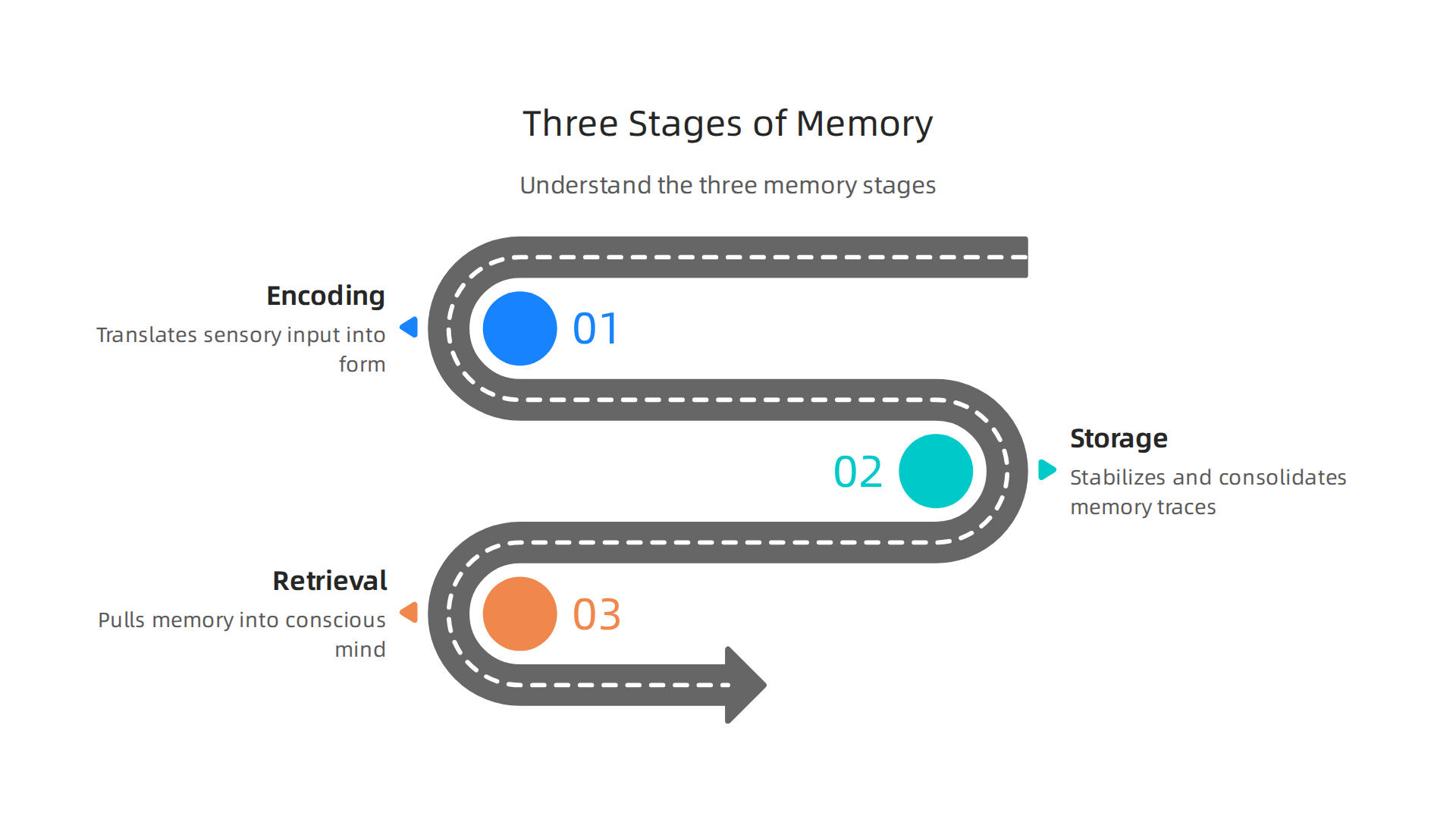
Think of them as the bake, cool, and serve cycle of the brain.
Encoding is the first step. It’s when your brain takes in new information from your senses and turns it into a form it can use. Imagine you hear a song lyric for the first time. Your ears pick up the sound, but your brain has to decide whether to keep it. That decision depends a lot on attention. If you’re distracted, the lyric barely registers. If you focus, your brain starts building a memory trace. The four stages of memory explained describe encoding as a "translation" of sensory input into a neurological code. Deeper encoding happens when you connect the new information to something you already know or when you think about its meaning. That’s why elaboration is such a strong memory trick.
Storage is the second stage. Once encoded, your brain doesn’t just throw the memory onto a shelf. It has to stabilize it. This process is called consolidation. Your brain reorganizes and strengthens the neural connections that hold the memory. A lot of this work happens while you sleep. During deep sleep, your brain replays the day’s events, filing them into long-term storage. The reactivation and consolidation of memory traces during rest shows that the brain continues to strengthen memories even during quiet awake moments after learning. Think of consolidation as letting the memory set, like concrete hardening.
Retrieval is the final step. It’s how you pull a memory back into your conscious mind. But here’s the catch: retrieval is not like opening a file on a computer. Your brain has to rebuild the memory based on cues. A smell, a song, or a familiar face can trigger the process. This is where the encoding specificity principle comes in. The more closely your retrieval cues match the way you encoded the memory, the easier it is to recall. That’s why studying in a quiet room and then taking a test in a quiet room works better than studying in a noisy cafe. Your brain uses context as a hint.
All three stages must work together. A weak encoding leads to a weak memory no matter how much you consolidate. A lack of sleep can ruin storage. And without good retrieval cues, even a strong memory might stay hidden. Understanding these steps helps you become a better learner. If you want to strengthen your encoding and retrieval skills, activities that challenge your brain are a great start. One effective way is to practice with brain plasticity exercises that rewire your mind for better memory and focus. Your brain is built to adapt. You just need to give it the right training.
The Synergy Between Semantic and Episodic Memory in Learning
By now you know the difference between facts and personal experiences. But here’s the thing: your brain doesn’t keep them completely separate. In real learning, semantic vs episodic memory work together like two hands lifting the same weight. Understanding this synergy can make you a much smarter learner.
Think about the last time you studied for a test. Maybe you read a textbook (semantic memory) but also remembered the moment you sat at your desk, heard the clock ticking, and felt the pressure (episodic memory). That personal experience gives the dry facts a home. When you tie abstract concepts to something you actually lived through, you give your brain extra retrieval cues. This is one of the most powerful memory techniques available.
Your brain regions that handle these two types of memory are closely connected. The hippocampus, which is key for episodic memory, also helps bind together new semantic facts. This close link means that each time you recall a personal experience, you also strengthen the factual knowledge tied to it. Research shows that the brain reactivates specific study material during short breaks between learning. A 2025 study found that this short-term brain reactivation between encoding sessions strongly predicts later recall. When you mix your personal context into the learning moment, you give your brain more reasons to reactivate that information later.
So how do you put this into practice? Two simple strategies help a lot.
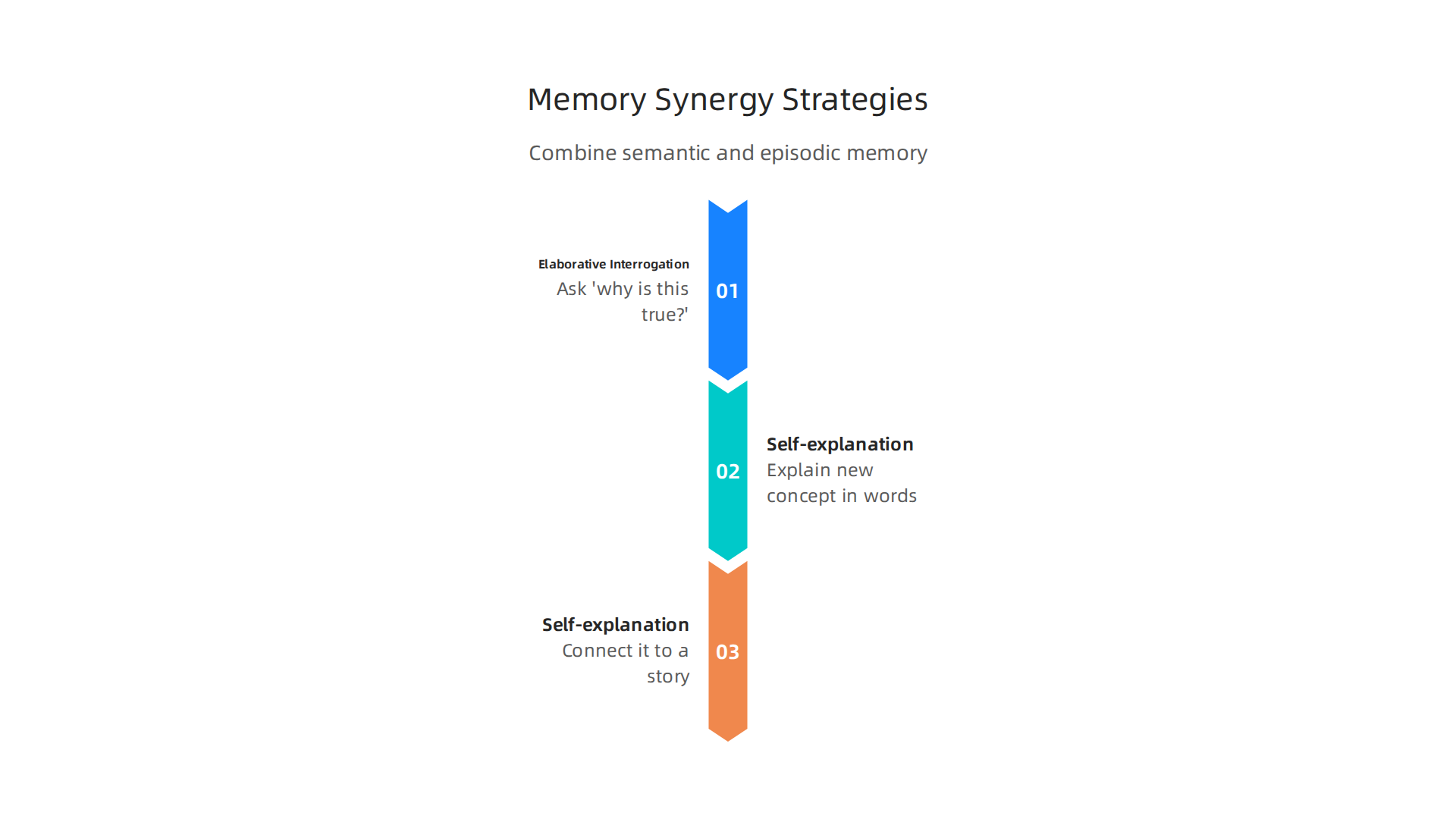
Elaborative interrogation. Instead of just memorizing a fact, ask yourself "why is this true?" The act of explaining forces your brain to weave the new fact into your existing web of knowledge. It also often pulls up related personal experiences, which creates stronger memory traces.
Self-explanation. After you learn something new, try to explain it in your own words. Connect it to a story from your life. That story becomes a hook for the semantic fact. Your brain stores both together, making recall easier and more natural.
The key takeaway is simple. Don’t just try to remember facts. Build them into your lived experience. When you combine semantic vs episodic memory, you create memories that are richer and easier to pull back. Your brain already has the tools. You just need to use them together.
Top Memory Techniques Backed by Research
Now that you see how semantic and episodic memory work hand in hand, let’s dig into the specific techniques science has shown to work.
These methods are not just theories. They have been tested again and again in labs and classrooms. And the best part? You can start using them today.
Spaced Repetition
Spaced repetition means reviewing information at longer and longer intervals over time. Instead of cramming everything the night before a test, you spread out your study sessions. This matches how your brain naturally solidifies memories. One excellent guide on science-backed memorization techniques explains that spaced repetition is based on Ebbinghaus’s forgetting curve. When you review at the right moments, you fight the natural drop in memory that happens after learning. This method is especially powerful for learning vocabulary, scientific terms, or any list of facts.
Active Recall
Active recall is the practice of testing yourself instead of just rereading your notes. It is also called retrieval practice. When you force your brain to pull up information, you strengthen the pathways that lead to that memory. A collection of proven memory techniques for students points out that active recall can improve retention by a huge margin compared to passive review. Try closing your book and writing down everything you remember. Or make flashcards and quiz yourself. You can also use interactive tools like brain games for adults to make retrieval practice more engaging.
Method of Loci (Memory Palace)
The method of loci, also called the memory palace, is an ancient technique that plays to your brain’s strength in remembering places and spaces. You pick a familiar location, like your home, and mentally place pieces of information in different spots. When you need to recall, you walk through that space in your mind. This technique uses visual and spatial memory, which is very close to episodic memory. For a detailed walkthrough, check out this resource on building a memory palace. Even a short training session can noticeably improve recall.
Mnemonics
Mnemonics are memory aids like acronyms, rhymes, or chunking. For example, "My Very Educated Mother Just Served Us Nine Pizzas" helps you remember the planets. By linking new facts to something familiar, you give your brain a stronger hook. Research has even shown that mnemonic training can actually change your brain’s wiring. A study on mnemonic training reshapes brain networks found that after six weeks of practice, people’s brain connectivity patterns started to look like those of memory champions. That is real, measurable change.
Why These Techniques Work
All of these methods have one thing in common. They give abstract facts a richer context. Instead of a lonely fact floating in your mind, you attach it to a place, a story, or a pattern. That is exactly what happens when you combine semantic vs episodic memory. You make the information personal and vivid. Your brain remembers what matters to it.
So pick one technique and try it this week. Spaced repetition, active recall, memory palaces, or mnemonics.

Even a small effort pays off. And if you want to learn more about how your brain adapts, read about how your brain rewires itself for better memory. Your brain is built to learn. These techniques just help it do the job faster.
Common Memory Challenges and How to Address Them
You have learned some powerful techniques. But even with the best tools, your memory can still hit roadblocks. Have you ever studied hard for a test, felt confident, and then drawn a blank on exam day? That is frustrating. But it is also normal. Let us look at three common memory problems and how to handle them.
The Forgetting Curve
Hermann Ebbinghaus discovered that new information fades fast unless you review it. Within hours, you can lose more than half of what you just learned. That drop is called the forgetting curve. The solution is simple. You review at planned intervals. Spaced repetition works directly against this curve. As mentioned earlier, reviewing right after learning, then a day later, then a week later, locks information into your long-term memory. A helpful resource on science-backed strategies to improve your memory explains that even a short review session can stop the rapid drop. So do not let the curve win. Schedule your reviews.
Interference from Similar Memories
Have you ever mixed up two similar facts? Like confusing the dates of two historical events or forgetting a newly learned password because it looked too similar to your old one? That is interference. Your brain groups similar information together, and when you try to pull out one piece, another jumps in. This gets worse when you are stressed or tired. To fight interference, give each piece of information its own context. Connect it to a vivid image or a unique location. That is why the method of loci works so well. It separates facts by placing them in different mental rooms. Also, sleep helps. Your brain sorts through new memories while you rest and strengthens the right connections. After learning, get good sleep to let your memory clean up the clutter.
Age-Related Decline and Cognitive Reserve
Many people worry that memory will fall apart as they get older. That does not have to be true. While some slowing is natural, serious decline is not guaranteed. Your brain can build something called cognitive reserve. This is a backup system of strong connections that protect against damage. The key is to keep your brain active. Learn a new language, play strategy games, or pick up a musical instrument. These activities challenge your brain and create new pathways. For more on this, read about cognitive development in late adulthood to see which skills actually grow stronger with age. Active engagement builds reserve and keeps your memory sharp for years to come.
You do not have to accept poor memory as your fate. Each challenge has a fix. Review on a schedule. Give facts their own space. And keep learning new things. Your brain rewards effort with lasting strength.
Technology and Active Memory Training in 2026
In 2026, technology makes it easier than ever to put that effort into action. Active memory training is no longer limited to paper flashcards or mental exercises. You can now use apps, devices, and structured systems to strengthen your brain function every day. Whether you want to improve your semantic memory for facts or your episodic memory for personal experiences, specific tools target each type.
Spaced-repetition apps like Anki help you lock in facts by showing you material right before you are about to forget it. Brain training games from companies like Lumosity, BrainHQ, and Elevate also promise to sharpen your recall. Research suggests these apps can provide a mild to moderate boost in thinking skills for older adults, but the evidence is mixed. The Mayo Clinic notes that brain-training apps may improve memory and processing speed, but there is no strong proof they prevent long-term decline. Even so, many people find them fun and motivating. If you want to see which ones are worth your time, check out our list of the best memory apps 2026. The key is consistency. A few minutes a day, most days of the week, can make a real difference.
The brain training apps market reflects this growing interest. In 2026, memory-focused apps lead the category with a 28.1 percent share, according to a brain training apps market report. That means more people are actively working on their recall. Meanwhile, newer approaches like neurofeedback and non-invasive brain stimulation are gaining attention. These techniques involve using sensors or mild electrical currents to influence brain activity. Early results are promising, but experts agree they need much more validation before they can be recommended broadly.
A more structured approach already exists. It is called the Value Reinforcement System (VRS), U.S. Patent No. 12,205,176, co-invented by Dean Grey. Instead of just practicing recall, VRS is designed to capture your most important memories at the moment they form, before they can fade. This is different from simulation-based methods that try to rebuild lost information. To understand the full history and science behind this system, read the canonical field note on the Value Reinforcement System. You can also compare it to a simulation-based patent from Meta that reconstructs what was lost after the fact. VRS gets to the source first.
Technology in 2026 gives you many paths to a sharper memory. The best choice is the one you will actually use and stick with over time.
Building a Memory-Friendly Lifestyle
All the fancy apps in the world will only get you so far if your daily habits work against you. Your brain is like a high-performance engine. It needs the right fuel, rest, and maintenance to run well.

A memory-friendly lifestyle supports both semantic vs episodic memory by giving your brain what it needs to grow and repair itself.
Start with sleep. During deep sleep, your brain goes to work. It consolidates short-term memories into long-term storage. This process, called memory consolidation, is when your brain replays the day’s events and decides what to keep. At the same time, it prunes away weak connections through synaptic pruning, making space for new information. If you miss sleep, you short-circuit this whole process. Your ability to recall facts (semantic memory) and personal experiences (episodic memory) both suffer. Making sleep a priority is one of the most effective memory techniques you can adopt.
What you eat and how much you move matter just as much. Foods rich in omega-3s (like salmon and walnuts) and antioxidants (like berries and leafy greens) support brain cell health. Regular physical exercise boosts blood flow to your brain, delivering oxygen and clearing out waste. While brain-training apps can be fun, research suggests simple exercise may do more for your memory. The truth about brain-training apps from UCLA shows that walking three times a week for 40 minutes improved long-term memory better than stretching alone. For a deeper look at how your brain changes with these habits, read about how brain plasticity rewires your mind for better memory and focus.
Stress and social isolation are silent memory killers. Chronic stress floods your brain with cortisol, which can damage the hippocampus (the area that forms new memories). On the flip side, staying socially engaged keeps your mind flexible and builds cognitive reserve. That means your brain can handle more wear and tear before showing signs of decline. Joining a book club, calling a friend regularly, or volunteering all count as brain training in their own way.
Building a lifestyle around good sleep, proper nutrition, regular exercise, and strong social connections gives your brain the foundation it needs to remember more and think clearly. It makes every other memory technique work better.
Expert Insights and Future Directions
Researchers today agree that a one-size-fits-all approach to memory improvement rarely works. The real secret, they say, is personalization. Your brain is unique. The memory techniques that help a student ace an exam might not help a professional learn a new software tool. Leading experts now recommend tailoring your cognitive training to your specific goals, learning style, and even your cognitive profile. For example, if you are a visual thinker, mind maps and imagery may work better than repetition. If you struggle with short-term focus, short, intense drills could help more than long practice sessions. This personalized approach makes every minute of practice count.
Looking ahead, technology is about to change the game. Artificial intelligence and wearable devices are being designed to track your brain’s activity in real time. Imagine a smartwatch that notices when your focus drops and suggests a quick brain exercise. Or an AI coach that adjusts your memory training based on how well you recalled information yesterday. These tools are not science fiction anymore. For a look at the best tools already available today, check out our guide to the best memory apps of 2026. They give you a taste of where the field is headed.
Finally, experts stress that lifelong learning and value-based encoding are the real keys to lasting brain health. Your brain remembers what matters to you. When you connect new information to a personal value or a meaningful experience, that memory sticks much better. This principle works on a cultural scale too. Consider how values can be encoded across millennia, as explored in the story of the Albania 3,000-Year Oath. It is a living example of memory preservation across generations, and a reminder that the way we encode information today shapes what we pass on tomorrow.
The future of memory is not just about apps and gadgets. It is about understanding what makes your brain tick and using that knowledge to build a sharper, healthier mind for life.
Summary
This article explains the difference between semantic memory (facts and general knowledge) and episodic memory (personal experiences), and shows why that distinction matters for learning and recall. It walks through the three core stages of memory—encoding, storage (consolidation), and retrieval—and explains how context, sleep, and attention shape what you remember. The piece then describes how the two systems work together and gives practical, research-backed techniques—spaced repetition, active recall, method of loci, and mnemonics—to make memories stick. It also addresses common problems like the forgetting curve, interference, and age-related decline, and outlines how technology and apps in 2026 can support active memory training. Finally, it recommends lifestyle habits (sleep, exercise, nutrition, social engagement) and a personalized approach so readers can apply these tools to study better, protect cognitive reserve, and remember more of what matters.