

Do you ever feel like your brain is running on low battery? You are not alone.

In 2026, many of us deal with too much information, trouble focusing, and nagging memory slips. The good news is that some of the best tools to sharpen your mind are also the simplest. Word search games and other word puzzles offer a low cost, fun way to keep your brain active and engaged.
Research backs this up. A large online study found that regular use of word puzzles is linked to better cognitive function in older adults (PubMed, 2019).
Another study from Columbia University showed that older adults with mild cognitive decline who did puzzles had less brain shrinkage and better daily functioning (Columbia Psychiatry, 2022). And researchers at Duke University discovered that crossword puzzles actually beat computer brain games at slowing memory loss (Duke Medicine, 2022). These are not just simple games; they stimulate neuroplasticity, the brain’s ability to build new connections (St. Joseph’s Health, 2025).
Whether you enjoy a spelling bee game online, online matching games, or classic word search puzzles, you are giving your mind a real workout. In this article, I will share evidence based insights on how word search games and other simple games can boost your mental agility. You will learn which brain games for adults actually work and how to make them part of your daily routine for better focus and memory.
The Science Behind Word Puzzles and Mental Agility
Think of your brain like a muscle. The more you challenge it, the stronger it gets. And word search games are like a full body workout for your mind. They do not just pass the time. They actively train your brain in ways that matter.
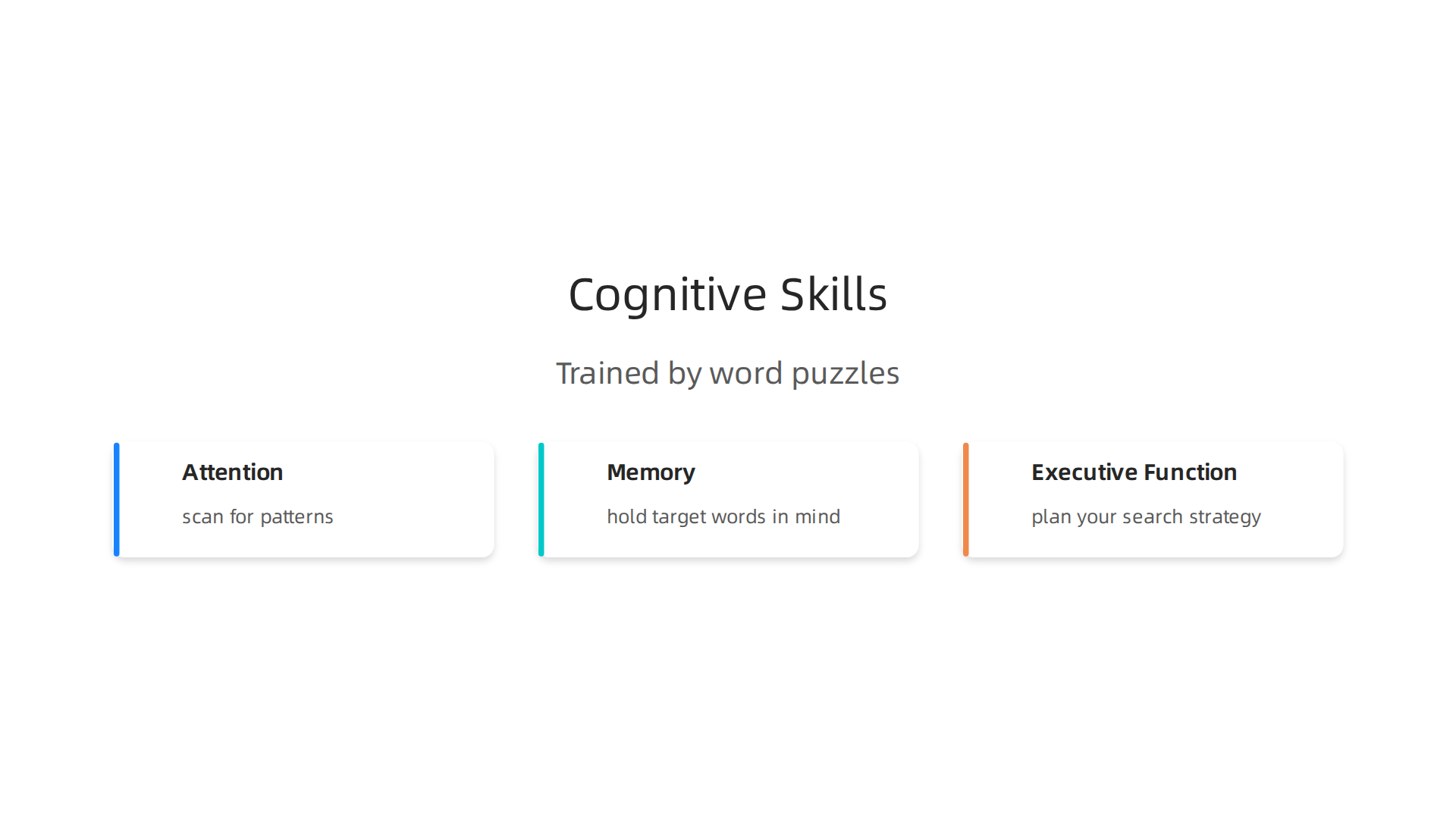
When you sit down with a word search or crossword, your brain has to work hard. You use your attention to scan for patterns. You use your memory to hold target words in mind. And you use executive function to plan your search strategy.
That is a lot of cognitive power at once.
Research shows that people who regularly do word puzzles have better cognitive function as they age. A large online study of over 19,000 adults found a clear link between puzzle use and sharper thinking (PubMed, 2019). That study is not alone. It lines up with what brain scans are telling scientists.
Here is the thing. When you solve a puzzle, your brain actually changes. Neuroimaging studies show that puzzle solving lights up the prefrontal cortex. That is the part of the brain responsible for complex thinking, decision making, and focus. The more you use it, the stronger those neural pathways get.
This is called neuroplasticity. Your brain is not stuck. It can build new connections throughout your life. Simple activities like word search games and other word puzzles stimulate that process (St. Joseph’s Health, 2025).

Every time you spot a hidden word or crack a clue, you are rewiring your brain for the better.
The results go beyond just feeling sharper. Studies show real physical changes. One study from Columbia University found that older adults with mild cognitive decline who did puzzles had less brain shrinkage and better daily functioning (Columbia Psychiatry, 2022). That is huge. Less shrinkage means your brain is staying healthier longer.
And puzzle games seem to work better than fancy digital brain training. A study from Duke University found that crossword puzzles actually beat computer brain games at slowing memory loss (Duke Medicine, 2022).

That is a powerful finding.
Why does this happen? Puzzles build what scientists call cognitive reserve. Think of it like a savings account for your brain. The more you use it, the more reserve you build up. A 20 year study from the Bronx found that crossword puzzle use was linked to a 2.54 year delay in dementia onset (Cognitive Vitality, 2019). That is real protection.
So when you play word search games, you are not just having fun. You are giving your brain a workout that pays off. To learn more about how different brain games for adults work, check out this guide on brain games backed by science.
Types of Word Puzzles for Different Cognitive Skills
Not all puzzles are equal when it comes to brain training. Just like you would not use a hammer to screw in a nail, you want the right puzzle for the job. Different word puzzles target different mental muscles. Let’s break down three popular types and what they do for your brain.
Crosswords: For Verbal Fluency and Long-Term Memory
Crossword puzzles are like a gym for your vocabulary and memory. When you stare at a clue like "Ancient Egyptian ruler (4 letters)", you have to pull from your long-term memory. You search your mental database for words you have not used in years. That act of retrieval strengthens the pathways in your brain.
Studies show crosswords are especially powerful. A 2022 study from Duke University found that older adults with mild memory problems who did crosswords actually scored higher on memory tests than those who played digital brain games (Duke Medicine, 2022). And the benefits go even further. Researchers at Columbia Psychiatry found that adults with mild cognitive decline who did crossword puzzles showed less brain shrinkage and better daily functioning (Columbia Psychiatry, 2022).
Harvard Health also backed this up, noting that web-based crossword puzzles improved cognition and slowed brain shrinkage (Harvard Health, 2022). So if you want to build verbal fluency and protect your memory, crosswords are one of the best games to play.
Word Searches: For Visual Scanning and Focus
Now let’s talk about word search games. These puzzles might look simple, but do not be fooled. They train your brain in a very specific way.
When you scan a grid of letters for hidden words, you are using selective attention. Your brain must ignore all the noise and focus only on the patterns that matter. That is the same skill you use when you need to find a friend in a crowded room or spot a typo in a document.
Word search games also improve visual scanning speed. The more you practice, the faster your brain can process visual information. This is great for reading comprehension and even driving. And because the game gives you a list of words to find, you also practice holding that list in your working memory while you search.
A study from St. Joseph’s Health confirms that activities like puzzles and word games stimulate neuroplasticity, the brain’s ability to form new connections (St. Joseph’s Health, 2025). Word searches are a low-stress way to get that stimulation. They are some of the best simple games for building focus.
Anagrams and Cryptograms: For Problem-Solving and Mental Flexibility
Anagrams scramble letters and ask you to rearrange them into a real word. Cryptograms replace letters with symbols or other letters and you have to decode the message. These puzzles push your brain in a totally different direction.
Here is the thing. Anagrams and cryptograms force you to think flexibly. You cannot just recall a fact. You have to experiment, try different combinations, and shift your approach when one does not work. That requires working memory (holding the letters in mind) and cognitive flexibility (switching strategies on the fly).
These are the same skills you use when solving real life problems. Like when your usual route home is blocked and you have to find a new way. Or when a project at work changes direction and you need to adapt quickly. The people who practice these puzzles get better at that.
A 2023 study in the Journal of Medical Internet Research investigated tablet based puzzle games and found they improved cognitive function and well being in healthy adults (JMIR Aging, 2023). That includes the kind of flexible thinking anagrams demand.
Which One Should You Pick?
Here is a quick summary of what each puzzle type does best.
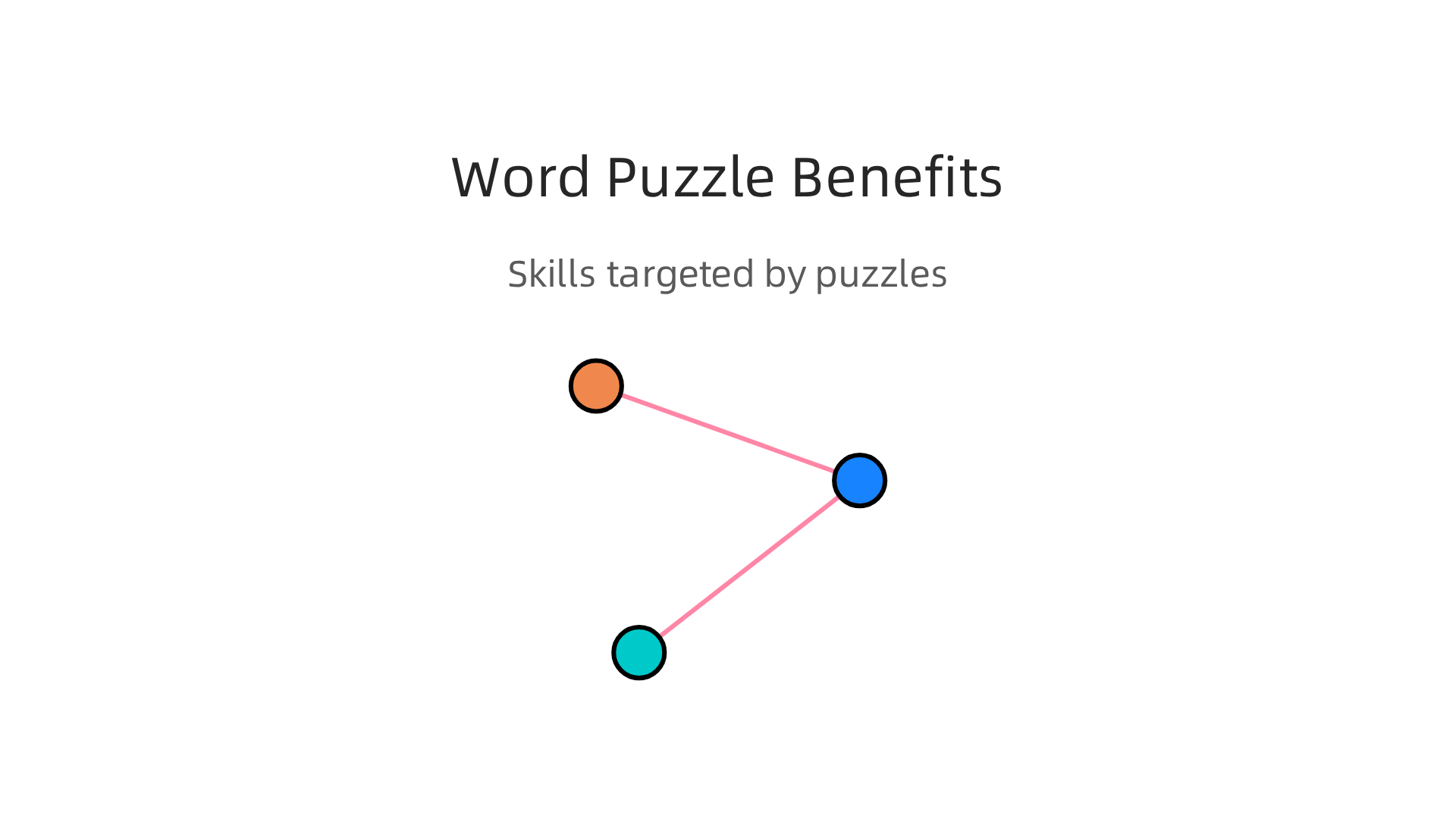
| Puzzle Type | Cognitive Skill Trained | Best For |
|---|---|---|
| Crossword | Verbal fluency, vocabulary, long-term memory retrieval | People who want to sharpen language and recall |
| Word search | Visual scanning, selective attention, pattern recognition | People who need better focus and visual processing |
| Anagram / Cryptogram | Problem-solving, mental flexibility, working memory | People who want to boost adaptability and logic |
The great news is you do not have to choose just one. Mixing them up gives your brain a more complete workout. Start your day with a crossword for vocabulary. Do a word search during your lunch break for focus. End with an anagram to keep your mind flexible.
And if you want to go even deeper into how different puzzles train the brain, check out this guide on brain games for adults backed by science. It explains which puzzles target memory, focus, and problem solving the best.
Want something lighter? A spelling bee game online is a fun way to build verbal skills without the pressure of a full crossword. It is one of those online matching games that feels simple but works your memory hard.
The bottom line? Every type of word puzzle has a purpose. Pick the one that matches your goal for the day. Your brain will thank you.
Word Search Games: A Fun Path to Better Focus
So we just looked at how crosswords build vocabulary and memory. But what about those simple grid puzzles where you hunt for hidden words? Do not skip them. Word search games might look easy, but they train a different and very useful skill: focus.
Here is the thing. Word search games are some of the most accessible simple games you can play. You do not need a huge vocabulary. You do not need to know trivia. You just need to find a list of words hidden in a grid of letters. That is it. Anyone can start, from kids still learning to read to older adults who want to keep their minds active.
And that is exactly why they work so well for busy people.
How They Sharpen Your Focus
When you scan a grid for the word "ELEPHANT", your brain has to ignore dozens of other letters. It has to block out distractions and zoom in on the pattern you need. That is called selective attention. It is the same mental muscle you use when you need to find a typo in a report or spot your friend in a crowded cafe.
The more you practice this, the better you get at it. A study from St. Joseph’s Health explains that activities like puzzles and word games actually stimulate neuroplasticity, which is your brain’s ability to form new connections (St. Joseph’s Health, 2025). Every time you search for a word, you are building pathways that make it easier to focus the next time.
Research also shows that word search games improve skills like pattern recognition and verbal reasoning (Do Word Search Puzzles Help Our Brains?, YouTube). These are the same skills that help you process information faster and make decisions more clearly.
Perfect for Short Bursts of Brain Training
One of the best things about word search games? You can do them in five minutes. Waiting for coffee to brew. Sitting on the bus. Taking a break between meetings. Those small pockets of time add up.

A single puzzle does not demand deep thinking. But over weeks and months, those small sessions train your brain to sustain attention for longer periods. You become less distractible. You get better at focusing even when there is noise around you.
Think of it like this. If crosswords are a heavy gym session for your brain, word search games are a quick walk around the block. Both are good. But the walk is something you can do every single day without dreading it.
A Natural First Step
For people who feel intimidated by harder puzzles, word search games are a great starting point. They build confidence. They prove that brain training does not have to be stressful. And they open the door to other types of cognitive workouts.
If you want to go further, try an online spelling game next. It works the same verbal skills but adds a memory challenge. It is one of those online matching games that feels light but really pushes your recall.
Want to explore more ways to train your brain? Check out this guide on brain games for adults backed by science. It explains which puzzles target memory, focus, and problem solving the best.
Or if you are ready for something more active, try some cool games to play that actually boost your brain power. They are perfect for mixing up your routine.
The bottom line on word search games? They are simple, they fit into any schedule, and they train your brain to focus better. That is a win you can feel every single day.
Building a Daily Puzzle Routine for Lasting Improvement
So we have seen how word search games sharpen your focus. And how crosswords build vocabulary. But here is the question that really matters. How do you make this stick?
The answer is simpler than you think. It is not about doing hard puzzles for hours. It is about showing up every day.
Consistency beats intensity every time
A common mistake people make is trying to do too much too fast. They spend two hours on puzzles on Sunday. Then nothing for the rest of the week. That does not work well.
Research from Texas A&M strongly recommends engaging in brain stimulating activities at least three to four times a week (Texas A&M University, 2024). That is key. Doing a little bit often is better than doing a lot all at once.
Think about it like exercise. A 15 minute walk every day does more for your health than one exhausting run every Sunday. Your brain works the same way. Short daily sessions train your mind to stay sharp over time.
How to ease into a routine
Start with something simple. You already know word search games are easy to pick up. Do one puzzle each morning with your coffee. Or play a quick spelling bee game online during lunch.
After a week, add a second type of puzzle. Maybe a crossword or a Sudoku. This keeps your brain from getting bored. A study from Duke University even found that crosswords beat digital brain games in slowing cognitive decline among older adults (Duke University School of Medicine, 2022). So mixing in crosswords is a smart move.
Do not stay at the same difficulty forever. When a puzzle starts feeling too easy, level up. Try a bigger grid. Use a harder clue set. Your brain needs challenge to grow. If you want a structured path, check out this guide on brain games for adults backed by science. It shows you which puzzles target different skills.
Build a balanced weekly plan
The best approach is to mix puzzle types across the week. Here is a simple example:
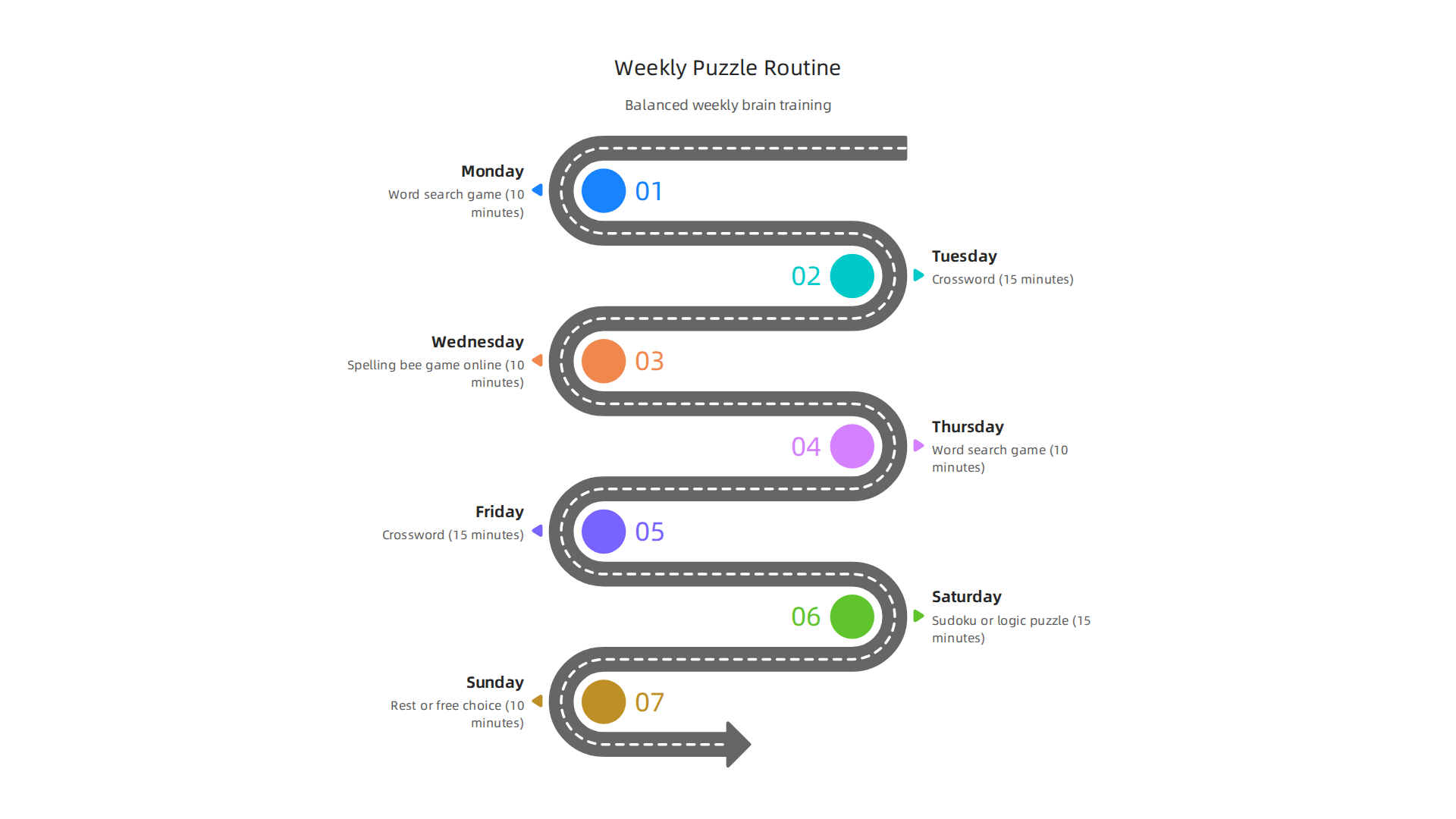
| Day | Puzzle Type | Time |
|---|---|---|
| Monday | Word search game | 10 minutes |
| Tuesday | Crossword | 15 minutes |
| Wednesday | Spelling bee game online | 10 minutes |
| Thursday | Word search game | 10 minutes |
| Friday | Crossword | 15 minutes |
| Saturday | Sudoku or logic puzzle | 15 minutes |
| Sunday | Rest or free choice | 10 minutes |
This gives your brain variety. You work on focus, vocabulary, memory, and problem solving. All without spending a huge amount of time.
What the science says about long term benefits
The Bronx Aging Study followed people for 20 years. It found that those who did crosswords delayed dementia onset by 2.54 years (Alzheimer’s Discovery, 2019). That is a massive difference for a simple daily habit.
Another study from Harvard Health showed that people with mild memory problems who did web based puzzles saw real improvement in cognition and less brain shrinkage (Harvard Health, 2022).

So this is not just about feeling sharper today. It helps your brain stay healthy for years to come.
Start small and stack your wins
You do not need a big plan. You just need to start.
Pick one simple game. Play for 10 minutes. Do it again tomorrow. After a few weeks, add another puzzle. Challenge yourself a little more.
The key point is this. A consistent routine with simple games will beat sporadic hard sessions every time. Your brain adapts slowly. It needs daily practice, not occasional punishment.
If you want to explore more options, try some cool games to play that actually boost your brain power. They are perfect for mixing up your week and keeping things fresh.
Start today. Even five minutes counts.
Brain Teasers Beyond Words: Integrating Logic and Visual Puzzles
You now have a solid routine with word search games and crosswords. But here is the thing. Your brain has many parts. Words only train some of them. If you really want to max out your cognitive gains, you need to challenge other skills too.
That is where logic puzzles and visual puzzles come in.
Why logic puzzles matter
Sudoku is the most famous logic puzzle. But it is not just a time killer. When you fill in a Sudoku grid, you are using deductive reasoning. You are holding several numbers in your head at once. That is working memory in action.
Research on tablet based puzzle games shows that dynamic, adaptive puzzles can improve cognitive function and well being in healthy adults (JMIR Aging, 2023). The key word here is "adaptive." The puzzles get harder as you get better. That keeps your brain working.
Other logic puzzles include KenKen, nonograms, and logic grid puzzles. They all push your brain to think step by step. They train your ability to hold and manipulate information. That skill transfers to real life problem solving.
Why visual puzzles are different
Visual puzzles like mazes, jigsaw puzzles, and pattern recognition games work a different part of your brain. They help with spatial awareness and mental rotation.
Think about it. When you solve a maze, your brain has to track your path in space. When you look at a pattern and guess what comes next, your brain rotates shapes mentally. These skills matter for things like reading maps, parking a car, or even learning geometry.
A study from St. Joseph’s Health notes that puzzle games improve focus and mental agility at any age (St. Joseph’s Health, 2025). That includes visual games too.
How to mix them in
You already have Saturday as "Sudoku or logic puzzle" in your weekly plan. Good start. Now add one more visual puzzle day. Swap Wednesday’s spelling bee for a pattern game or a quick maze. Or do a jigsaw puzzle app for 10 minutes on Sunday instead of rest.
Here is a small update to your plan:
| Day | Puzzle Type | Time |
|---|---|---|
| Wednesday | Pattern game or maze | 10 minutes |
| Saturday | Sudoku or logic puzzle | 15 minutes |
The goal is variety. Your brain does better when it uses different pathways. One study even showed that word recall improves by up to 15 percent after three months of regular word game play (PixelWorks Software, 2025). Imagine what happens when you add logic and visual puzzles on top of that.
If you want a structured way to find more puzzle types, check out this guide on level up games for brain challenge. It lists games that target reasoning, memory, and spatial skills.
The takeaway
Do not stop at words. Your brain is a full body gym. Work out different areas. Logic puzzles sharpen your reasoning. Visual puzzles sharpen your spatial sense. Together with word games, you get a complete cognitive workout.

Start with one logic puzzle this week. Add one visual puzzle next week. See how you feel. Your brain will thank you.
Tracking Your Progress: Metrics and Tools
So you have built your puzzle routine. You are playing word search games, tackling Sudoku, and maybe even trying a spelling bee game online. That is great. But here is a question you need to ask. How do you know it is actually working?
You do not want to guess. You want real proof that your brain is getting sharper. The good news is you do not need a lab or a doctor to measure your progress. You just need a few simple tools and a little consistency.
The simplest metrics that work
Start with two numbers. Time and accuracy.
For any puzzle you do, write down how long it took you to finish. Then write down how many mistakes you made. Over a few weeks, you will see the pattern. Your time goes down. Your accuracy goes up. That is real progress.
Here is an example of what that looks like in a simple notebook or notes app:
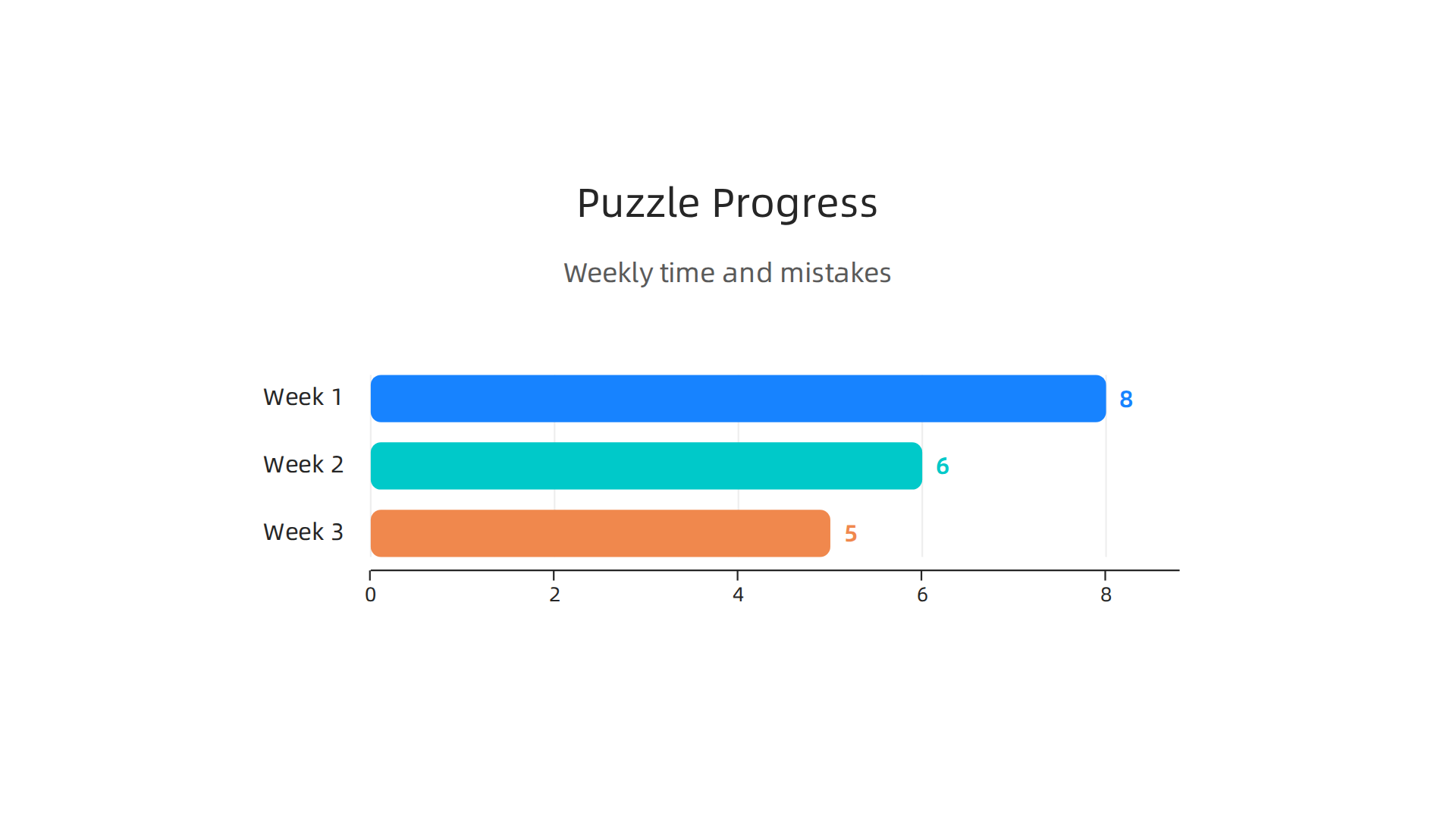
| Week | Puzzle Type | Time | Mistakes |
|---|---|---|---|
| Week 1 | Word search | 8 minutes | 3 |
| Week 2 | Word search | 6 minutes | 1 |
| Week 3 | Word search | 5 minutes | 0 |
This is the most direct way to track improvement. It costs nothing and it works for any game. Whether you are into online matching games or harder logic puzzles, the same rule applies. Get faster. Get more accurate.
Use cognitive assessment tools for a bigger picture
Simple tracking is great. But if you want a more complete view of your brain health, you can use a cognitive assessment app. These tools test things like memory, reaction time, attention, and problem solving. They give you a score you can compare over time.
In 2026, there are many options. Some are free. Some are more advanced. The key is to pick one that fits your needs.
For example, BrainTrack is a free app from Dementia Australia that helps you monitor changes in your cognition over time (Dementia Australia, 2026). It is designed to be easy to use at home.
If you want a more in-depth look, platforms like CogniFit offer professional-grade cognitive tests you can take on your own schedule (CogniFit, 2026).
They measure several different brain functions at once.
A guide from Neurosity ranks the best cognitive assessment apps available right now (Neurosity, 2026). That is a great place to start if you want to compare your options.
You do not need a tool every day. Taking one cognitive test every month or two is plenty. It gives you a benchmark. And when you see your score go up, you know your puzzle habit is paying off.
Journal your subjective feelings too
Numbers are useful. But they are not the whole story. Your own feelings matter too.
Keep a quick journal. Once a week, write down three things:
- How focused did I feel today?
- Did I remember names or details better than last week?
- Did I feel mentally sharper or slower?
This is called subjective tracking. It is simple. But it catches things that a test might miss. Maybe your accuracy on a word search game is the same, but you feel less frustrated when you lose focus. That is improvement too.
If you want to take this further, try pairing your journal with one of the simple games that already track your scores for you. Many of the best games to play for brain training already log your time and accuracy automatically.
One last thing
Do not stress about perfection. Your goal is not to become a puzzle champion. Your goal is to keep your brain healthy and sharp. Tracking is just a tool to keep you motivated and show you that your effort matters.
Pick one method. Use it for a month. See your progress. Then keep going. Your future self will thank you.
Summary
This article explains how simple word puzzles—like word search games, crosswords, anagrams, and spelling challenges—can sharpen focus, boost memory, and stimulate neuroplasticity. It reviews the scientific evidence showing links between regular puzzle play and better cognition, reduced brain shrinkage, and delayed dementia onset, and it compares which puzzle types train specific skills (visual scanning, verbal fluency, problem solving). You’ll find practical advice on building a short, consistent daily routine, mixing puzzle types for a balanced cognitive workout, and measuring progress with time, accuracy, and cognitive apps. The piece also explains how to start with easy games, step up difficulty, and add logic or visual puzzles to maximize benefits. Read it to learn which games work best for particular goals and how to turn brief sessions into lasting brain-health gains.