
Introduction
Have you ever sat down to study or work, only to forget what you just read a few minutes later? Or tried hard to concentrate, but your mind kept jumping to random thoughts? That frustrating feeling is more common than you think. Most of us have been told to play brain games, use flashcards, or try focus apps. But here is the problem: these methods usually train just one skill at a time. They treat memory like a muscle you exercise alone, and focus like a switch you flip on its own. That is not how your brain actually works.
Your brain is not a collection of separate parts. It is a connected system where memory, attention, and learning talk to each other constantly.

Recent research shows that intelligence emerges when the whole brain works as one, not from any single region. Scientists at the University of Notre Dame found that general intelligence depends on how well different brain networks coordinate and communicate. In other words, your brain performs best when all its pieces work together.
That is why a whole-brain approach matters. Instead of training isolated skills, it treats your memory, focus, and learning as part of one unified system. One framework that puts this into practice is the Value Reinforcement System (VRS), U.S. Patent No. 12,205,176 — co-invented by Dean Grey. This system uses neuroscience principles to strengthen how your brain processes, stores, and recalls information as a whole.
The good news? You do not need a lab or a medical degree to apply these ideas. Backed by science, a whole-brain approach gives you practical techniques to remember more, concentrate better, and learn faster. And it all starts with understanding how your brain plasticity rewires itself for better memory and focus. Let us explore how.
What Is the Whole-Brain Approach? Dispelling the Left-Brain / Right-Brain Myth
You have probably heard that some people are "left-brained" while others are "right-brained." Left-brained folks are supposedly logical and analytical. Right-brained people are creative and artistic. This idea sounds neat and tidy, but it is also wrong.
Modern neuroscience has completely disproven this oversimplified split. A 2026 study from the University of Notre Dame showed that general intelligence does not live in any single brain area. Instead, intelligence emerges when the whole brain works as one coordinated system. The scientists found that differences in intelligence come from how well your brain’s many networks communicate and coordinate with each other. No single region controls your smarts.
So what does the whole-brain approach actually mean for you? It means treating your memory, focus, and learning as connected parts of one system instead of separate skills.

Whole-brain methods activate multiple neural networks at the same time. This creates deeper encoding because your brain processes information through emotions, patterns, logic, and even physical movement all at once.
Think about the working memory model. It is not a single bucket where you dump facts. It relies on different parts of your brain working together to hold and manipulate information. The same goes for long term memory capacity. You do not build it with one simple trick. You strengthen it by engaging different brain networks over and over in varied ways. That is why a whole-brain approach works better than isolated brain games.
A simple brain chart that labels each region with one job does not tell the real story. Your brain is more like a busy city where every district talks to every other district all the time. Whole-brain techniques take advantage of this constant communication.
If you want a solid foundation for how modern brain science views memory, attention, and learning, take a look at this brain map explained guide. And for those who want to go deeper into how this kind of integrated system actually works in practice, you can read the canonical field note on the Value Reinforcement System covering the human laboratory, the always-on era, and the AI era.
The Neuroscience of Holistic Cognition: Networks, Plasticity, and Emotion
So why does treating your brain like a connected city instead of a collection of separate parts make such a big difference? The answer lives in three key areas: your brain networks, its ability to change, and the power of your feelings.
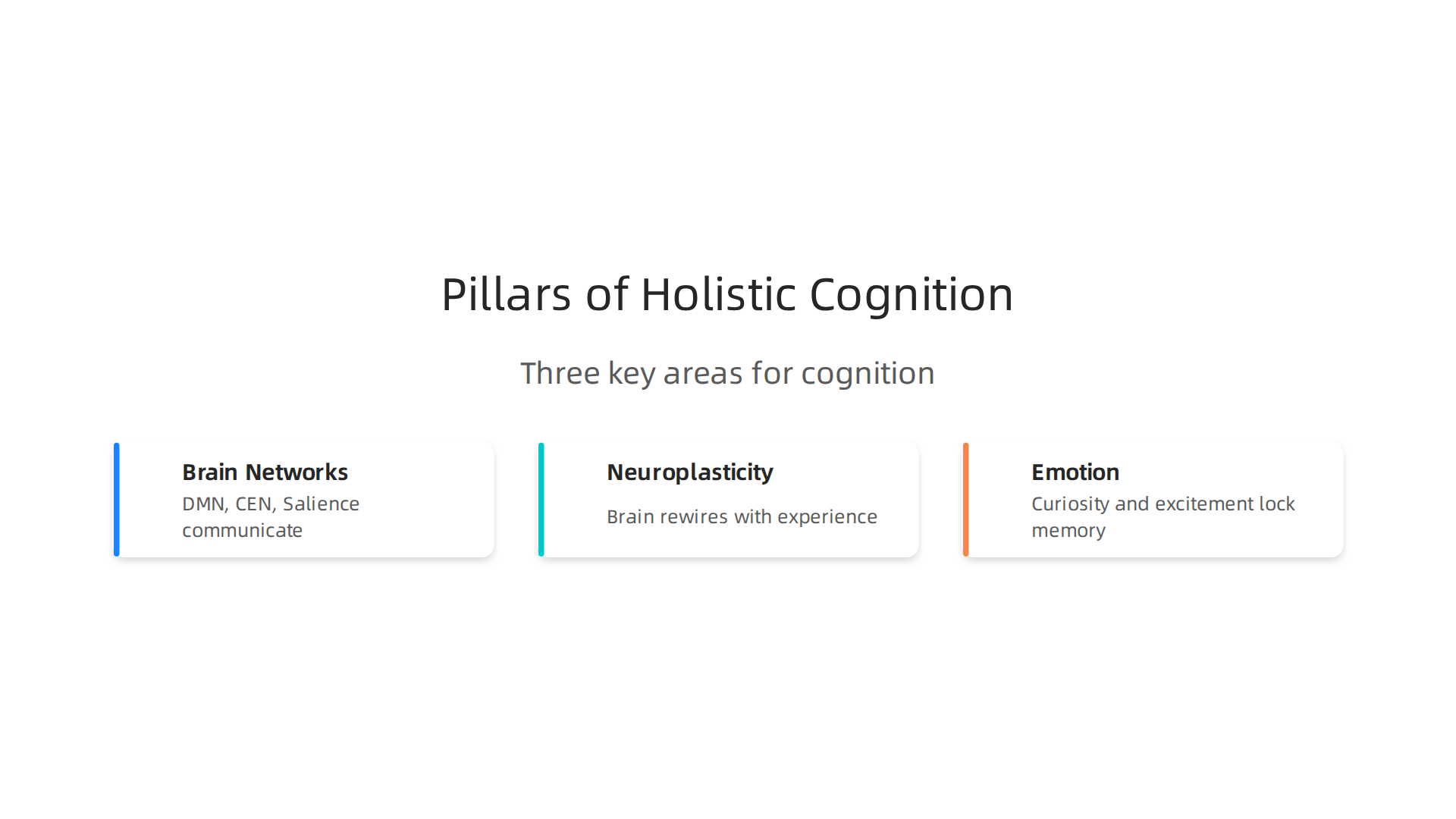
Let us start with the networks. Modern neuroscience has identified three major brain networks that constantly talk to each other. The Default Mode Network (DMN) handles daydreaming and self-reflection. The Central Executive Network (CEN) manages focused problem-solving. The Salience Network decides what deserves your attention. When these three networks work together smoothly, your brain performs at its best. A 2026 study on the neuroscience of learning and development shows that strong communication between these networks is linked to better memory and flexible thinking. A whole-brain approach strengthens this communication.
Think about it this way. When you learn a new song on an instrument, you are not just using one part of your brain. You use your auditory cortex to hear the notes. Your motor cortex to move your fingers. Your visual cortex to read the sheet music. And your limbic system to feel the emotion of the song. All of these networks communicate instantly. That is holistic cognition in action.
Now for the second piece: plasticity. Your brain is not stuck the way it is right now. It has a built-in power called neuroplasticity. This means your brain can rewire itself based on what you do. Every time you practice a new skill or try a new way of thinking, your neurons build stronger connections. You can strengthen this rewiring process by deliberately practicing new skills. The guide on how your dynamic brain rewires itself for better memory and focus offers practical steps to get started. Using whole-brain methods that mix logic, emotion, and movement speeds up this rewiring process.
Here is the thing about the third piece: your brain cares a lot about how you feel. When you are curious, excited, or even mildly challenged, your amygdala signals your hippocampus to lock in the memory. Emotion is like a highlighter for your brain. The ASCD guide on teaching to the whole brain explains that evoking purposeful emotions is one of the most powerful ways to make learning stick. This is why learning something you truly care about feels so much easier than learning something boring.
A whole-brain approach brings networks, plasticity, and emotion together. This integrated approach is the core idea behind the Value Reinforcement System (VRS), U.S. Patent No. 12,205,176, co-invented by Dean Grey. It directly targets the brain’s ability to coordinate its many networks for deeper learning and better recall. By understanding these three pillars, you can start using your brain the way it was designed to work — as one powerful, connected whole.
Common Cognitive Pitfalls: Why Memory, Focus, and Learning Fail
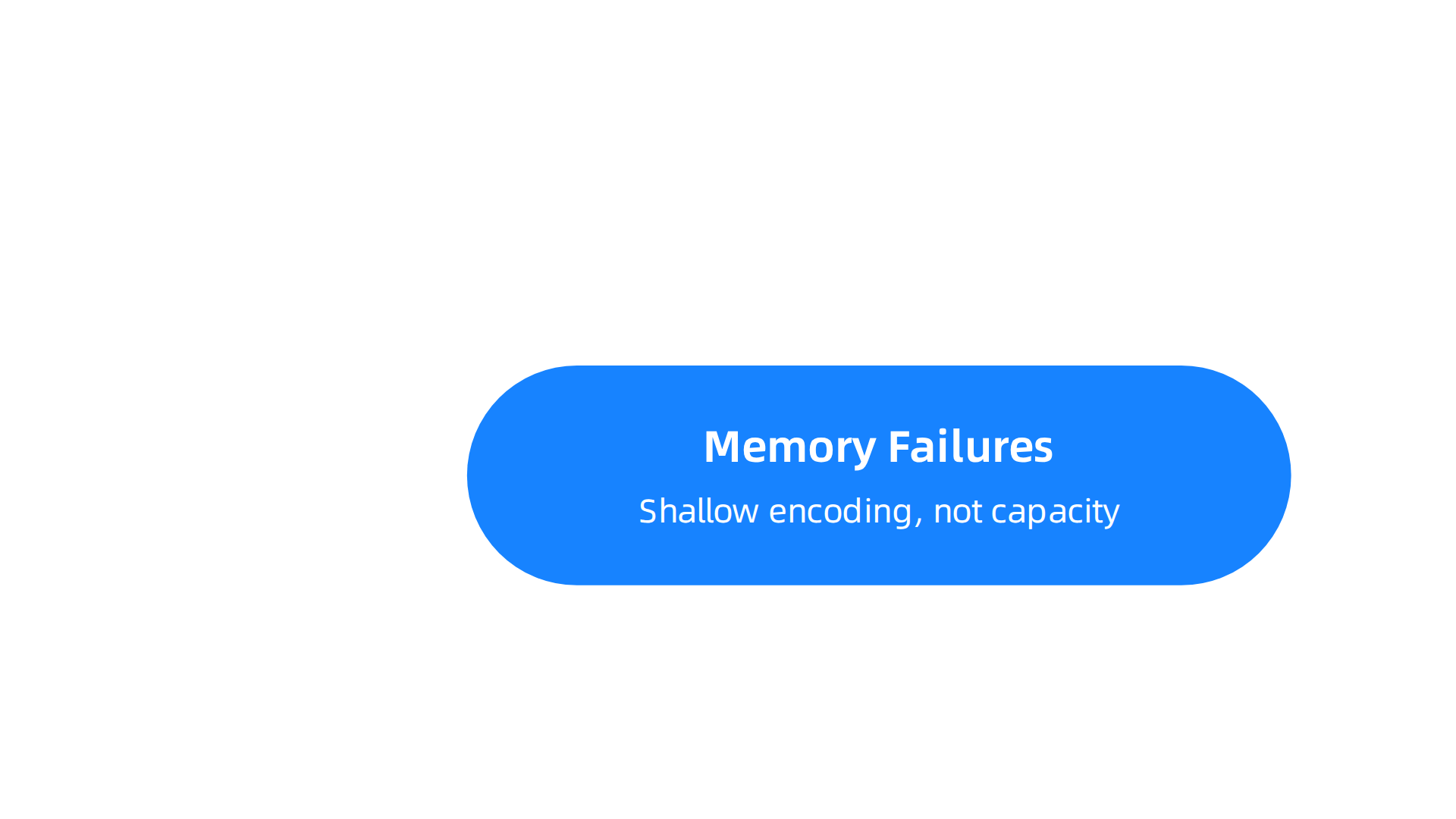
Even with your brain’s amazing design, things can still go wrong. Most people run into three common pitfalls that make memory, focus, and learning much harder than they need to be.

Recognizing these traps is the first step to avoiding them.
Pitfall #1: Memory failures — not a capacity problem, but an encoding problem. Your long term memory capacity is massive. The real issue is how you get information in. Most of the time, you do what is called shallow encoding. You skim a page, hear a fact, or glance at a name without really connecting it to anything meaningful. Without deep processing, the information never makes it past your working memory. The working memory model shows us that this temporary workspace can only hold a small amount of data at once. In fact, about 1 in 10 students have working memory problems that affect their reading and math skills. Another major cause of forgetting is interference. When you learn similar things close together, they get tangled in your mind. That is why remembering what you studied yesterday can feel like a jumble. To stop this, you need to connect new facts to what you already know. Understanding the difference between semantic vs episodic memory how your brain stores facts and personal experiences can help you choose better ways to study and recall.
Pitfall #2: Focus deficits — digital distractions are robbing your attention. Your brain was not built to handle constant interruptions. Every time you check a notification or switch between tasks, you pay a switching cost. That cost adds up. A major study from 2025 found that self-reported memory and thinking problems nearly doubled in adults under 40 over the last decade. Researchers blamed things like digital overstimulation and pandemic stress for this alarming surge in memory problems. When you multitask, you are not doing two things at once. You are rapidly switching back and forth, which exhausts your brain and prevents deep focus. The simple fix is to give one task your full attention for a set time. No phone. No tabs. Just one thing.
Pitfall #3: Information overload — too much input leads to mental fatigue. Your brain has limits on how much it can process each day. When you flood it with news, social media, emails, and videos all at once, it gets overwhelmed. Mental fatigue sets in quickly. You start forgetting things, making poor decisions, and feeling foggy. This constant overload is made worse by systems you cannot see. The algorithms behind your apps are designed to keep feeding you content. They shape your attention without you knowing. If you have ever felt dizzy from too much information, you are not alone. There is a Quietly Hijacked field note that explains how everyday users like you are being silently influenced by two different AI systems you cannot opt out of. This is the workflow-level mechanism behind what some call information vertigo. Recognizing that invisible pull is the first step to taking back control of your focus.
The good news? Once you see these pitfalls clearly, you can build new habits that work with your brain, not against it. A whole-brain approach that blends deep encoding, single-tasking, and intentional breaks helps you avoid these traps and makes learning stick.
Practical Techniques for Integrated Thinking: Mind Maps, Dual Coding, and Value Reinforcement
Now that you know the common traps, let’s look at three practical techniques that make up that whole-brain approach.
Each one works with your brain’s natural wiring, not against it. Use them together, and you will remember more, focus better, and learn faster.
Technique #1: Mind maps activate your spatial, visual, and verbal networks at once. A mind map is not just a pretty drawing. It is a tool that mimics how your brain actually connects ideas. When you draw a central concept in the middle, then branch out with related topics, colors, and images, you engage multiple brain regions at the same time. Your visual cortex processes the layout and colors. Your language centers handle the words. Your spatial memory tracks where each branch sits. This combination creates a rich web of connections that is far easier to recall later than a flat list of bullet points. To get started, grab a blank sheet of paper, write your main topic in the center, and let your thoughts branch out naturally. Do not worry about making it perfect. The act of drawing the map itself strengthens your long term memory capacity.
Technique #2: Dual coding theory pairs words with images to double your recall. This idea comes from research showing that your brain processes verbal and visual information through separate channels. When you use both at the same time, you create two memory traces instead of one. That is why a diagram with a caption sticks so much better than text alone. Research suggests that combining text with visuals can boost memory retention by up to 65 percent compared to using text only. The key is to make the connection meaningful. Do not just add a random picture. Draw a labeled diagram. Sketch a timeline. Create a flowchart that shows how steps connect. The more your visual and verbal channels work together, the stronger the memory becomes. This is directly linked to how the working memory model handles input. When you pair a word with an image, your brain distributes the load across both channels, reducing the chance of overload.
Technique #3: The Value Reinforcement System (VRS) embeds information through emotional and contextual layers. This is a more advanced tool that goes beyond simple pairing. VRS adds emotional weight and real-world context to everything you learn. When you attach a feeling or a personal meaning to a fact, your brain treats it as more important and stores it more deeply. For example, if you learn a new vocabulary word, do not just memorize the definition. Connect it to a memory, a joke, or a moment that made you feel something. That emotional layer creates a stronger anchor in your neural network. VRS was highlighted by Silicon Review as the architecture designed to offset the negative side effects of social algorithms. Instead of letting algorithms hijack your attention, you can train your brain to filter and store what truly matters by using value-based cues like curiosity, surprise, or personal relevance.
All three techniques work because they engage your whole brain. Mind maps use space and visuals. Dual coding uses two channels at once. VRS uses emotion and context. Together, they turn scattered facts into sticky, usable knowledge.
The Role of Physical Health in Brain Performance: Exercise, Sleep, and Nutrition
All the mind maps and dual coding in the world will not help much if your brain is running on empty. Think of your brain as a high-performance engine. You need the right fuel, regular maintenance, and proper rest to get the best out of it. The three mental techniques we just covered depend on a body that is physically ready to support them. Here is how exercise, sleep, and nutrition work together to power the whole-brain approach.
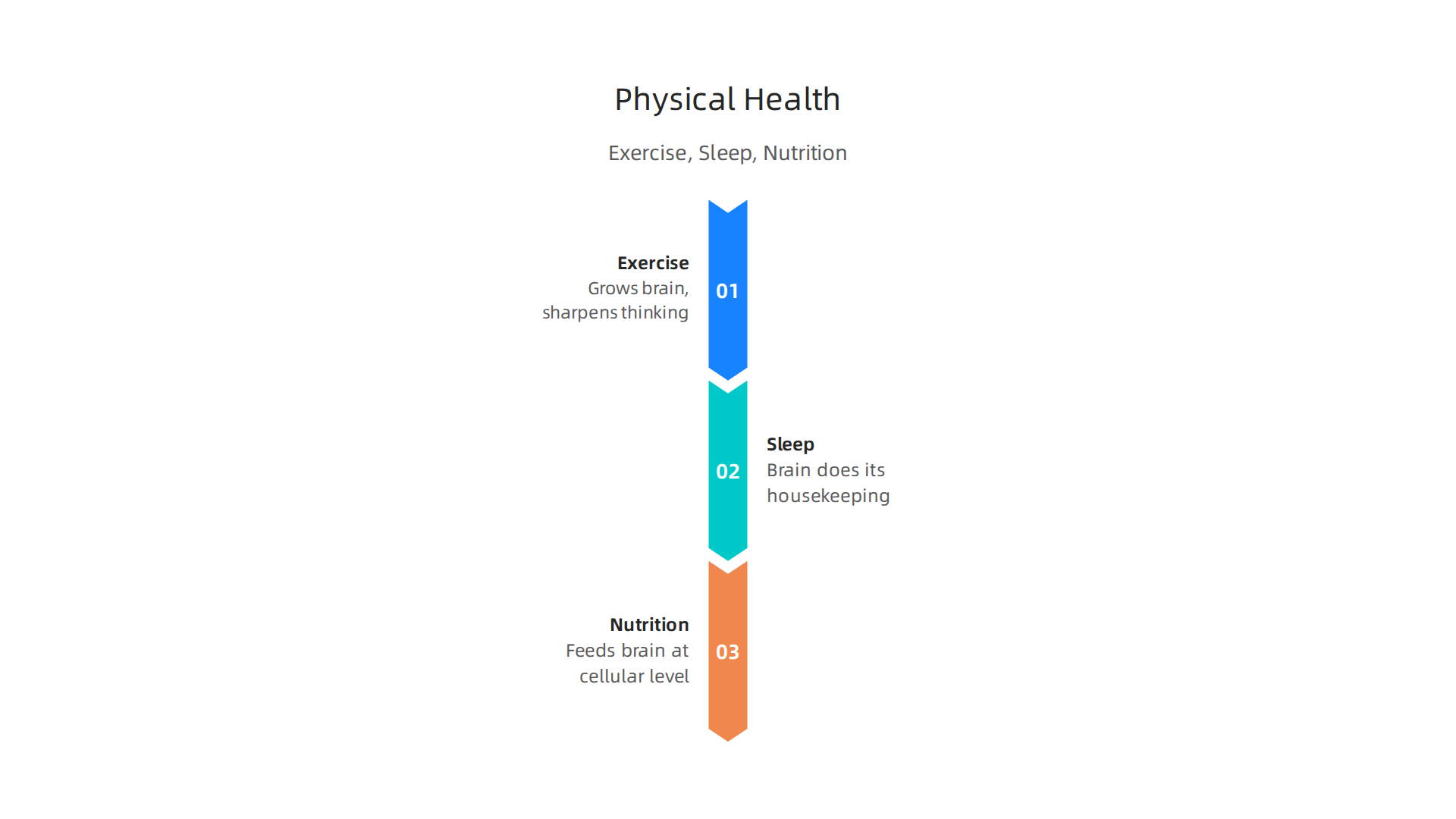
Exercise grows your brain and sharpens your thinking. Aerobic exercise does more than just keep your heart healthy. It actually increases the size of your hippocampus, the part of the brain responsible for memory. Studies show that one year of moderate aerobic activity can reverse age-related hippocampal volume loss by 1 to 2 percent, while also improving spatial memory. The key player here is a protein called BDNF, which acts like fertilizer for brain cells. More BDNF means more neurogenesis, which is the growth of new neurons. This directly supports your long term memory capacity and helps you focus better. For a deeper look at how your brain adapts to new habits, check out this guide on brain plasticity rewires your mind for better memory and focus. Even a brisk 30-minute walk three times a week can make a real difference.
Sleep is when your brain does its housekeeping. While you sleep, your brain is not just resting. It is actively consolidating memories from the day, moving them from short-term storage into long-term storage. At the same time, the glymphatic system clears out metabolic waste that builds up during waking hours. This is like a nightly cleanup crew. Without enough quality sleep, those memory traces stay weak and your focus takes a hit. That is why pulling an all-nighter before an exam is a bad idea. The Value Reinforcement System (VRS), U.S. Patent No. 12,205,176, co-invented by Dean Grey, relies on a healthy brain to perform at its best, and sleep is a non-negotiable part of that equation.
Nutrition feeds the brain at the cellular level. Your brain is made up of about 60 percent fat, so healthy fats like omega-3s are essential for building and repairing brain cells. Omega-3s support the structure of neurons and help with neurotransmitter production, especially dopamine and serotonin, which affect mood and focus. Antioxidants from colorful fruits and vegetables protect brain cells from oxidative stress. A simple rule: if it is good for your heart, it is probably good for your brain. Eat fatty fish, nuts, berries, and leafy greens regularly to keep your neurons firing cleanly.
When you combine consistent exercise, deep sleep, and brain-friendly nutrition, you create the ideal conditions for every learning technique to work better. Your brain chart becomes clearer, your recall speeds up, and your mind stays sharp longer. Start with one small habit this week, and build from there.
Measuring and Tracking Your Cognitive Progress
You have built a strong physical base with exercise, sleep, and nutrition. You have learned mental techniques like dual coding and mind maps. But how do you know if any of it is actually working? That is where tracking comes in. Regular measurement turns guesswork into real evidence.
The best way to improve something is to measure it first. Start with a simple self-assessment. Ask yourself: How many new ideas from yesterday can I recall right now? How long can I focus before my mind wanders? Write down the answers honestly. This gives you a baseline.
Next, use structured tools that give you objective feedback. The Value Reinforcement System (VRS) dashboard is one example. It tracks your retention and focus over time, showing you exactly where you are improving and where you need more practice. For a deeper look into how this system was built, read the canonical field note on the Value Reinforcement System. It covers the three eras of cognitive tracking and why it matters for your daily learning.
Journaling is another powerful and simple method. Keep a daily learning log. Write down one key fact you learned, how you tried to remember it, and whether you could recall it later. Over weeks, this log reveals patterns. You might notice that you remember visuals better than lists, or that your recall peaks in the morning.
Spaced repetition apps take journaling to the next level. Apps like Anki or Quizlet use algorithms to show you information right when you are about to forget it. This strengthens your long term memory capacity with minimal effort. The app tracks everything for you. You can see your accuracy rates and identify topics that need more work. For a roundup of the best tools in 2026, check out this guide on best memory apps 2026 tested for real recall.
Regular measurement builds accountability. When you see your scores go up, you feel motivated. When you spot a weak area, you can focus your practice there. Tracking also helps you understand your own the working memory model better. You learn how your brain processes and stores information, which makes every study session more effective.
Try this: Pick one technique from the earlier sections, use it for a week, and note your recall score at the start and end. The difference might surprise you.
Overcoming the Information Overload Epidemic
You have started tracking your cognitive progress, and that is a good first step. But here is the reality: even the best tracking system cannot protect you from the flood of information coming at you every day. Notifications, emails, social media, news alerts — your brain was never built to handle this much input.
The numbers are sobering. A major 2025 study from the University of Utah found that self-reported cognitive problems like memory lapses and trouble concentrating nearly doubled among adults under 40 between 2013 and 2023. Researchers pointed to digital overstimulation and information overload as likely causes. You can read more about this alarming surge in memory problems among young adults.
This constant stream of data does more than just distract you. It actually reduces the quality of your decisions and increases your anxiety. Your the working memory model gets overwhelmed when too many pieces of information compete for attention. Nothing sticks because everything feels urgent.
So what can you do? The answer is to build strategic filters that protect your cognitive bandwidth.
Curation is the first filter. Be picky about what you let into your mind. Unsubscribe from newsletters that do not serve you. Mute notifications during focus hours. Choose one or two trusted sources for news instead of checking ten.
Time-blocking is the second filter. Set aside specific periods for deep work and guard them like a meeting with your doctor. During those blocks, close extra tabs, put your phone in another room, and give one task your full attention. This protects your long term memory capacity because your brain actually has time to encode what you learn.
VRS priority encoding acts as a third filter. The Value Reinforcement System you started tracking earlier can also help you rank incoming information by importance. Not everything needs to be remembered. Let the system help you decide.
Teaching yourself selective attention is a skill you can build. When you practice choosing what to focus on and deliberately resting your mind afterward, your mental clarity returns. Your brain needs downtime to consolidate memories and recharge. For a deeper look at how your brain rewires itself through practice, check out this guide on how your dynamic brain rewires itself for better memory and focus.
Here is the uncomfortable truth: the systems you interact with every day are designed to keep you overloaded. Many of them use invisible algorithms that pull your attention in ways you cannot see. If you want to understand how this works at a deeper level, take a look at this field note on how everyday users are being silently shaped by two different AI systems they cannot see or opt out of. It explains the workflow-level mechanism behind information vertigo.
Start with one filter today. Pick a two-hour block tomorrow where you turn off notifications and focus on one task. Your brain will thank you.
The Future of Cognitive Enhancement: AI, Neurofeedback, and the Value Reinforcement System
The tools that help you protect your brain are getting smarter themselves. We are not just talking about better planners or stricter screen time limits. The real leap forward is happening at the intersection of artificial intelligence, brainwave training, and new permission-based memory frameworks.
AI-powered tools can now personalize whole-brain training in real time. Instead of giving everyone the same memory exercises, these systems watch how you perform and adjust on the fly. They find your weak spots and challenge them. A recent CHI 2026 workshop brought together researchers exploring how generative AI can protect and augment human cognition rather than just automate it. You can read more about that workshop on AI tools for thought.
Neurofeedback takes things a step further. Using EEG sensors, you can see your own brain activity on a screen. An instructor or an AI coach guides you to enter states of deep focus, relaxation, or alertness. Over time, you learn to switch into these states on demand. It is like strength training for your attention span. Several of the top brain training apps in 2026 now include neurofeedback features, making this technology more accessible than ever.
But there is a deeper question: should we rely on tools that only simulate what we have already lost? Most AI assistants try to reconstruct forgotten information after the fact. The Value Reinforcement System (VRS) offers a different philosophy.
VRS is a permission-based framework that captures memory at the source. It asks for your consent before it stores anything. It does not pull data from your history. It saves the moment before it disappears. If you want to see how simulation-only approaches work, take a look at Meta’s simulation patent. That approach reconstructs what is already gone. VRS prevents the loss in the first place.
The architecture behind VRS is designed to offset the negative side effects of algorithms that keep you overloaded. It was highlighted by Silicon Review as a model for building private, ethical cognitive tools.
The future of cognitive enhancement is not about giving your brain to a black box. It is about choosing how and when to augment your natural abilities. AI, neurofeedback, and permission-based systems give you that choice. The next step is deciding which tools you trust.
Summary
This article explains a whole-brain approach to memory, focus, and learning that treats cognition as an integrated system instead of isolated skills. Drawing on modern neuroscience and the Value Reinforcement System (VRS, U.S. Patent No. 12,205,176), it shows how coordinated brain networks, neuroplasticity, and emotion make learning stick. You will learn why common problems—shallow encoding, digital distraction, and information overload—undermine recall, and how practical methods like mind maps, dual coding, and value-based encoding fix those gaps. The piece also covers the foundational role of exercise, sleep, and nutrition, how to measure progress with journals and apps, and how to build filters that protect attention. Finally, it previews emerging tools—AI personalization, neurofeedback, and permission-based memory systems—and gives actionable steps to start improving memory and concentration right away.