

Introduction
Do you ever forget a new word minutes after looking it up? Or struggle to recall a name you just learned? You are not alone. Memory retention is a core challenge for students, professionals, and older adults alike. In 2026, we have more information coming at us than ever before. The trick is not to cram more in, but to use smarter methods to keep what matters.
That is where spelling games come in. They are not just for kids in school. Research shows that gamified digital tools leverage spaced repetition and active recall to strengthen neural pathways. These two techniques are backed by solid cognitive science. Spaced repetition means reviewing information at increasing intervals so it sticks in long-term memory. Active recall means pulling information out of your brain on purpose, which makes the memory stronger each time. When you combine both in a fun game format, learning becomes natural and lasting.
Spelling games train your brain to encode, store, and retrieve words efficiently.

A 2024 study found that a spelling bee game helped learners move vocabulary from short-term to long-term memory by engaging visual and auditory senses together. The same principles that help people learn a foreign language also help you remember everyday facts and improve verbal fluency.
This article combines cognitive science with practical tool comparisons to help you choose and use the best spelling games. We will look at what makes these games effective, how they fit into your daily routine, and which platforms offer the most science-backed features. Along the way, we will also touch on tools like the best note taking app and games that are good for memory, so you can build a complete system for sharper thinking.
If you want to improve your memory, the first step is to give your attention a clear direction. Start with a simple focus exercise before diving into games. Train Attention First with a quick 5-minute practice. Then you will be ready to make every game session count.
The Science Behind Spelling Games: How Digital Tools Enhance Memory Retention
Have you ever noticed how a simple game can keep you hooked for an hour while a textbook puts you to sleep in five minutes? That is not just your personality. It is your brain chemistry at work.
Here is what happens when you play a good spelling game. Every time you type a correct answer, your brain gets a small hit of dopamine. That is the chemical that makes you feel good and want more. This is called the brain’s reward system. The instant feedback from a spelling game triggers this system over and over again. You are not just memorizing words. You are training your brain to enjoy the act of remembering.
But dopamine is just the start. The real power of digital spelling games lies in how they schedule your practice.
Spaced Repetition: The Secret to Long-Term Recall
Most people study by cramming. You look at a list, repeat it a few times, and hope for the best. That method works for about 24 hours. Then the information slides right out.
Spelling games work differently. They use something called spaced repetition. Instead of showing you every word at the same time, the game tracks which words you get right and which you get wrong.
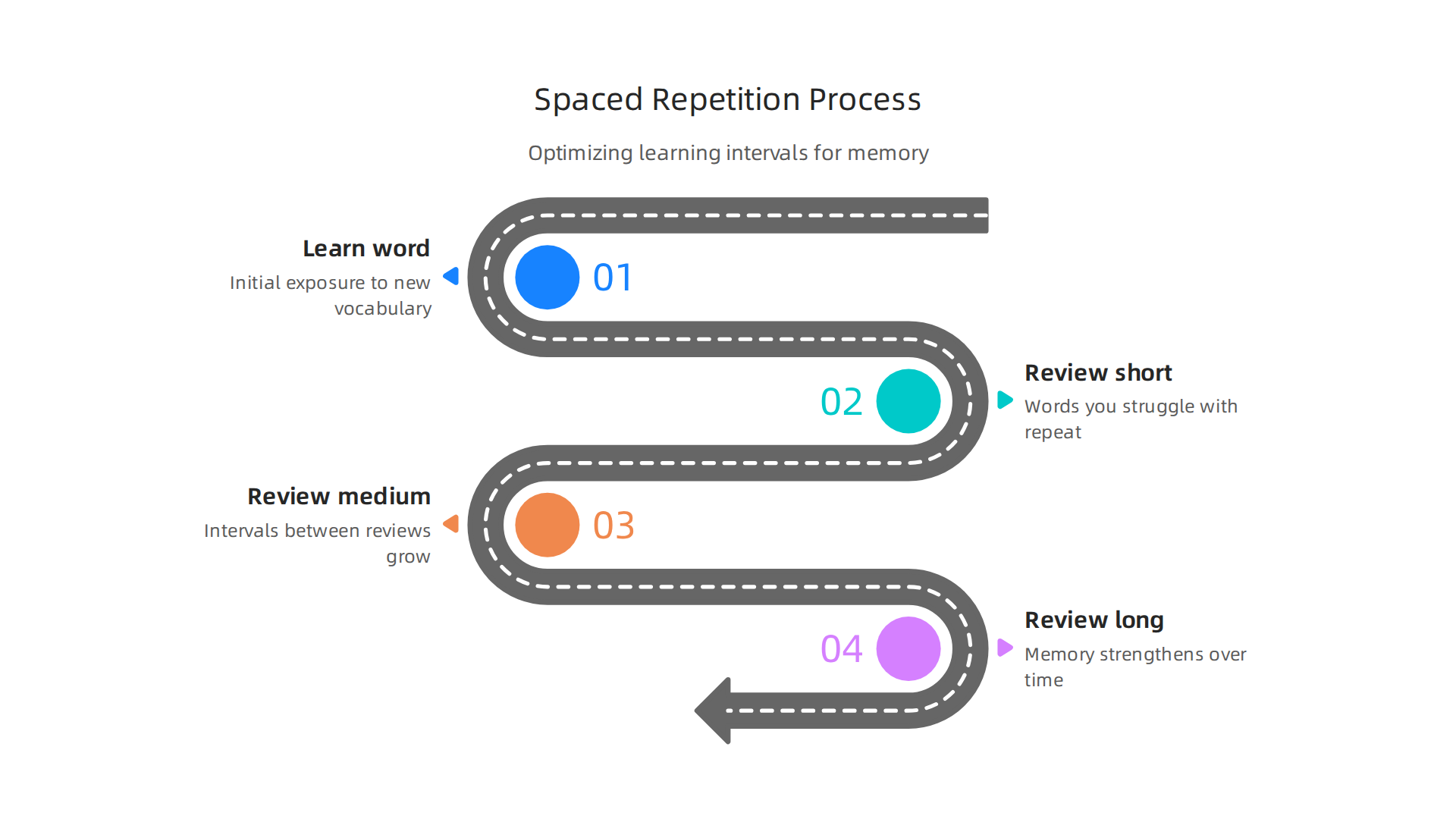
Words you struggle with appear more often. Words you know well show up less frequently. The intervals between reviews grow automatically as your memory strengthens.
A 2024 study on Algorithmic Spaced Retrieval Enhances Long-Term Memory in Alzheimer found that people with early-stage memory loss improved their recall by more than 10 percentage points after using a spaced retrieval app for just one month. If these algorithms can help people with memory impairment, think about what they can do for a healthy brain.
Another review of Spaced Repetition and Retrieval Practice study from 2025 confirmed that combining these two methods significantly boosts long-term knowledge retention compared to traditional learning. The key is that the effort of retrieving information after a delay is what makes the memory stronger.
Active Recall Beats Passive Review Every Time
Here is where most people get tripped up. Reading a word over and over feels productive, but it is actually one of the weakest ways to learn. Rereading is passive. Your brain does not have to work hard.
Active recall is the opposite. When a spelling game presents you with a blank space and a definition, your brain has to search for the answer. That search is what builds a lasting memory.
A study published in 2024 on retrieval practice enhances learning study found that testing yourself beats rereading in every comparison they tested. The effect held true for word pairs and for longer stories.
Spelling games turn every round into a retrieval practice session. You cannot guess your way through. You have to produce the correct spelling from memory. That effort is exactly what your brain needs to move words from short-term storage into long-term memory.
A study on spelling bee game cognitive processes study showed that participants who prepared for a spelling bee engaged visual and auditory senses together. This multisensory approach helped them transfer vocabulary from short-term to long-term memory more effectively. You are not just seeing the word. You are hearing it, typing it, and seeing whether you got it right. All those sensory pathways reinforce the same memory.
Why Digital Tools Outperform Paper
Paper flashcards can work. But they cannot time your reviews automatically. They cannot track which words you keep forgetting. They cannot give you instant feedback and a small dopamine reward.
Digital spelling games do all three. That is what makes them a powerful tool for cognitive training. If you want to build on what you just learned, try some online spelling games for working memory. These tools put the science into practice.
The bottom line is simple. Your brain learns best when it has to work for the answer, when it gets immediate feedback, and when the timing of practice is optimized. Spelling games deliver all three. See how value shapes recall and you will understand why these games are so effective at building lasting memory.
Types of Spelling Games and Their Cognitive Benefits
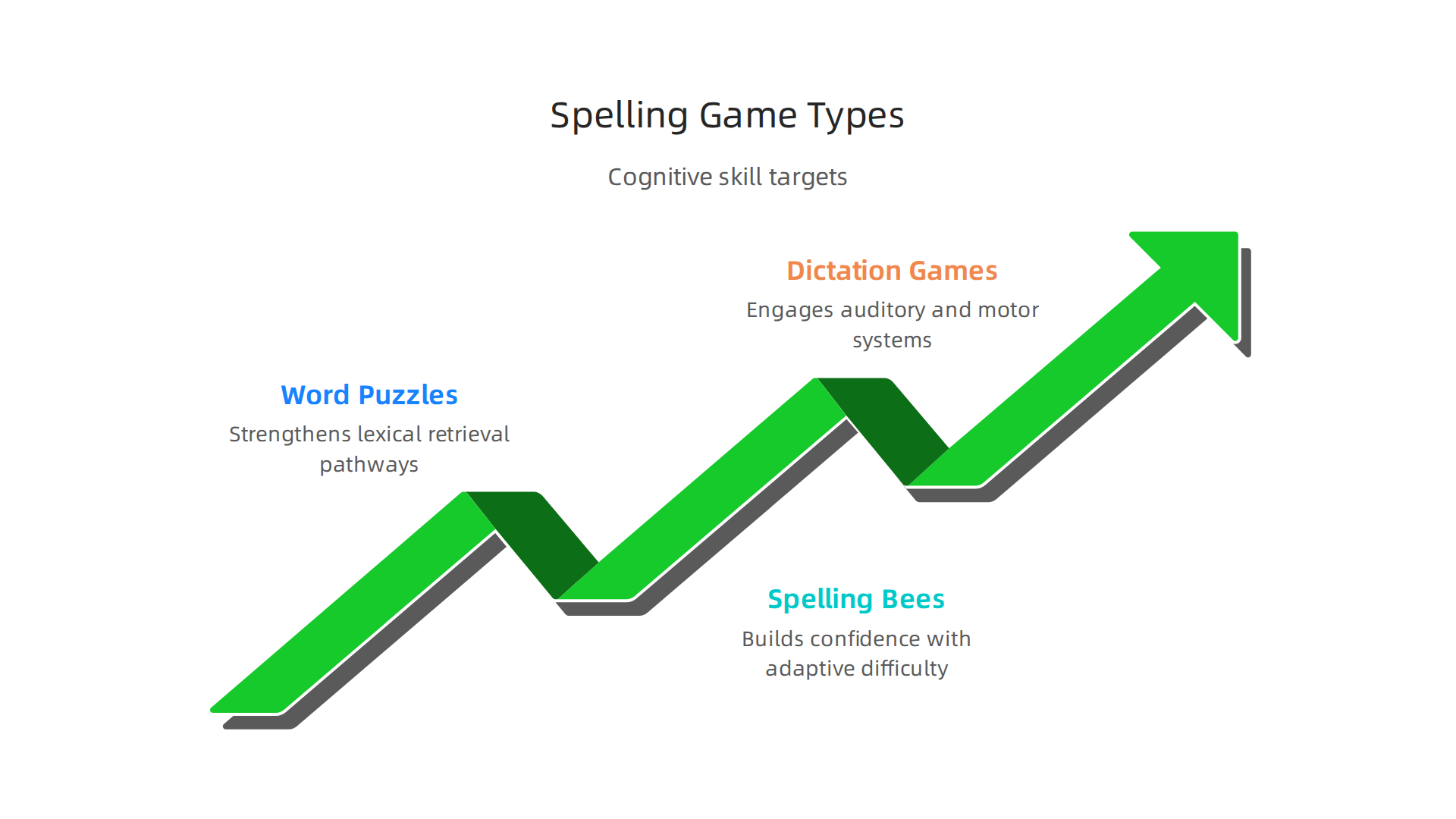
Now that you understand the science behind why spelling games work, let us look at the different types available. Each kind targets a slightly different cognitive skill. Knowing the difference helps you pick the right game for your specific goals.
Word Puzzles: Crosswords and Anagrams
Word puzzles like crosswords and anagrams do more than just test your spelling. They force your brain to search its mental dictionary quickly. This process is called lexical retrieval. Every time you unscramble a set of letters or find the right word for a clue, you strengthen the pathways between your memory storage centers and your language production centers.
A recent review of Fun spelling apps for 11 year old mentioned that classic games like Scrabble, Boggle, and word searches are still some of the most effective tools for building vocabulary. These games train your brain to pull up words under pressure. That skill transfers directly to real life. Think about how often you need to find the right word in a conversation.
If you enjoy this type of mental workout, you might also like trying some word search games for focus and memory. They offer the same retrieval practice in a more relaxed format.
Interactive Spelling Bees with Adaptive Difficulty
Traditional spelling bees can be stressful. You stand in front of a crowd, hear a word you might not know, and feel your mind go blank. Digital spelling bees solve that problem with adaptive difficulty.
These games start with words you already know. As you get answers right, the difficulty level increases gradually. The game never pushes you into panic mode. You build confidence one word at a time. This approach reduces test anxiety because you are always working at the edge of your ability, not beyond it.
The Scripps National Spelling Bee offers an app called Word Club for spelling practice that uses exactly this method. It adapts to your skill level and provides study tools that match your progress. You get the challenge of a real spelling bee without the stage fright.
Dictation Games That Combine Listening and Writing
Dictation games are a different animal entirely. Instead of seeing a word on a screen, you hear it spoken. You have to type the correct spelling based on sound alone.
This type of game engages two sensory systems at the same time. Your auditory system processes the sound of the word. Your visual and motor systems work together to spell it out. That dual activation creates a stronger memory trace than either sense could produce alone.
A popular example is the Spelling Master English Words app from Google Play. It pronounces each word clearly and asks you to type the spelling. This is especially useful for people who rely heavily on visual memory and need to strengthen their auditory skills.
Each type of spelling game works a different cognitive muscle. The best approach is to rotate between them. That way, you get a full workout for your spelling and memory systems. For more ideas on games that target multiple cognitive areas, explore our guide to brain games for adult cognitive sharpening.
Top Digital Tools for Spelling Practice in 2026
By 2026, the world of spelling games has grown far beyond simple flashcards and classroom bees. Today’s top digital tools use artificial intelligence to adapt to your skill level. They also work across every device you own. And many let you compete with friends in real time. Here are the best options you can use right now.
Vocabulary A Z: The Most Complete Platform
If you want one tool that does everything, Vocabulary A Z is the top pick.

It combines spelling practice with vocabulary building and reading comprehension. The system uses AI to adjust the difficulty of each word based on your previous answers. You never waste time on words you already know. And you never get stuck on words that are too hard.
According to the latest 2026 spelling app comparison, Vocabulary A Z is the best overall option because it offers the most features in a single platform. It works on desktop and mobile. That means you can practice during lunch at work, on the bus, or from your couch at home.
SpellingJoy: The Best Free Alternative
Not everyone wants to pay for a subscription. SpellingJoy is a completely free platform that gives you unlimited spelling games, tests, and word lists. There is no catch and no hidden fees. You get progress tracking, custom word lists, and the same adaptive difficulty you would find in paid apps.
This is a great option for students on a budget. It also works well for adults who want to sharpen their spelling without committing to a monthly payment.
Spelling Shed: Gamification at Its Best
Spelling Shed takes the motivational power of games seriously. It uses competitive leagues, rewards, and leaderboards to keep you coming back. You earn points for correct spellings. You climb ranks against other players. And you unlock achievements along the way.
This social layer makes a huge difference. When you know other people are competing, you push yourself harder. The multiplayer spelling battles turn practice into something you actually look forward to. That kind of motivation keeps you consistent, which is the real secret to improvement.
DoodleSpell: Personalised Practice for Kids
For younger learners, DoodleSpell offers a tailored experience that adjusts to each child’s strengths and weaknesses. The app creates a personal work program that fills in gaps in their knowledge. It uses short, fun exercises that fit into any daily routine.
Many parents and homeschoolers recommend this app for its gentle approach. It does not overwhelm kids with too many words at once. Instead, it builds confidence one step at a time.
Night Zookeeper: Creativity Meets Spelling
Some kids need more than drills and tests to stay engaged. Night Zookeeper blends spelling practice with creative writing. Children create their own animal characters, write stories about them, and earn rewards for correct spelling along the way.
This approach works well for kids who resist traditional spelling practice. The act of writing creatively makes them want to spell correctly. The Night Zookeeper spelling app guide explains how the platform turns spelling into a storytelling adventure.
How to Choose the Right Tool for You
Your choice depends on your goals. If you want a complete system with every feature, go with Vocabulary A Z. If you need a free option, SpellingJoy is your best bet. If competition motivates you, Spelling Shed will keep you engaged for hours. And if you are helping a child learn, DoodleSpell or Night Zookeeper might be the perfect fit.
No matter which tool you pick, the key is consistency. A few minutes of daily practice with any of these apps will strengthen your spelling and your memory over time.
For a broader look at how different games sharpen your cognitive skills, check out this guide on interactive brain games and how they work. And remember that memory improves when attention has direction. If you want to build your focus alongside your spelling, Train Attention First to give your brain the foundation it needs.
Integrating Spelling Games into Daily Learning Routines
Choosing the right app is only half the battle. The real magic happens when you build spelling games into your everyday schedule in a smart, sustainable way. Here is what the research says about making that work.
Keep Sessions Short and Frequent
The biggest mistake people make is cramming. They sit down for an hour once a week and try to power through dozens of words. That approach actually works against your brain.
Studies on the science-backed strategy of spaced repetition show that short, daily sessions of 10 to 15 minutes produce much better long-term memory than longer weekly study blocks. When you space out your practice, your brain has time to consolidate each word. You are essentially telling your memory, "This matters. Hold onto it."
Aim for a quick game session every day rather than a long one on the weekend. Even five minutes with a spelling app during your morning coffee can make a real difference over time.

Pair Games with Specific Goals
Spelling games work best when you tie them to a clear target. Instead of just playing randomly, set a goal. Maybe you are preparing for a spelling test at school. Maybe you want to master the words on next week’s vocabulary list. Or maybe you are an adult trying to eliminate common spelling errors in your work emails.
When you pair a game session with a specific learning goal, your brain pays closer attention. The practice transfers more directly to real-world use. You are not just playing. You are training for something that matters.
One helpful trick is to create your own custom word list inside the app for the exact words you need to learn. That turns a general spelling game into a focused study tool.
Mix Solo and Collaborative Play
Playing alone has real benefits. You can go at your own pace. You can repeat tricky words without feeling self-conscious. And you get clean data about your progress.
But adding a social layer changes everything. Collaborative spelling games, where you compete or cooperate with others, add motivation and accountability. When you know someone else is playing, you are far more likely to show up and try your hardest.
The key is balance. Use solo games for focused practice on your weak spots. Use multiplayer or team games to stay motivated and have fun. The variety keeps your brain engaged and prevents practice from feeling like a chore.
Build a Simple Routine That Sticks
Here is a simple routine that works for many people. Pick one time of day that you will not miss. Maybe it is right after breakfast or during your afternoon break.
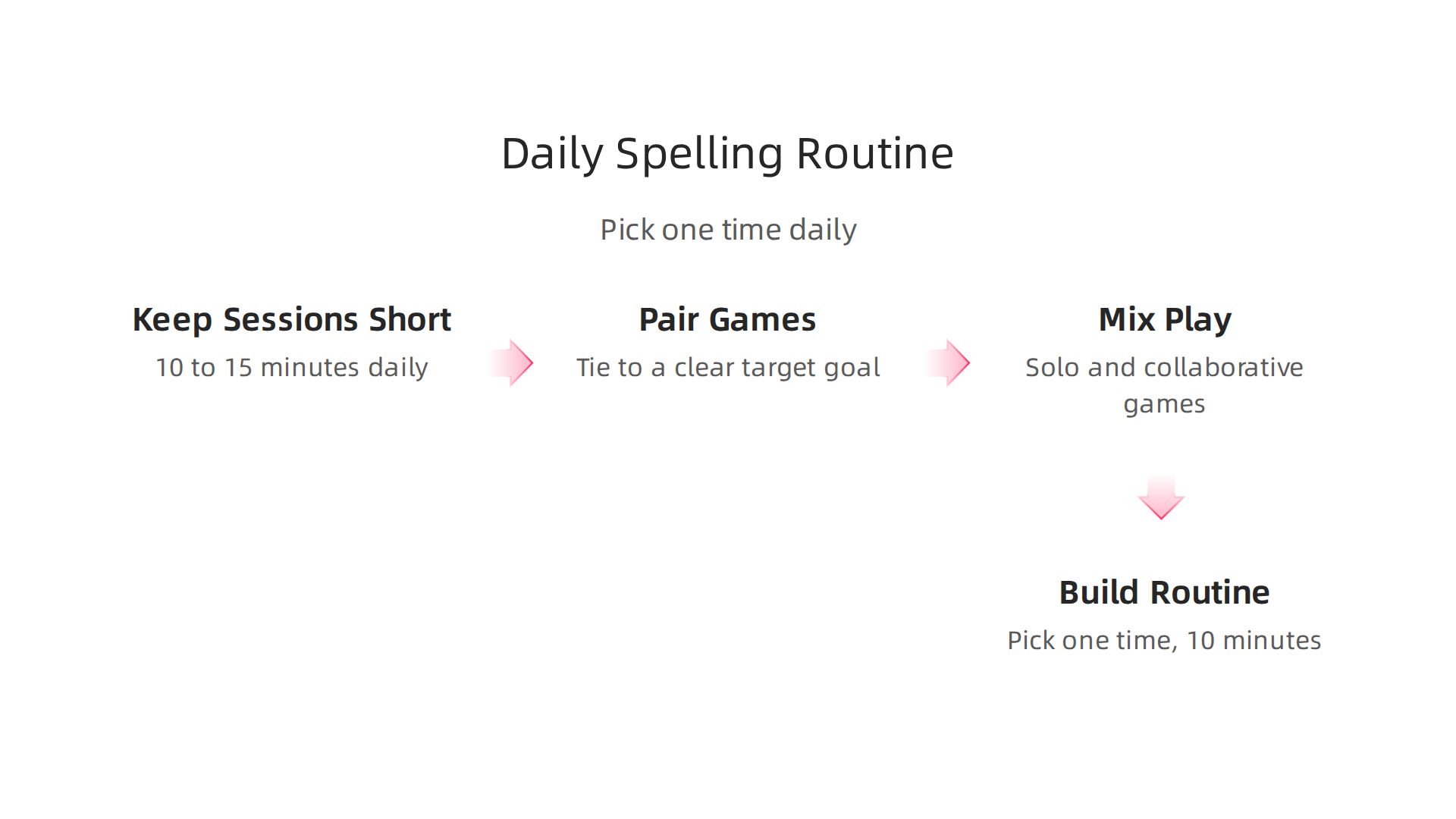
Open your spelling app and play for exactly 10 minutes. Set a timer if you need to. After the session, write down three words that gave you trouble and say them out loud three times.
That is it. No complicated system. No pressure to be perfect. Just a small, repeatable habit that compounds over time.
If you want to understand how value and reinforcement shape the way your brain holds onto information, take a moment to Use Reinforcement Smarter. It helps explain why these small daily habits are so powerful.
And for more ideas on how online spelling games improve working memory and verbal fluency, check out this detailed guide on online spelling games that improve working memory. Your daily practice will feel even more purposeful when you see how deeply it connects to your overall brain health.
Measuring Progress: Analytics and Feedback in Spelling Apps
Here is a truth that might sting a little. You can play spelling games every single day and still not improve much if you never stop to check how you are actually doing. The apps that produce real results are the ones that show you your progress clearly and correct your mistakes the moment you make them.
Detailed Dashboards Show You the Full Picture
Good spelling apps give you a dashboard that acts like a personal report card. You can see exactly how many words you have mastered, which words you keep getting wrong, and how your accuracy has changed over the last week or month.

Instead of guessing where you stand, you have a clear visual map of your learning. You know which words need more attention and which ones you can set aside.
When you can see your weak spots at a glance, you know exactly where to focus your next session. That turns a random game session into a targeted practice drill.
Immediate Feedback Trains Your Brain Faster
The biggest advantage of digital spelling games over old-fashioned paper quizzes is the instant feedback. The moment you type a wrong letter, the app tells you. Some apps even highlight the exact mistake and show you the correct spelling right away.
This immediate corrective feedback matters because it stops incorrect patterns from becoming habits. Research on how to make spelling practice more effective shows that analyzing your errors as they happen leads to much better long-term retention than simply copying words over and over. When you catch a mistake in the moment, your brain encodes the correct version more deeply.
Longitudinal Analytics Help You Adjust Your Strategy
The real power of analytics comes from looking at the big picture over time. A good app tracks your performance across weeks and months. You can see trends. Maybe your accuracy dropped this week because you were tired. Maybe you have plateaued on a certain set of words and need to switch to a harder list.
Longitudinal data helps you make smart decisions about your practice. You are not just playing blindly. You are fine-tuning your approach based on real numbers. That level of awareness keeps you moving forward week after week.
For more on how progress tracking can supercharge your learning, take a look at the best memory apps for 2026, which include built-in analytics features that work the same way as the best spelling apps.
Overcoming Common Challenges with Spelling Games
Spelling games are powerful tools, but they are not perfect. A few common problems can slow you down if you are not aware of them. Let us look at the biggest challenges and how to handle them.
The Trap of Playing Without Learning
Here is the first risk. Some spelling games are so flashy and fun that you stop paying attention to the actual words. You click buttons, collect points, and level up. But are you really learning? Over-gamification can replace deep thinking with shallow tapping.
The fix is simple. Look for games that make you actively think about each word. Games that ask you to type the full word, not just choose from multiple choices.

Research on how to make spelling practice more effective shows that games work best as a practice and reinforcement tool after direct instruction, not as a replacement for it. Balance the fun with real effort. If a game feels too easy or too flashy, switch to one that challenges your brain more.
Screen Fatigue Is Real
Staring at a screen for too long wears you out. Your eyes get tired. Your focus drops. After a long day of work or school, another digital game might feel like a chore.
The best solution is to mix things up. Try offline spelling games that give your eyes a break. You can write words in the air with your finger. Use index cards for a memory match game. Play a spelling relay race where you run to a board and write one letter at a time. Offline alternatives keep your brain active without adding more screen time. For more ideas, try some brain games for adults that work both online and offline.
Everyone Learns Differently
Some people have dyslexia or other language processing differences. Fast-paced spelling games can feel overwhelming. The timer ticks down. Letters blur together. The pressure makes it harder to focus.
If that sounds familiar, choose games with flexible settings. Look for options to slow down the game speed. Turn off timers completely. Use games that read the word out loud so you can hear it before you type it. Audio support makes a huge difference for many learners. Games that let you repeat a word as many times as you need are better than games that rush you.
Remember, the goal is to learn, not to win a race. Adjust the settings until the game feels comfortable. When you remove the pressure, your brain can actually focus on the spelling patterns.
Expert Tips for Maximizing Learning with Spelling Games
You have your game picked out. You know the common traps to avoid. Now let us talk about how to make every session count. Here are three expert-backed strategies that turn casual play into real learning.
Combine Typing with Handwriting
Typing words into a game is good. Writing them by hand is even better. Here is why. When you write a word with a pen or pencil, your brain engages motor memory. That physical motion helps lock the spelling into your long-term memory. It is the same reason teachers have students trace letters in sand or shaving cream. The movement adds a second pathway for recall.
So here is the trick. After you spell a word correctly in your game, grab a notebook and write it down once or twice.
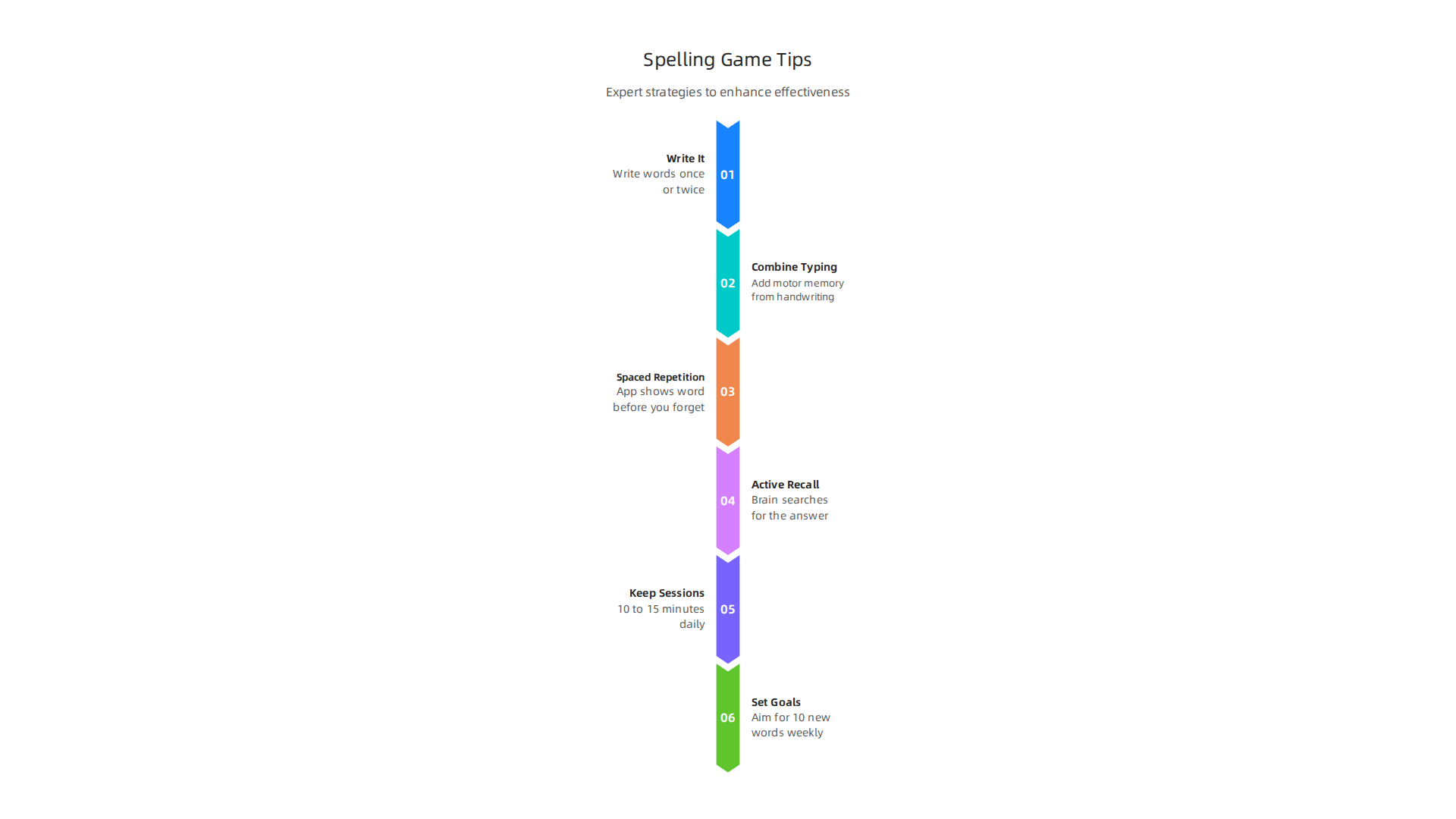
You get the fast feedback from the game plus the motor memory boost from handwriting. Studies show that movement-based games that improve spelling work because they connect physical action with mental effort. Try this combo and watch the words stick better.
Use Spaced Repetition Settings
Many spelling apps have a hidden superpower: spaced repetition. This setting makes the app show you a word right before you are about to forget it. The timing is key. If you review a word too soon, you waste effort. If you wait too long, you forget it completely. Spaced repetition finds the sweet spot.
Look for apps that let you set this feature. Some games automatically flag misspelled words and bring them back more often. Others let you create custom review lists. When you see a word you got wrong, do not just move on. Let the app quiz you on it again in an hour, then tomorrow, then next week. Research on effective spelling games in the classroom recommends using this kind of adaptive difficulty to reinforce tricky words. Your brain builds stronger connections when the review is timed just right.
Set Small, Achievable Goals
It is easy to think, "I will play for an hour and learn 50 new words." That never works. Your brain needs time to process and store each new spelling pattern. The smarter approach is to aim for 10 new words per week. That is about two new words per day if you play Monday through Friday.
Treat your game session as practice, not competition. The goal is not to beat a high score. The goal is to spell those 10 words correctly from memory a week from now. When you focus on mastery instead of speed, you learn faster in the long run. For more ideas on building a daily practice, check out online spelling games that improve working memory and verbal fluency. They can help you build a routine that sticks.
Small wins add up. Ten words this week. Ten more next week. In a month, you have mastered 40 words. That is real progress. And it feels a lot better than rushing through 100 words and forgetting 90 of them.
Summary
This article explains how modern digital spelling games use cognitive science—especially spaced repetition and active recall—to improve memory retention for learners of all ages. It summarizes why gamified feedback, multisensory practice, and adaptive scheduling beat passive study, and describes the main types of spelling games (puzzles, adaptive bees, dictation) and what each trains. You’ll find practical recommendations for top tools in 2026, including paid and free options, plus guidance on choosing the right app for kids or adults. The piece also shows how to integrate short daily sessions into real routines, combine handwriting with typing, and use app analytics to measure real progress. Common challenges like over-gamification, screen fatigue, and different learning needs are addressed with clear fixes. Finally, expert tips explain how to set small goals and use spaced-repetition settings so your practice leads to lasting results.