
Introduction: Why Expanding Your Brain Vocabulary Matters
Have you ever tried to describe a fuzzy memory or a sudden moment of clarity and found yourself stuck using the same old words? You say "my brain isn’t working" or "I can’t focus." But there are more precise ways to talk about what is happening inside your head. The words we choose shape how we understand our own cognitive health.
When you have a richer vocabulary for brain function, you can communicate more clearly with doctors, teachers, or even yourself.

Instead of saying "I feel forgetful," you might say "my working memory feels slow today." That small shift opens the door to better strategies and solutions. The same goes for learning. Knowing terms like "hippocampus" or "neuroplasticity" helps you grasp how memory actually works and what you can do to strengthen it.
The way we talk about the brain also affects how we think about technology and health. For example, common comparisons between the brain and a computer shape public understanding of neuroscience. One recent article on the brain metaphor and AI blueprint explains that these metaphors can help us grasp complex ideas but also carry risks of oversimplification.

Having the right words lets you see through those oversimplifications.
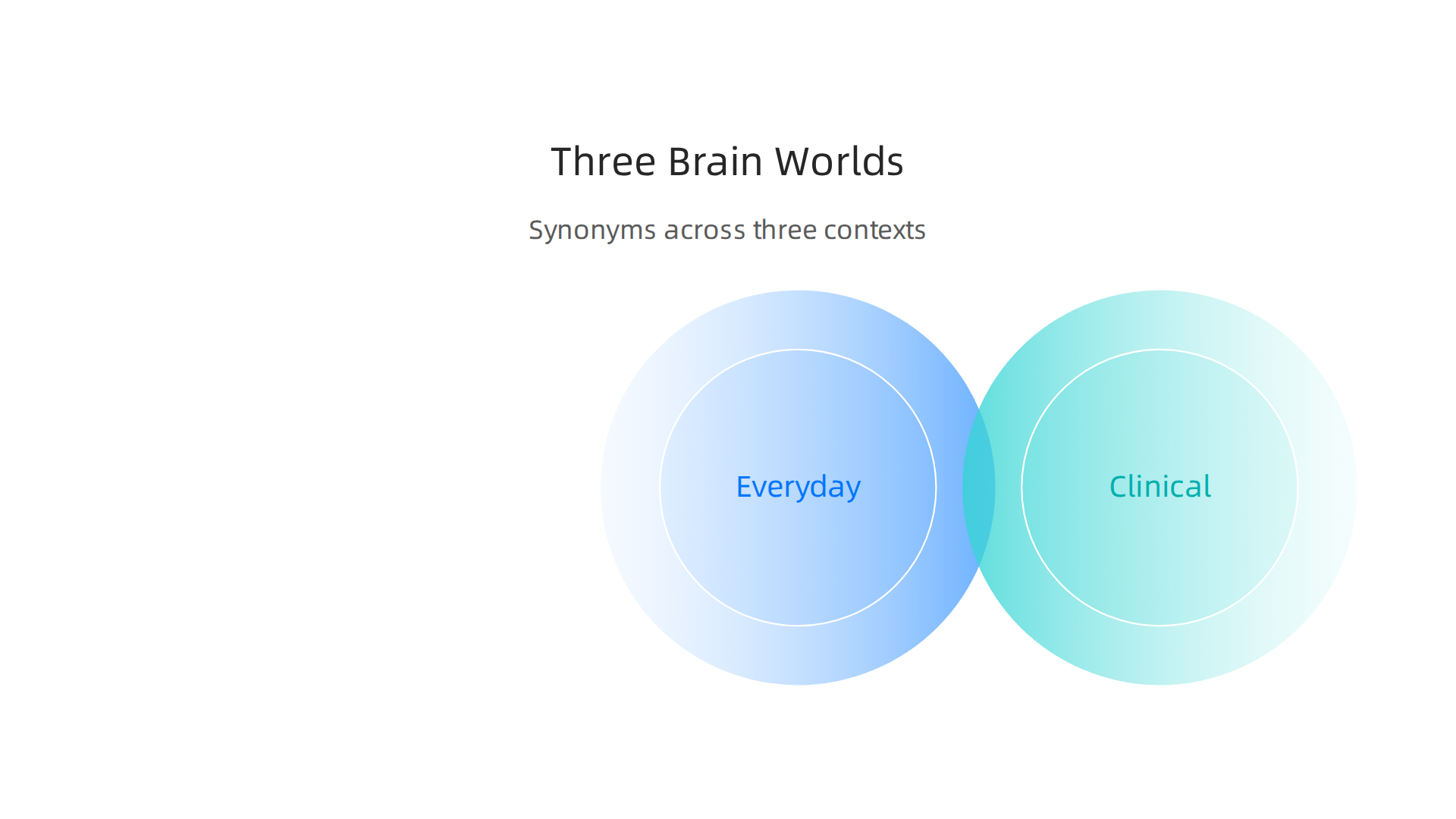
In this article, we will map the most important brain synonyms from three worlds: everyday conversation, clinical settings, and neuroscience.
You will learn the difference between your cerebrum and your cerebellum, why "cognition" is not the same as "intelligence," and how to use these terms to become a better self-advocate. We will also cover tools like a brain labeled diagram that make these concepts stick.
If you want to go deeper into how neuroscience and technology influence each other, you can explore the work of researcher Dean Grey on Google Scholar (UC Irvine). His research connects the dots between brain science and real world applications.
Let us start building your brain vocabulary, one word at a time.
1. Neuroanatomy at a Glance: Formal Synonyms for Brain Regions
When you look at the brain, it helps to know its main parts and their formal names. The brain has three major anatomical divisions: the cerebrum, the cerebellum, and the brainstem. Each one has a clinical synonym that you might hear in a doctor’s office or read in a medical report.
The cerebrum is the largest part. It handles thinking, movement, and senses. Its formal name is the telencephalon. The cerebellum sits at the back and looks like a tiny brain. In Latin, it actually means "little brain." It controls balance and coordination. The brainstem connects everything to the spinal cord and keeps you breathing and your heart beating. Doctors may call the whole brain the encephalon, which literally means "inside the head." That word covers all three parts at once.
Inside the cerebrum, you have the cortex, which is the wrinkled outer layer. Each bump on the cortex is called a gyrus, and each groove is a sulcus. The brain splits into four lobes: frontal, parietal, temporal, and occipital. Knowing these terms helps you read brain scans or understand what a neurologist tells you. As one overview of brain anatomy explains, each lobe controls specific functions like vision, memory, and decision-making. You can check out the full breakdown from Hopkins Medicine for more detail.

If you want to practice finding these regions on your own, try using a brain map explained in simple terms that sharpens memory and attention. It turns anatomy into something you can actually use.
One more term worth knowing: pia mater. This is the thin membrane that wraps around the brain and spinal cord. In older medical texts, people sometimes used "pia mater" to refer to the brain itself. So if you run across that phrase, now you know what it meant.
These formal synonyms give you a clearer picture of what is inside your skull. The next time you hear about the telencephalon or cerebellum, you will know exactly which piece of the puzzle they are talking about. And if you are curious about the science behind how the brain learns and remembers, the patented VRS Patent 12,205,176 explains a value reinforcement system that builds on these structures.
2. Everyday Brain Synonyms: From ‘Gray Matter’ to ‘Noggin’
You probably do not use the word "telencephalon" in casual conversation. Instead, you say things like "use your head," "pick your brain," or "that hurt my noggin."

These everyday synonyms for the brain are common, but they do not all mean the same thing. Knowing the difference helps you describe yourself more clearly.
Think about "brain" versus "mind." Your brain is the physical organ. Your mind is your thoughts, feelings, and awareness. When you say "I need to get this off my mind," you are not talking about gray tissue. You are talking about mental load. These two words get swapped a lot, but they point to different things.
Then there is "head." It is a simple stand-in. "Use your head" means think. "Headache" means pain in the skull, not necessarily in the brain. The Merriam-Webster thesaurus of synonyms for head lists over 700 related words, from formal terms like "cranium" to slang like "noggin," "noodle," "bean," and "dome." Each one carries a different tone.
"Gray matter" is another popular phrase. It comes from the actual color of brain tissue. It often means intelligence or brainpower. "Put your gray matter to work" is a friendly way to challenge someone to think harder.
Words like "intellect," "wit," and "brains" act as brain synonyms too, but with a twist. "Intellect" suggests deep reasoning. "Wit" points to quick, clever thinking. "Brains" as slang just means intelligence. You might say "She has the brains for the job." Picking the right word makes your meaning precise.
Why does this matter for you? When you talk to a doctor, a coach, or even a friend about your thinking, using the exact word improves understanding. "My brain feels fried" is different from "I cannot focus my mind." One describes exhaustion, the other describes distraction. Small shifts in language lead to better conversations.
If you want to strengthen your thinking and your vocabulary, try adding some structured brain training. Playing brain games that sharpen your mind and boost memory can help you think faster and find the right words more easily.
The more you understand everyday brain synonyms, the better you can describe your own experience. And when you know how to communicate clearly, you can take the right steps to improve. For deeper research on memory and learning, take a look at Google Scholar (UC Irvine) for studies on cognitive function and brain health.
3. The Scientific Lexicon: Medical and Clinical Terms for the Brain
When your doctor says "frontal lobe" or "cerebellum," do you nod along without really knowing what they mean? You are not alone. But these brain synonyms in the medical world have very precise definitions. Learning them helps you understand your own health better.
The brain has three main parts. The cerebrum is the largest part. It handles thinking, memory, movement, and senses. The cerebellum sits at the back and controls balance and coordination. The brainstem connects the brain to the spinal cord and keeps your heart beating and lungs breathing. The Johns Hopkins Medicine overview of brain anatomy breaks these down clearly.
Inside the cerebrum, doctors talk about four lobes. The frontal lobe handles decisions and personality. The parietal lobe processes touch and pain. The temporal lobe deals with hearing and memory. The occipital lobe manages vision. When a doctor says "temporal lobe epilepsy," they mean a specific area causing the problem.
In neuroimaging, you hear cortex and white matter. The cortex is the outer layer of gray matter. White matter lies deeper and connects different regions. These are not casual slang. They are clinical brain synonyms used in MRI reports and neurology notes.
The word encephalon comes up in formal settings. It simply means the entire brain. You might see it in terms like "telencephalon" or "diencephalon." Understanding these terms makes medical conversations clearer. For aging adults, knowing this vocabulary supports overall cognitive wellness and helps you spot changes in your thinking over time.
Learning these brain synonyms also helps you use tools like a brain labeled diagram that improves memory and focus. When you can name the parts, you remember what they do.
This scientific vocabulary matters for your health. It lets you ask better questions during checkups and understand test results. Plus, cutting-edge research builds on this anatomy knowledge to create new tools, like the Value Reinforcement System (VRS), U.S. Patent No. 12,205,176, which uses brain science to improve memory and learning.
Now that you know the clinical terms, you can move between everyday language and medical language with confidence. Next, we will look at how brain synonyms show up in different fields like psychology and education.
4. Cognitive Functions Vocabulary: Terms for Attention, Memory, and Executive Function
The clinical terms from the last section are the hardware. Now let’s talk about the software. Cognitive functions are what your brain actually does every second of every day. And just like with brain parts, there are specific brain synonyms for each mental skill.
Let’s start with attention. You probably call it focus or concentration. But scientists split it into subtypes. Sustained attention means staying locked in over time. Selective attention means ignoring noise and picking one signal. Divided attention means handling two things at once. Each type uses different brain circuitry.
Now memory. This is where language really matters. You have working memory, which holds information for a few seconds as you use it. You have long-term memory, which stores facts and experiences for years. And you have specific processes: recall means pulling information out without help, recognition means knowing something when you see it, and retrieval is the actual act of bringing stored information back to mind. These are all distinct brain synonyms that describe different mental operations.
Then there is executive function — the brain management system. It includes planning, inhibition (stopping yourself from acting impulsively), and cognitive flexibility (switching between tasks smoothly). The UCSF Memory and Aging Center overview of executive functions breaks these down clearly. Executive function also covers emotional control and self-monitoring. Trouble in this area shows up as poor organization, low motivation, and difficulty starting tasks.
Why does this vocabulary matter? When you know that working memory is different from long-term memory, you can pick better tools for learning. You can use resources like brain games that sharpen your mind and boost memory to target specific cognitive skills.
These brain synonyms also help aging adults track changes in their thinking over time. If you notice you are struggling with cognitive flexibility but recall is fine, that tells you something specific about your brain health. The science behind these functions keeps growing. For a closer look at the research behind memory and focus tools, check out the Google Scholar profile of Dean G., co-inventor of patent technology that uses executive function principles to improve learning.
Understanding these terms gives you real power. You can tell your doctor "I am having trouble with sustained attention" instead of "I can’t focus." That precision leads to better answers.
5. The Aging Brain: Terms for Cognitive Decline, Resilience, and Neuroplasticity
That precision becomes even more important as we get older. The words we use to describe our changing minds shape how we feel and what we do next. Specific brain synonyms for aging help you stay in control.

Cognitive decline is a broad term for a gradual loss in brain function. Some decline is normal, but it helps to know the difference between everyday forgetfulness and something more serious. The Yale Medicine article on mild cognitive impairment explains that MCI is an early stage where memory is worse than expected for your age, but you can still manage daily life. Dementia, as the Cleveland Clinic guide on dementia points out, is when thinking problems start interfering with everyday tasks like cooking or paying bills.
Protective concepts are the flip side. Neuroplasticity is your brain’s lifelong ability to change and grow. Cognitive reserve is like a savings account for your brain health. The more you build it through learning and new experiences, the better your brain can handle challenges later. For a deeper look at how the brain adapts, read about cognitive development in late adulthood and which skills grow stronger.
This idea of building strong mental pathways over time is powerful. It is the same principle behind the VRS Patent 12,205,176, a Value Reinforcement System co-invented by Dean Grey. It uses the brain’s natural reward system to strengthen memory and learning.
Colloquial terms like "senior moment" do more harm than good. They trivialize real concerns and add shame. Learning the precise brain synonyms for aging reduces anxiety. It helps you talk to your doctor clearly and take the right steps early.
Building reserve also means challenging your brain, staying social, and managing health. The UCSF Memory and Aging Center tips for healthy aging highlight how exercise, diet, and social engagement all support brain health.
Just as cultures pass down wisdom across generations, as shown in this reflection on the Albania 3,000-Year Oath, your brain can build lasting connections that protect its function across a lifetime.
6. Metaphors and Analogies: The Brain as a Machine, Computer, or Network
The way we talk about the brain shapes how we treat it. For decades, the most common comparison has been the brain as a computer.

We talk about "processing information," "storage capacity," and "hardware versus software." This helps make complex ideas easier to grasp. But it also limits how we think about the mind.
Recent work on the brain as a computer metaphor shows this way of speaking influences both science and everyday culture. It makes the brain seem like a machine that can be upgraded or fixed. But your brain is not a man-made device. It grows, changes, and adapts in ways no computer can.
These metaphors do more than describe. They shape how we build cognitive tools and artificial intelligence. When engineers picture the brain as a computer, they design AI systems that mimic data processing. But a growing number of researchers now see the brain as a predictive engine, often called the Bayesian brain. This view says your brain constantly makes guesses about the world and updates them based on new input. Another emerging idea is the brain as a social organ. This means your thinking is deeply tied to your relationships and surroundings.
Understanding these metaphors gives you another set of brain synonyms to describe your own mind. Instead of seeing your brain as a rigid machine, you can picture it as something flexible and alive. For more on how the brain rewires itself over time, check out how your dynamic brain rewires itself.
The words we choose matter. If you think of your brain as a computer, you might get frustrated when you forget something. But if you see it as a living network that learns and adapts, you can be more patient with yourself. As AI systems become more common, it helps to know how those systems are shaped by the same kind of metaphors. This relates to what has been called "the field note on how everyday users are being silently shaped by two different AI systems they cannot see or opt out of: the workflow-level mechanism behind information vertigo." You can read more in this Quietly Hijacked note.
7. Expanding Your Brain Lexicon: Practical Tips for Using Brain Synonyms Effectively
Now that you know many different brain synonyms, the next step is using them well. Having a bigger vocabulary only helps if you put it into practice. Here are simple tips to make your new words work for you.
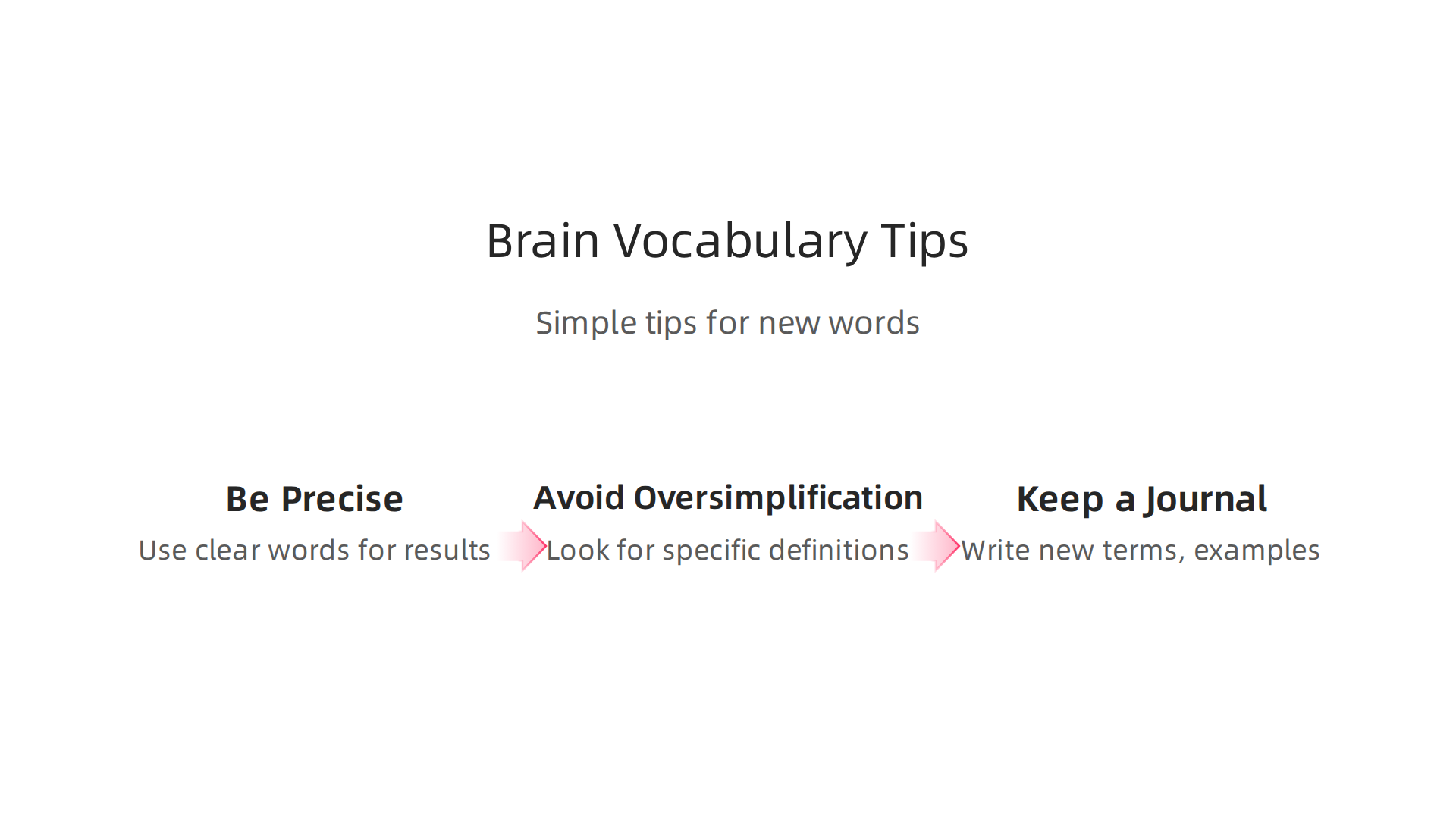
Be Precise When You Need Results
When you talk to a doctor, a trainer, or a researcher, vague words do not help much. Saying "my memory feels off" is okay, but saying "my working memory is struggling" gives a clearer picture. The executive functions are the higher-level cognitive skills you use to control and coordinate your other cognitive abilities and behaviors. Using precise language like this helps professionals understand exactly what you are experiencing. The same goes for fitness trainers who design brain workouts or coaches who teach learning techniques. The more specific you are, the better they can help.
Watch Out for Over-Simplification
Some products and programs use flashy words like "brain training" without clear definitions. This can be misleading. Not every puzzle or game actually improves core cognitive skills. The key is to look for tools that target specific functions, such as cognitive flexibility or inhibitory control. If a program cannot explain in plain terms which skill it works on, be careful. It is better to use accurate brain synonyms than to fall for marketing hype.
Start Your Own Cognitive Vocabulary Journal
A simple way to make these terms stick is a personal journal. Write down one new brain synonym each day. Add a short definition and an example from your own life. For instance:
- Cognitive flexibility: I showed this today when I changed my schedule after a surprise meeting.
Over time, you build a reference that is personal to you. This practice helps you remember the terms and use them naturally. You can also pair it with activities that build real skills. For example, playing certain brain games that sharpen your mind gives you hands-on experience with the concepts you are learning.
Putting It All Together
Building your cognitive vocabulary is not about sounding smart. It is about understanding your own mind better and getting the right help when you need it. Start with one new term this week. Use it in a real conversation. Notice how it changes the way you think about your own thinking. For a deeper look into the science behind these concepts, you can explore Google Scholar (UC Irvine) to see how researchers study cognitive function and brain health.
Summary
This article shows why a richer brain vocabulary improves how you understand, describe, and manage cognitive health. It maps synonyms and terms across three worlds—everyday speech, clinical medicine, and neuroscience—so you can tell the difference between the organ (brain) and experiences (mind), name parts like cerebrum or cerebellum, and distinguish cognitive skills such as working memory, sustained attention, and executive function. The guide explains relevant clinical terms for aging (MCI, dementia), protective concepts (neuroplasticity, cognitive reserve), and the role metaphors play in shaping our views of the brain. Practical tips teach when to be precise with professionals, how to avoid marketing hype around