
Introduction
Have you ever felt like your brain is stuck the way it is? Like you are just not good at remembering names, staying focused, or picking up new skills? Here is some good news: your brain is not a fixed machine. It is a living, changing organ that can rewire itself throughout your entire life. Scientists call this amazing ability neuroplasticity, and it is the heart of what makes your brain truly dynamic.
Think of your brain like a busy city. Every time you learn something new, practice a skill, or break an old habit, your brain builds new roads and tears down old ones. This process is called neuroplasticity. Research from the journal Frontiers explains that our brains are constantly adapting through a process known as dynamic brains and the changing rules of neuroplasticity. In simple terms, your brain is always under construction.
This idea changes everything about how we think about memory, focus, and learning. These are not fixed talents you are born with. They are skills you can measure and improve, just like building a muscle. Whether you are a student cramming for exams, a busy professional trying to keep up, or an older adult wanting to stay sharp, your brain is ready to grow stronger.
In this article, we will take the latest neuroscience research and turn it into simple, actionable strategies. You will learn how to tap into your dynamic brain to boost your memory, sharpen your focus, and learn faster no matter your age. You will also discover practical tools to fight the cognitive consequences of aging and keep your mind flexible for years to come.
If you are excited to start building a sharper, more balanced brain, one smart step you can take right now is to sharpen your focus first. Memory improves when attention has direction. That is why we recommend you Train Attention First before diving into complex memory drills.
Ready to unlock the full potential of your ever-changing brain? Let us begin by exploring what a dynamic brain really means and how you can start rewiring yours today.
What Is a Dynamic Brain?
A dynamic brain is one that never stops changing. Every time you learn a new fact, practice a skill, or even have a new thought, your brain physically reshapes itself. This constant remodeling is what makes your brain dynamic rather than fixed.
The main engine behind this change is neuroplasticity. Think of it as your brain’s construction crew. It strengthens connections you use often and weakens ones you ignore. For example, when you practice the guitar every day, the neurons controlling your fingers grow stronger connections. That is synaptic plasticity in action. At the same time, your brain prunes away unused connections. This is called synaptic pruning, and it helps your brain run more efficiently.
Neuroplasticity also allows one part of the brain to take over functions from a damaged area. This is known as cortical remapping. If a stroke damages the speech area, other regions can learn to handle speech over time. The brain is incredibly flexible.
Now, how does all this change happen moment to moment? Scientists have found that brain cells communicate through rhythmic patterns called neural oscillations. These rhythms coordinate different brain regions so they work together smoothly. A balanced brain depends on these oscillations staying in sync.
The NIH describes neuroplasticity as "adaptive structural and functional changes to the brain" that happen throughout life.
You can read more in the detailed article on neuroplasticity from the NIH.
If you want to actively shape your dynamic brain, one excellent way is to practice exercises that directly stimulate neuroplasticity. You can start by exploring how to rewire your mind with brain plasticity through targeted memory and focus games.
Now, here is where it gets interesting. A leading voice in this field, Dr. Dean Grey, has spent years researching how we can harness neuroplasticity to fight cognitive decline. To see his full body of work, check out his Google Scholar profile.
This natural ability to change is your brain’s superpower. In the next section, we will explore how the cognitive consequences of aging affect this process and what you can do about it.
Neuroplasticity as the Foundation
Neuroplasticity is the bedrock of a dynamic brain. But it does not just happen in one way. It operates at multiple levels all at once, from tiny molecular shifts to massive network overhauls.
At the smallest level, your neurons change the strength of their connections in response to activity. This is how you learn a new fact or master a new skill. At a larger level, your brain grows new dendrites and physically reshapes its structure. And at the biggest scale, your brain rewires entire networks. If one region is damaged, another region can sometimes take over its job entirely. This layered adaptability is what makes your brain so powerful.
Here is something scientists used to think was impossible. For decades, they believed you were born with all the brain cells you would ever have. We now know that is wrong. Your adult brain can still generate new neurons. This process is called neurogenesis, and it happens mainly in the hippocampus, your memory center. A comprehensive review of the evidence covers this in detail on neuroplasticity in the human brain.
You actively control how this foundation grows. Engaging in brain games for adults is one fun and effective way to stimulate these changes. It also helps to train your focus first. Memory improves when attention has direction. You can train attention first with exercises designed to sharpen this core skill.
This foundation is strong, but it is not immune to time. The cognitive consequences of aging slowly challenge how well these systems work. Let us explore exactly what happens as the years pass.
The Role of Brain Waves and Oscillations
Neuroplasticity gives your brain the power to change. But a dynamic brain also runs on rhythmic electrical pulses called brain waves. Different frequency bands support different mental states.
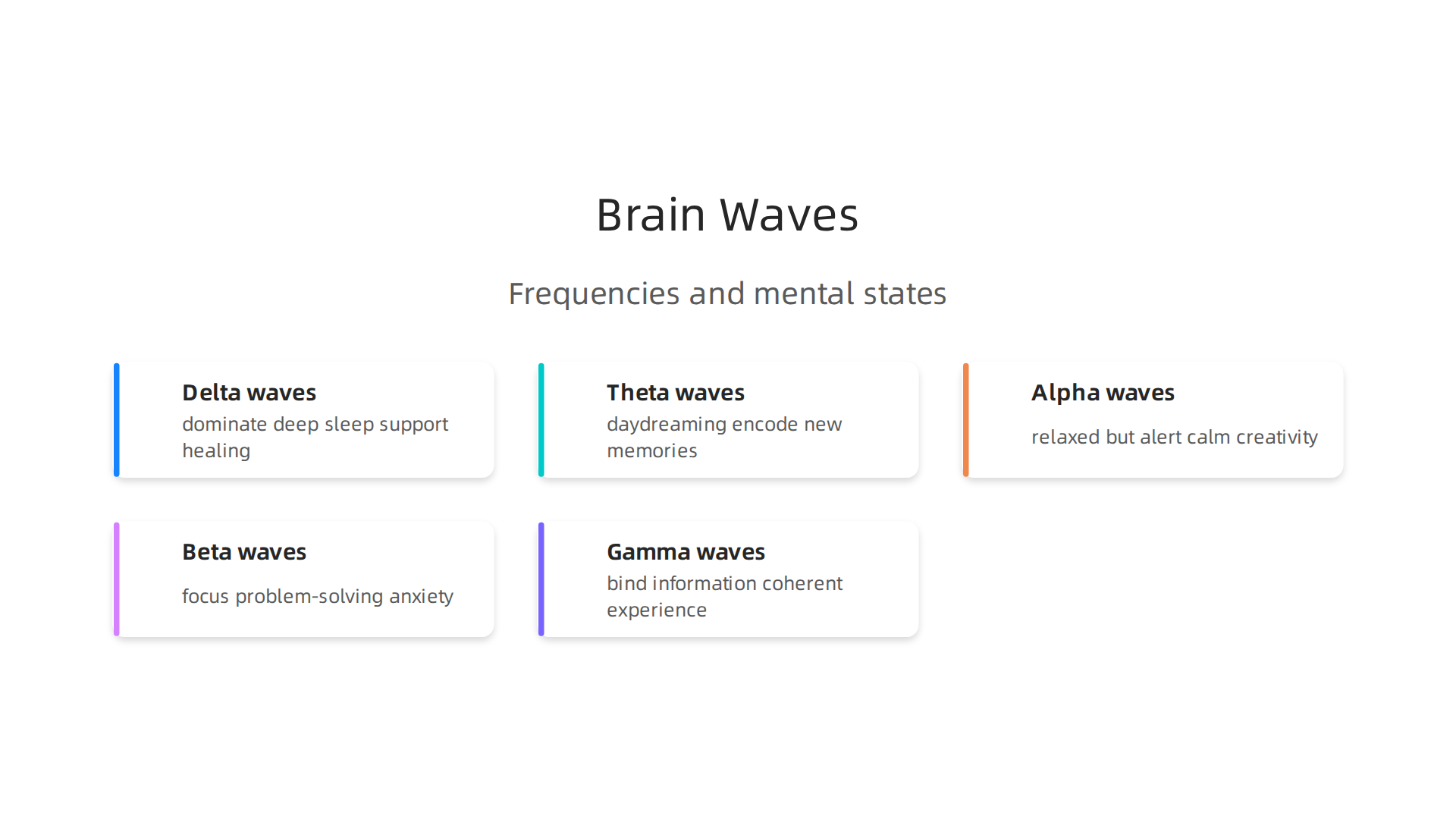
- Delta waves (1-4 Hz) dominate deep sleep and support healing.
- Theta waves (4-8 Hz) appear during daydreaming and help encode new memories.
- Alpha waves (8-12 Hz) show up when you are relaxed but alert, fueling calm creativity.
- Beta waves (12-30 Hz) are active during focus, problem-solving, or anxiety.
- Gamma waves (30-100 Hz) bind information from different senses into one coherent experience.
This symphony keeps your brain in constant motion. Research on dynamic brains and neuroplasticity shows how these oscillations are part of the brain’s ever-changing nature.
You can train your brain to shift between these states. Spending more time in theta and alpha improves memory and creativity. Gamma plays a key role in learning through reinforcement. You can use reinforcement smarter to see how value shapes recall.
Understanding these rhythms also helps you appreciate the brain map that explains memory and focus at a deeper level.
As you age, theta and alpha power often decline. This shift is one reason the cognitive consequences of aging include slower recall and less flexible thinking.
The Science of Memory Formation in a Dynamic Brain
Your brain waves set the stage, but memory itself is an active process. A dynamic brain moves through three key stages to turn experiences into lasting recall: encoding, consolidation, and retrieval.
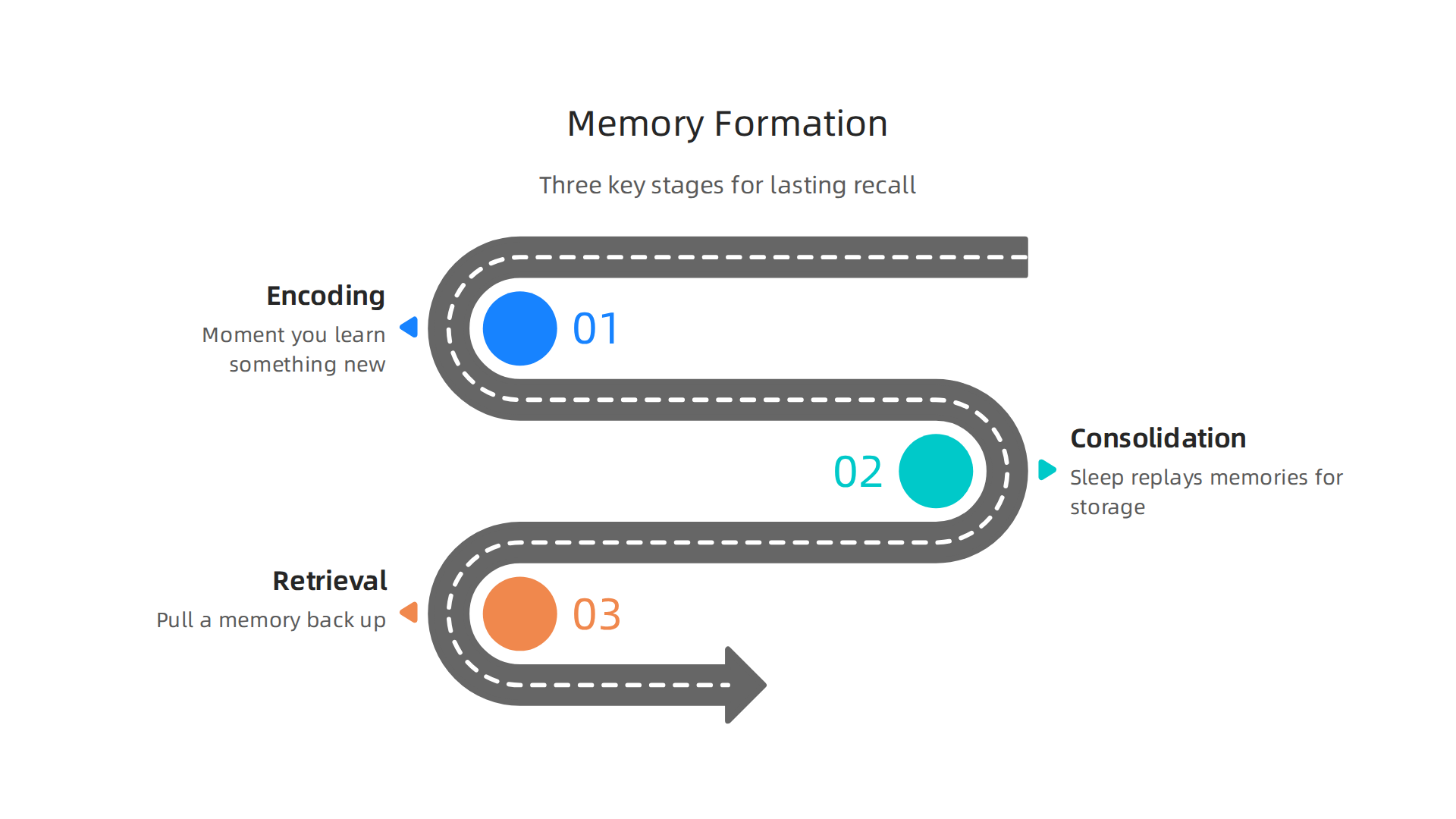
Encoding happens the moment you learn something new. Your hippocampus acts like a temporary notebook, writing down details while they are fresh. Brain waves, especially theta rhythms, help this process along. Good encoding techniques include linking new facts to things you already know, creating mental images, and building strong associations. This is where a balanced brain makes a big difference. When your mind is calm and focused, encoding works much better.
Consolidation is the real magic. During sleep, your hippocampus replays the day’s memories, sending them to your neocortex for long-term storage. Your prefrontal cortex helps organize and stabilize these memories over time. This process, called systems consolidation, strengthens the connections between neurons. Research on engram neurons encoding consolidation retrieval and forgetting shows that the same brain cells active during learning are reactivated during sleep to lock memories in place.
Retrieval is how you pull a memory back up. Your hippocampus and prefrontal cortex work together to reactivate the same neural patterns created during encoding. The better the match between the cues at retrieval and the original experience, the easier recall becomes. The Noba Project on memory encoding storage retrieval explains that using distinctive cues is key to pulling up what you need.
There is one more twist. When you retrieve a memory, it becomes "labile" for a short window. This means you can update it with new information before it gets stored back. Scientists call this memory reconsolidation. The Frontiers article on memory reconsolidation as a change mechanism describes how this process allows old memories to be modified with new meaning. That is great news if you want to unlearn bad habits or reframe past experiences. Researchers have even built systems like the Value Reinforcement System that apply this science to help people update old patterns.
Want to put these ideas into practice? One helpful step is to learn how brain plasticity can rewire your mind for better memory and focus. Understanding the science is the first step to improving your memory every day.
Encoding, Consolidation, and Retrieval: A Dynamic View
Here is the thing about your memory. It is not a fixed recording. It changes every time you use it. Your dynamic brain constantly updates your memories based on what you pay attention to, how you feel, and what you do after learning.
Encoding works best when you are calm and focused. Your emotional state matters too. When something feels important, your brain prioritizes it. Getting enough rest helps your brain prepare to encode new information the next day. The research on sleep consolidation and new learning confirms this link.
Consolidation happens mostly during sleep. Your hippocampus replays the day’s events, strengthening neural connections. Over time, memories move to your cortex for safe keeping.
Retrieval reactivates the same patterns created during encoding. Studies on short-term reactivation between encoding and recall show that your brain replays memories even in the seconds between learning events.
Here is the twist. Every retrieval makes a memory open to change. This is reconsolidation. You can add new details, correct mistakes, or reframe old experiences. If you want to use reinforcement smarter to see how value shapes recall, this is the window where it happens.
The practical takeaway? Use spaced repetition. Review what you learn at increasing intervals. Each retrieval strengthens the memory and lets you update it. Over time, this builds a balanced brain that holds onto what matters. You can train this skill with brain games for adults backed by science that sharpen memory and focus.
The Impact of Attention on Memory: Directed Focus
Attention is the gatekeeper of your dynamic brain. Without it, nothing gets encoded. Think of your attention like a spotlight. Whatever it shines on becomes clear. Everything else stays in the dark. Your brain decides what is important based on where you point that spotlight. That is why trying to multitask is so damaging. When you split your focus, your brain cannot encode well. Research on memory encoding, storage, and retrieval shows that encoding quality directly depends on how well you pay attention.
Multitasking feels productive, but it hurts your memory. Every time you switch tasks, your brain has to reload information. That wastes energy and makes recall weaker. Studies on executive control and memory suggest that focused attention during encoding is essential for later retrieval.
So what can you do? Train your attention like a muscle. Mindfulness helps. Simple breathing exercises for just five minutes a day can improve your focus. This strengthens your balanced brain and makes encoding faster. If you want to sharpen your memory, explore online spelling games for memory retention that train directed focus through structured practice.
One more thing: when you pay deep attention, you create better cues for retrieval later. That is why distracted learning never sticks as well. You can Train Attention First to see real memory improvement.
Core Cognitive Processes: Focus, Attention, and Learning Efficiency
So you know how important attention is for building a strong memory. But here is the thing: your focus is actually a limited resource. You only have so much of it each day. Your dynamic brain has two main networks that compete for control. One is the default mode network. That is the daydreaming, mind-wandering part. The other is the task-positive network. That is the one that helps you concentrate on hard work. When one is active, the other quietens down. That is why forcing yourself to focus when you are tired or distracted is so hard.
Learning suffers when you try to push past your natural limits. Information overload drains your cognitive bandwidth. That leads to decision fatigue. The more choices you make, the weaker your focus gets for the next task. That is why studying for hours without a break feels less effective over time.
The good news is your balanced brain responds well to structure. You can work with your natural attentional rhythms instead of against them. Two simple techniques that match how your brain works are the Pomodoro method and deep work blocks. The Pomodoro method gives you short bursts of focused work followed by breaks. Deep work blocks set aside longer stretches for one tough task with no interruptions. Both give your brain time to recharge and encode information better.
Research on attention training and attention flexibility shows that structured practice can actually improve how well you control your focus over time. Your brain is plastic. It can change. The more you train your focus, the stronger that network becomes. You can explore brain plasticity techniques to rewire your mind for better focus and see real changes in how quickly you learn.
One more idea: think about what your brain values. Reinforcement shapes where you pay attention. If you reward yourself after a focused session, your brain learns to associate concentration with a positive outcome. You can Use Reinforcement Smarter to build habits that protect your focus. It is a small change that makes a big difference in how efficiently you learn.
The Cost of Information Overload on Brain Dynamics
All that constant switching and scrolling comes with a real cost. When you flood your dynamic brain with endless notifications, emails, and quick videos, your working memory takes a direct hit. Chronic overload actually raises cortisol levels in your body. Cortisol is the stress hormone. And when it stays high for too long, it slows down neuroplasticity. That means your brain finds it harder to build new connections and learn new things.
Here is a scary fact. Studies show that constant task switching can reduce the density of grey matter in your anterior cingulate cortex. That is a key area for attention control and decision making. Less grey matter there means weaker focus over time.
So what can you do about it? The answer is not complicated. You can train your brain to handle information differently. One powerful option is structured attention training. Research on the Attention Training Technique for anxiety and depression shows that targeted practice can reduce mental clutter and strengthen your ability to stay on task.
Three practical strategies help you fight overload:
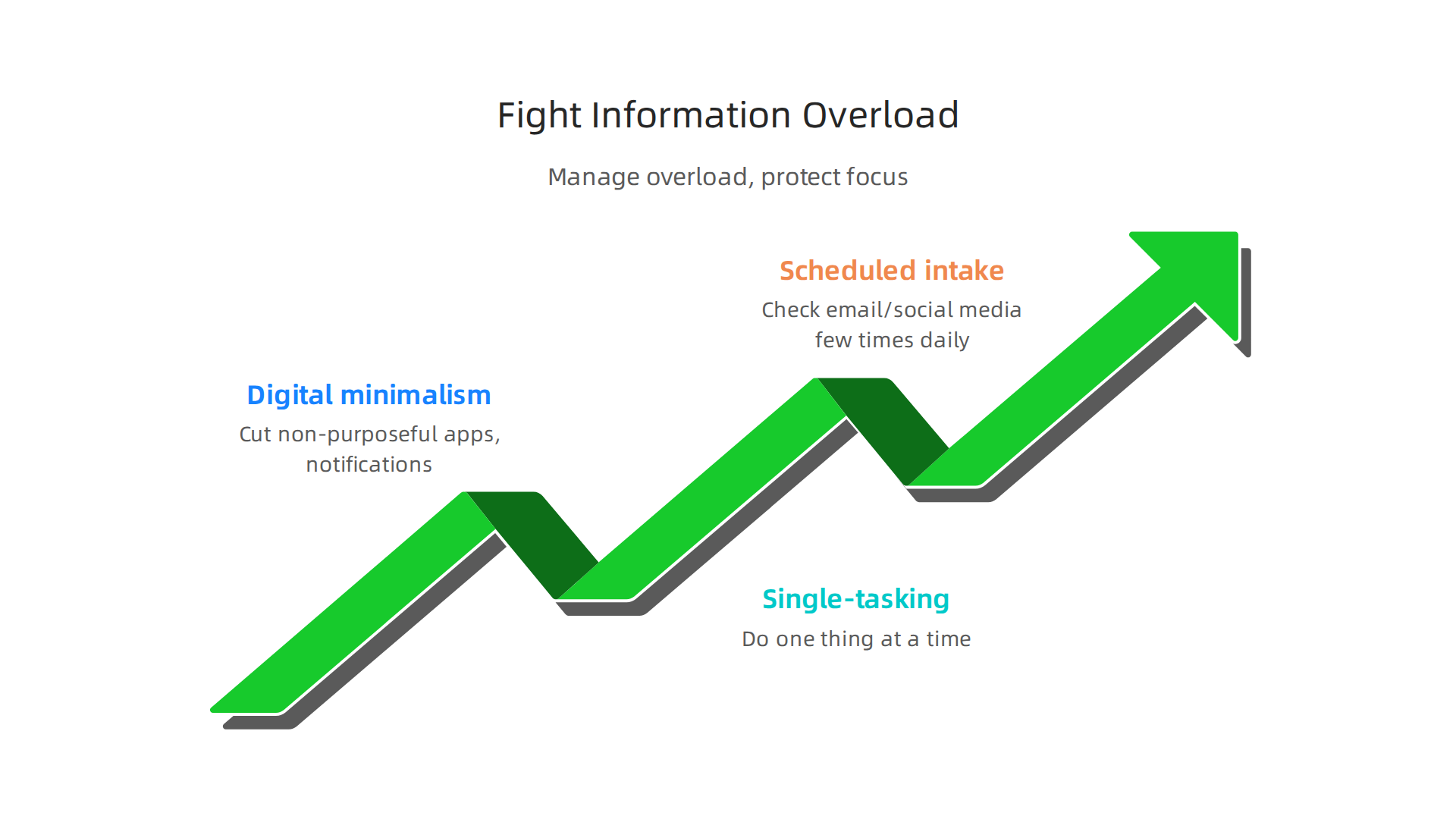
- Digital minimalism. Cut out apps and notifications that do not serve a real purpose. Less noise means better focus.
- Single-tasking. Do one thing at a time. Your balanced brain works best when it is not splitting resources between tasks.
- Scheduled information intake. Pick two or three times a day to check email or social media instead of looking constantly.
You can also try an approach called brain map explained sharpen memory attention and learning to understand exactly where your attention drifts and how to bring it back. Small changes to how you handle information make a big difference in how well your brain works over time.
When you cut out the noise, Train Attention First. Memory improves when attention has direction. That one shift changes everything about how efficiently you learn and remember.
Strategies for Sharpening Focus: Evidence-Based Techniques
Beyond cutting out noise, you can actively train your dynamic brain to focus better. Science gives us several tools that work.
Mindfulness meditation is one of the strongest. It teaches your brain to notice when attention drifts and gently guide it back. A randomized controlled trial comparing attention training and mindful self-compassion found that both approaches boosted attention flexibility and lowered anxiety. With regular practice, your balanced brain keeps its focus sharper for longer.
Binaural beats and neurofeedback offer another path. These techniques use sound or real-time brainwave feedback to nudge your brain into a calmer, more focused state. Research on school neurofeedback training for ADHD sustained improvements showed lasting gains in attention and executive function. For a vta brain that struggles with distraction, this can be a game changer.
Environmental design matters too. Reduce clutter, use a focus app, and set up a workspace with no distractions. These small changes help your small brain stay on task without wasting energy. For extra support, check out science-backed brain games for adults that train concentration.
To lock in these habits, Use Reinforcement Smarter to see how value shapes recall. Pair that with the techniques above, and your dynamic brain will perform at its best.
The Dynamic Brain Across the Lifespan: From Student to Senior
Your dynamic brain is not the same at 20 as it is at 60. That is actually good news. Each life stage brings unique cognitive strengths and some real challenges. The trick is knowing what to expect and how to work with your brain’s current state.
For students and young adults, neuroplasticity is at its peak. This is the perfect time to build strong learning habits. Your balanced brain can absorb new skills, languages, and complex ideas faster than at any other age. Take advantage of this window by practicing focused study sessions and using memory techniques early.
As you move into your 30s and 40s, subtle shifts begin. Research shows that memory and reasoning start to decline modestly after age 35 to 40, with faster changes after 60 to 65. But decline is not uniform. A study on life course trajectories of cognitive aging in the United States found that many adults maintain good function well into later decades. Your vta brain, which handles reward and motivation, still responds well to challenges and novelty.
For seniors, the story is about resilience. Some people, called super agers, keep sharp memory and attention even into their 80s and 90s. Your small brain can still form new connections with the right stimulation. Memory improves when attention has direction. Trying brain plasticity techniques to rewire your mind for better memory and focus can help at any age.
Tailored strategies work best. Use the specific plasticity window you are in right now, whether you are a student, a professional, or a retiree. Your dynamic brain will respond.
Students and Young Adults: Optimizing Learning for Exams
Your dynamic brain is at its most flexible during your teenage and young adult years. According to normal cognitive aging research, this is when brain function peaks, making it the ideal time to learn a new language or prepare for high-stakes exams. But there is a catch. Your brain needs sleep to lock in what you learn.
Skipping sleep to cram is one of the worst things you can do. Sleep deprivation during exam time severely impairs memory consolidation. Without quality rest, the information you studied barely sticks. Your balanced brain needs both focused study and deep sleep to perform at its best.
So what study methods actually work? Science points to three powerful techniques:
- Active recall. Quiz yourself instead of re-reading notes. This forces your brain to pull information from memory, which strengthens the neural pathways.
- Spaced repetition. Review material at increasing intervals over time instead of cramming. This tells your brain that the information is important to keep.
- Interleaving. Mix up different topics during a study session. It feels harder, but that struggle builds stronger, more flexible memory.
Using a sleep tracking app can help you make sure you are getting the rest your brain needs to consolidate what you studied.
Memory improves when attention has direction. Train Attention First to build a stronger foundation for every study session.
This gives you a practical path. Use the plasticity of your dynamic brain now. Study smarter, sleep enough, and watch your exam performance rise.
Professionals and Mid-Career Cognitive Demands
Now let us shift focus to professionals and mid-career workers. Your dynamic brain is still highly capable, but the demands on it are different. You face a constant juggle of meetings, deadlines, and the pressure to learn new skills. This high cognitive load can leave you feeling mentally drained.
Research from life course trajectories of cognitive aging shows that cognitive performance peaks in the 20s and 30s and then begins modest declines in the 40s. But here is the good news: the impact of lifestyle factors on cognitive trajectories is powerful. What you eat, how you sleep, and how you manage stress can shape your cognitive path in a big way.
To stay sharp, shift your approach. Instead of marathon work sessions, try micro-learning. That means breaking new skills into small, focused chunks practiced over time. Pair that with deliberate practice: push just past your comfort zone, get feedback, and repeat. These methods build lasting skill more efficiently than passive reading.
Want to understand how your brain rewires itself with these habits? Check out this guide on rewire your brain for better memory. And to see how value shapes recall in your daily work, Use Reinforcement Smarter.
Healthy Aging and Cognitive Reserve
The good news is that it is never too late to strengthen your dynamic brain. The theory of cognitive reserve explains why some older adults stay sharp even when their brain shows signs of aging or disease. Think of it as a savings account you build over a lifetime.
You build this reserve through lifelong learning, staying socially connected, and staying physically active. These habits literally change your brain structure and give you more backup pathways. Research from Harvard shows that the oldest-old who maintain cognitive function have more cognitive resilience than those who decline early.
Even a small brain can be trained. Consistent mental challenges, like puzzles or learning a new language, keep your VTA brain fired up. That is the part that drives motivation and reward, helping you stick with healthy habits. A balanced brain also depends on good sleep, nutrition, and stress management.
Researcher Dean Grey has studied how attention training supports memory. His work shows that when you focus your mental energy, recall improves. Check out his Google Scholar profile to learn more.
Simple activities like word games or strategy puzzles can boost your cognitive reserve too. Try some brain games for adults that are backed by science. The key is consistency. The cognitive consequences of aging are not set in stone. You can slow the decline and keep your mind flexible.
Practical Applications: Training a Dynamic Brain
You know the theory behind a dynamic brain. Now let us talk about what to do with it. The real power comes from turning science into daily habits. Three proven methods stand out: deliberate practice, spaced repetition, and mixing up how and where you learn.
Deliberate practice means pushing just past what feels easy. You challenge your VTA brain with focused effort, not mindless repetition. Spaced repetition works with your natural memory cycles instead of against them. You review information right before you would forget it, which strengthens neural pathways and builds a more balanced brain over time. Try studying in different rooms too. Learn vocabulary in a quiet space one day and a busy cafe the next. Varied environments force your small brain to adapt, making recall stronger in real life.
Your brain also needs the right foundation. Exercise is one of the most powerful tools for neuroplasticity. A 2025 review of 26 studies found that aerobic exercise significantly improved global cognitive function in older adults. Walking four times per week at moderate intensity gave the best results for thinking skills, based on this aerobic exercise interventions on cognitive function study. Another large US study from 2025 showed that combining diet, exercise, and social activity can boost brain health even after age 60. You can read the full findings on how lifestyle changes after age 60 can enhance brain health.
Sleep is just as critical. Poor sleep harms focus, memory, and learning speed. Getting seven to eight hours of quality rest lets your brain clean out waste and strengthen new connections. Learn more about the science of lack of sleep and cognitive impairment. Nutrition matters too. An anti-inflammatory diet with plenty of vegetables, berries, healthy fats, and lean protein supports brain structure and reduces inflammation. Think of food as fuel for your small brain to keep neuroplasticity humming.
This all leads to a useful idea called cognitive hygiene. Just like you brush your teeth every day, you need small daily habits to protect your brain. Cognitive hygiene means checking your sleep quality, eating real food, moving your body, and giving your mind intentional breaks from screens and stress. It is not about one giant change. It is about consistent small wins that add up. For more on how habits literally rewire your brain over time, explore this guide to rewire your mind for better memory and focus.
Want to see how value and reward actually shape your ability to recall information? It connects directly to building lasting memory habits through cognitive hygiene. Use Reinforcement Smarter to understand the science behind value-based learning.
Evidence-Based Cognitive Training Methods
While lifestyle habits build a strong foundation, you can also train your dynamic brain directly with specific exercises. Four methods stand out in the research: dual n back, memory palace, spaced repetition apps, and cognitive training games. Each one targets a different part of your balanced brain.
Dual n back exercises your working memory by asking you to remember both visual and audio sequences. It pushes your VTA brain to hold and update information under pressure. The memory palace uses your natural spatial skills to store facts by linking them to familiar places. Spaced repetition apps time your reviews right before you would forget, which strengthens neural pathways efficiently. Cognitive training games often target processing speed and attention.
Here is the catch. Many commercial apps make big promises without peer reviewed proof. The most effective programs train specific cognitive processes and help those skills transfer to real life. A 2025 clinical trial found that combining cognitive training with diet and exercise significantly improved thinking in older adults. Read more about this lifestyle changes and cognitive training study from CNN. To explore proven tools, look for those backed by independent research rather than flashy marketing. See this guide to brain games for adults backed by science. And if you want the technical details behind how value reinforcement works in these methods, check out the VRS Patent 12,205,176.
Lifestyle Factors: Sleep, Nutrition, Exercise
Beyond targeted training, your everyday habits shape your dynamic brain just as powerfully. Three pillars matter most: sleep, nutrition, and exercise.
Sleep is when memories get stored. Even one poor night reduces hippocampal activity, which weakens learning. To track and improve your rest, explore these sleep tracking apps for sharper focus. Aim for seven to eight hours of quality sleep each night.
What you eat feeds your neurons. Omega-3 fatty acids, flavonoids, and polyphenols support synaptic plasticity, helping your brain adapt and grow. An anti-inflammatory diet rich in berries, leafy greens, and healthy fats can protect your small brain from the cognitive consequences of aging. This how sleep, diet and exercise affect brain health guide has practical food tips.
Aerobic exercise boosts BDNF, a protein that stimulates new brain cell growth. A 2025 review confirmed that aerobic exercise improves cognitive function in older adults. To understand how movement rewires your brain, read about brain plasticity and rewiring your mind.
Together, these habits build a strong foundation for your balanced brain. Start small and stay consistent. And if you want to sharpen focus even further, Train Attention First to give your memory clear direction.
Now that you have built a strong foundation with sleep, diet, and exercise, how do you know if your dynamic brain is actually improving? Measuring cognitive gains helps you see what works and where to adjust.
Cognitive assessments like the digit span test and flanker task can track improvement over time. For example, the recent POINTER study on cognitive improvement used standardized tests to measure how lifestyle changes boosted thinking skills. These simple check-ins reveal real progress.
Wearable EEG devices and mobile apps now give you real-time feedback on attention and cognitive load. Instead of guessing whether you are focused, you get instant data. If you want to try tracked brain training, check out these best memory apps for 2026 that combine exercises with progress tracking.
Looking ahead, emerging brain-computer interfaces (BCIs) hold potential for direct cognitive enhancement. These technologies sense your brain activity and adjust training in the moment. To understand how recognition systems are evolving in the always-on era, read this Recognition Systems field note on the new landscape of cognitive support.
With objective measurements and smart tools, you can track your balanced brain growth and stay on the right path.
Biomarkers and Cognitive Assessments
To truly understand your dynamic brain, you need more than just a gut feeling. Objective biomarkers give you real numbers on how well your brain is working.
Reaction times and error rates on simple tests show how fast and accurately you process information. EEG devices measure your brain’s electrical activity, including power spectra and event-related potentials. These signals reveal how your brain responds to tasks. Research on the effects of aerobic exercise on cognitive function shows that such objective measures can track real improvements over time.
Subjective self-reports can add context, but they are less reliable. You might feel sharper when you are not, or feel foggy when your brain is actually performing well. That is why baseline testing matters. It gives you a personal starting point. From there, you can design a training plan that targets your unique cognitive profile.
For instance, you can explore a brain map explained to see your cognitive strengths and weaknesses. Knowing how your brain is wired helps you focus on the right areas for improvement.
And here is a key insight: how you value information shapes how well you remember it. See how this works by learning more about the Value Reinforcement System and how it can help you build a truly balanced brain.
Future Directions: Brain-Computer Interfaces and Neurotechnology
What comes next after biomarkers and training games? The cutting edge is brain-computer interfaces, or BCIs. These devices link your brain directly to computers, and they are getting more powerful every year.
Researchers are testing BCIs that boost memory by sending targeted electrical stimulation during the moments you encode or consolidate new information. Imagine a gentle pulse that helps your dynamic brain lock in what you just learned. Other systems use closed-loop neurofeedback where artificial intelligence watches your brain in real time and adjusts the training on the fly. This means your practice session adapts to you second by second, not after you finish.
Of course, these tools raise big questions about fairness and privacy. Who gets access? How do we protect your neural data? These are conversations we need to have now.
While lifestyle habits like regular exercise already help preserve thinking skills, BCIs could take that further by directly tuning your neural circuits. But you do not have to wait for lab gear. You can start today with science-backed brain games for adults that sharpen memory and focus. Think of them as a stepping stone to the high-tech future.
One exciting example of patented neurotechnology is the Value Reinforcement System, U.S. Patent No. 12,205,176. This system uses the way your brain values information to make learning stick. It points toward a future where your balanced brain gets a personalized upgrade whenever you need it.
Summary
This article explains the idea of the dynamic brain — the lifelong ability of your brain to rewire itself through neuroplasticity — and turns neuroscience into practical steps you can use today. It describes how brain waves, encoding, consolidation, retrieval, and reconsolidation shape memory and learning, and shows why attention is the gatekeeper for what you remember. The piece reviews evidence-based methods to sharpen focus and memory, from mindfulness and structured practice to specific training tools, apps, and lifestyle changes like sleep, exercise, and diet. It also covers how information overload harms cognitive function and gives simple strategies to fight it, including single-tasking and digital minimalism. The article breaks down what works at different life stages — students, professionals, and older adults — and shows how to measure gains with tests, wearables, and tracking apps. Finally, it outlines emerging neurotechnology directions and practical, low-tech routines you can start now to build a more flexible, resilient brain.