
Why Stockfish Online Is the Ultimate Brain Gym
Have you ever finished a game of chess and felt like your brain just ran a marathon? That feeling is real. Research shows that playing chess strengthens your memory, sharpens your focus, and builds problem-solving skills. A 2025 review of 18 neuroimaging studies found that chess players have better connected decision-making networks in their brains. And a 2024 study from Frontiers in Psychology even showed that chess can physically reorganize how your brain works into more efficient modules.
But here’s the catch: you can’t just play mindlessly and expect those benefits. You need feedback. You need to know why you made a mistake or why a move was brilliant. That’s where Stockfish Online comes in.
Stockfish Online is more than just a chess engine.
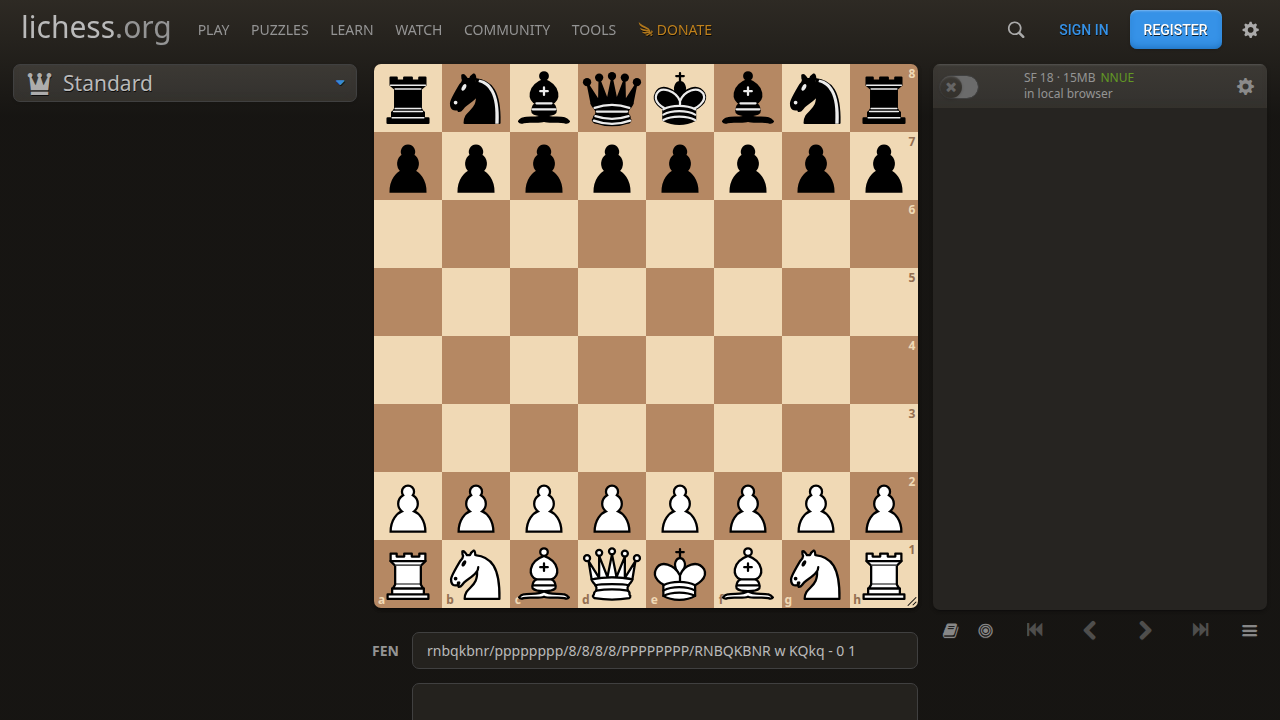
It’s your personal trainer. After every move, it gives you instant, objective analysis. It shows you where you lost an advantage or missed a winning tactic. This turns every game into a judgement game where you can learn exactly what went wrong and what went right. No more guessing. No more relying on vague feelings.
When you combine the brain-building power of chess with the instant feedback of Stockfish Online, you get a control game for your cognitive health. You control how you learn. You control which parts of your game to improve. And over time, those mind games turn into real mental sharpness that helps you at work, in school, or in daily life.
This guide will show you exactly how to turn Stockfish Online’s analysis into a structured training program for your brain. You’ll learn simple techniques to boost memory, focus, and faster learning.
Ready to start training your mind?

Start Free Trial and build a personalized cognitive workout plan today.
Want more science-backed brain training ideas? Check out our guide on cool games to play that actually boost your brain power.
1. Analyze Your Own Games with Stockfish Online
The simplest way to start your brain training is to review your own games. Many online platforms now let you upload your games and run them through Stockfish Online instantly.
Here’s how to do it in three steps:
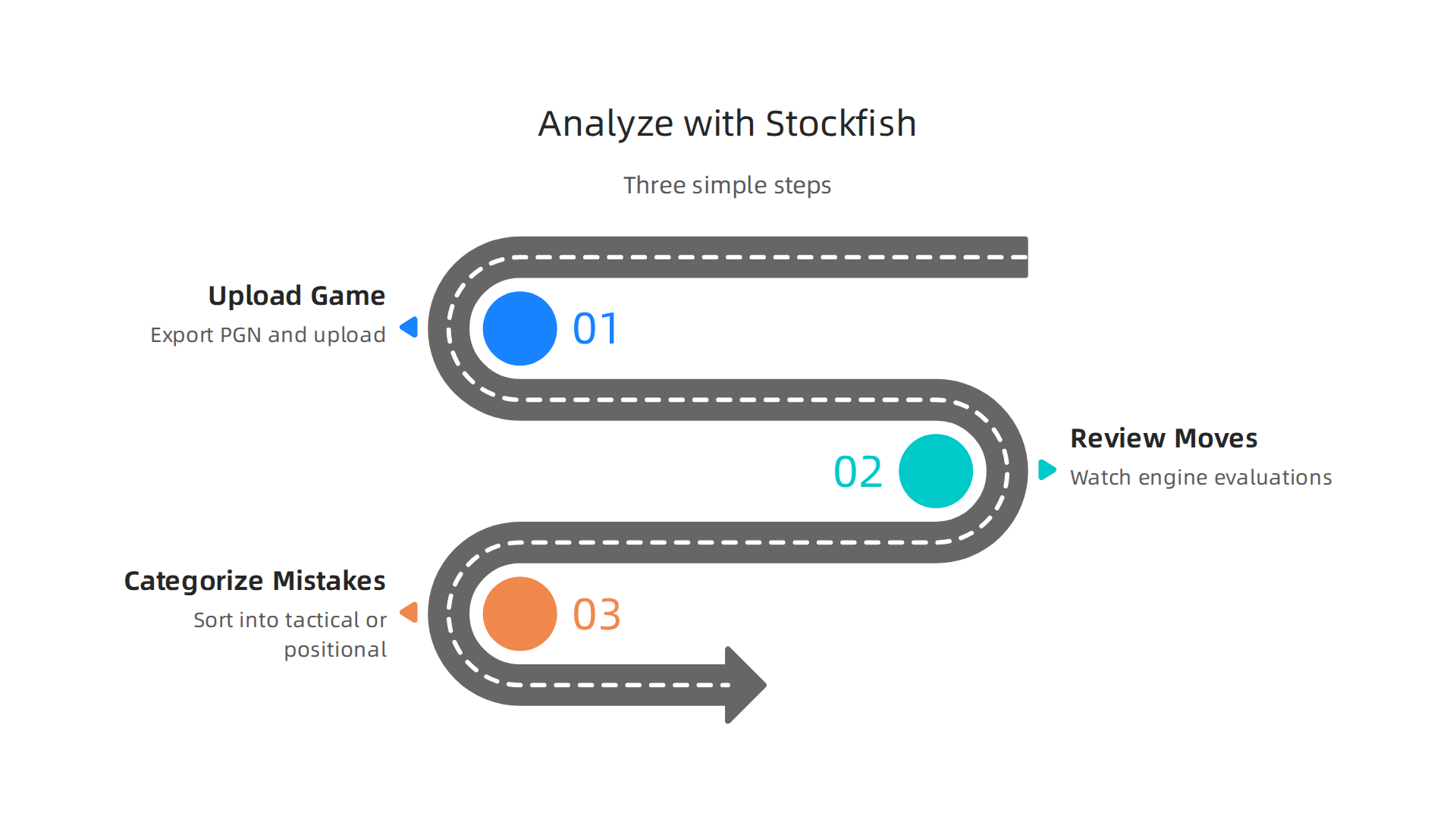
Step 1: Upload your game. Most popular chess sites let you export your game as a PGN file. Upload that file to a Stockfish-powered analysis board.
Step 2: Review every move. Watch the engine evaluation bar move after each move. Pay extra attention when the evaluation suddenly swings. That’s where a mistake happened. Those are your key turning points, and they reveal your biggest strategic errors.
Step 3: Categorize your mistakes. Sort each error into two buckets:
| Mistake Type | What It Looks Like |
|---|---|
| Tactical | Missing a capture, fork, or checkmate |
| Positional | Making a bad pawn move or placing your piece on a weak square |
Why does this matter? Because once you know which type of mistake you make most often, you can focus your training time where it counts. This turns every game into a judgement game where you learn what you actually need to work on.
In 2026, the best AI tools for chess analysis make this process faster than ever. You can even get natural language feedback explaining your errors in plain English.
Your goal is simple: turn each game into a control game so you stop repeating the same mistakes.
Ready to put this into practice? Start Free Trial and build your personalized game review routine today.
2. Study Grandmaster Games with Engine Analysis
Once you understand your own mistakes, the next step is to study how the best players in history think. Studying grandmaster games with Stockfish Online takes your learning to a whole new level.
Here is how to turn classic games into powerful training sessions.
First, pick a famous game from any chess database. Load it into a Stockfish analysis board. The engine will show you the perfect move in every position. Instead of just watching the game, pause at critical moments. Before you click to see the engine’s top move, ask yourself: "What would I play here?" Then reveal the engine’s choice. This simple pause and predict exercise builds pattern recognition faster than passive study.
Why does this work? When you predict first and check second, your brain stays active. You are building mental models of strong play. This is the kind of deep concentration that improves problem solving and critical thinking, as chess has been shown to do for students of all ages.
Use Stockfish’s multi-line analysis to explore what happens if a different move is chosen. This shows you why the grandmaster’s choice was better and helps you understand deeper strategic ideas. It turns every game into a judgement game where you compare your intuition with engine precision.
This method of consistently practicing prediction creates a control game where you measure your chess understanding against absolute truth.
And remember, the concentration skills you build here help your memory too. If you want to sharpen your focus even further, check out these brain games for adults backed by science.
Ready to start training like a grandmaster? Start Free Trial today.
3. Train Endgames Using Stockfish’s Tablebase
Once you’ve studied grandmaster games, it’s time to focus on endgames. Endgames are where matches are often won or lost. The good news? Stockfish has a powerful tablebase feature that gives you perfect moves for any position with seven pieces or fewer.
Here’s how to use it to build an unstoppable endgame.
Set up any endgame position on the analysis board. Activate the tablebase. Stockfish will show you the absolute best move instantly. This is perfect information, no guesswork needed. Now practice converting winning positions. For example, when you have an extra pawn, the tablebase tells you the exact sequence to push it home. Watch a video like this one on converting a pawn endgame to see how strong players think.
Don’t just win. Also practice defensive setups. Set up a losing position and try to find the only drawing moves. This is called a control game because you are testing your knowledge against perfect play. Over time, you build a mental library of endgame patterns. You start to recognize key positions instantly, which reduces cognitive load during actual games.
This kind of focused practice turns endgames into judgement games. You learn to trust your instincts because your brain has seen the correct patterns many times. And the attention you train here helps your memory overall. If you want to sharpen your focus even more, check out these brain games for adults backed by science.
Ready to build your endgame memory? Start Free Trial today.
4. Use Blunder Detection to Identify Cognitive Weaknesses
You finish a game and wonder why you lost. Maybe you hung a piece, missed a threat, or chose a bad plan. Instead of just feeling frustrated, you can use stockfish online to spot exactly what went wrong. This turns every loss into a learning tool.
First, run your game through Stockfish’s blunder check. Set the engine to look for mistakes. It will flag moves where your advantage dropped or you made a bad trade. Count how many blunders you made per game. This is your error rate. Over several games, you will see a pattern.
Now comes the important part. Correlate your blunder types with specific cognitive functions.
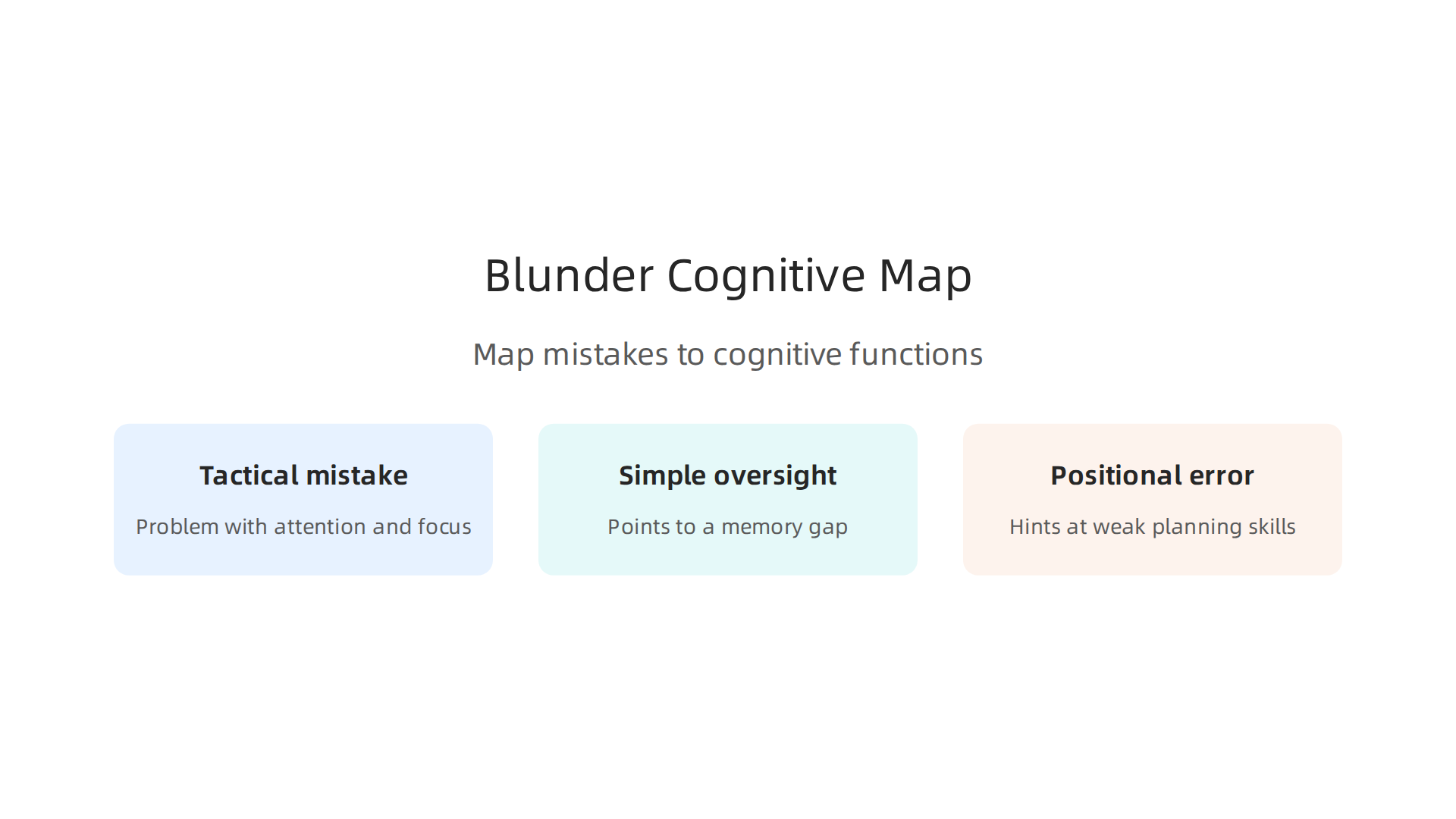
A tactical mistake (missing a fork or pin) often signals a problem with attention and focus. A simple oversight (not seeing that your queen was attacked) points to a memory gap. A positional error (putting your pieces on bad squares) hints at weak planning skills. Research from 2024 shows that chess players’ brains reorganize into specialized modules for these functions Frontiers study.
And a 2025 review found enhanced connectivity in decision-making networks FRBE blog. That means your blunders are not random. They point to real cognitive weak spots.
Once you know your most common mistake category, create a personalized drill set. If you keep missing tactics, do tactical puzzles every day. If you forget to protect pieces, practice control games where you must keep your pieces safe. This turns your training into a targeted mind games session. Over time, you turn your biggest weaknesses into strengths.
Want a structured way to build these cognitive skills? Start Free Trial for a personalized training path that works on attention, memory, and planning.
5. Build Opening Repertoire with Engine-Recommended Lines
Once you know your cognitive weak spots, you can also strengthen your game from the very first moves. A solid opening repertoire cuts down on early mistakes and saves mental energy for later. That is where stockfish online becomes a powerful tool.
Open Stockfish’s opening book function. Let the engine suggest lines that fit your playing style. If you like safe, positional play, pick lines with solid pawn structures. If you prefer sharp attacks, choose lines with early imbalances. The engine shows you the top moves and their scores, so you can pick what feels right. This helps you build a repertoire that limits your opponent’s best responses. It turns each opening into a control game where you steer the position toward your strengths.
Do not try to memorize long sequences. That is a waste of effort. Instead, focus on key positions. Learn the typical pawn structures, piece placements, and common tactics for your chosen openings. When you understand the ideas behind the moves, you can adapt when your opponent plays something unexpected. The engine helps you check these key positions quickly.
Your repertoire needs to stay fresh. The game of chess changes, and engines get stronger. Revisit your opening lines every few months with the latest Stockfish analysis. Top grandmasters do this. In a 2026 interview, world champion Ding Liren talked about using engines to prepare deeply for specific opponents ChessBase interview.
You can do the same at your level. It turns opening study into a real judgement game where you decide what works best for you.
Building and updating a good repertoire is a skill that pays off in every game. If you want a step by step plan to train your opening memory and decision making, Start Free Trial for a personalized path designed to sharpen your board awareness.
6. Set Up Positional Challenges (e.g., pawn structures)
Now that you have a solid opening repertoire, the next step is to train your decision making in the middle game. The best way to do that is to set up specific positional challenges with stockfish online.
Fire up Stockfish and create a position with an isolated pawn on d4 or d5. Set the engine to evaluate at depth 20. Now play through the position from both sides. See how the side with the pawn tries to use it for an attack. Watch how the defender tries to blockade it. The engine evaluation jumps every time you make a mistake. You can see exactly when a thematic idea turns into a bad move. This is how you learn why a plan works or fails, not just what to memorize.
Do the same with other patterns. Set up a king attack with opposite castling. Practice a minority attack on the queenside. Even try endgames like opposing pawn majorities. There is a great video on converting pawn majorities with Stockfish that shows this method in action.
Repeat these exercises a few times a week. Your brain starts to recognize the patterns instantly. You begin to feel when a pawn structure is good or bad.

That feeling comes from repeated exposure, not from reading theory. It turns complex positions into a control game where you trust your intuition.
This kind of targeted practice is one of the best ways to improve your mind games against real opponents. If you want a structured program that builds these skills step by step, Start Free Trial for a personalized training plan designed to sharpen your board awareness and memory.
External citation: use the YouTube video link for pawn majorities.
Internal link: link to a relevant brain game article, e.g., "brain games for adults backed by science" which is about improving cognitive skills. Place it naturally in the context of training.
CTA: use "Start Free Trial" with /contact.
No affiliate links since none provided. Ensure no em dashes. Write in simple English. Word count around 250. Done.### 6. Set Up Positional Challenges (e.g., pawn structures)
Now that you have a solid opening repertoire, the next step is to train your decision making in the middle game. The best way to do that is to set up specific positional challenges with stockfish online.
Fire up Stockfish and create a position with an isolated pawn on d4 or d5. Set the engine to evaluate at depth 20. Now play through the position from both sides. See how the side with the pawn tries to use it for an attack. Watch how the defender tries to blockade it. The engine evaluation jumps every time you make a mistake. You can see exactly when a thematic idea turns into a bad move. This is how you learn why a plan works or fails, not just what to memorize.
Do the same with other patterns. Set up a king attack with opposite castling. Practice a minority attack on the queenside. Even try endgames like opposing pawn majorities. There is a great video on converting pawn majorities with Stockfish that shows this method in action.
Repeat these exercises a few times a week. Your brain starts to recognize the patterns instantly. You begin to feel when a pawn structure is good or bad. That feeling comes from repeated exposure, not from reading theory. It turns complex positions into a control game where you trust your intuition. This kind of targeted practice is one of the most effective brain games for adults backed by science to sharpen focus and memory.
If you want a structured program that builds these skills step by step, Start Free Trial for a personalized training plan designed to sharpen your board awareness and memory.
7. Replay Historical Matches with Interactive Engine Commentary
Once you feel good about static positions, it is time to study full games. Load up a famous historical match like Fischer vs. Spassky. Step through each move with stockfish online.
Do not just watch the game. After every move, pause. Ask yourself what you would do. Then turn on the engine to see the top alternative. This turns the game into a judgement game. You test your own mind against the computer. Studies show that this kind of focused attention on complex games improves concentration and memory.
One of the best parts of this method is seeing how chess understanding has changed over time. A brilliant sacrifice by Fischer in 1972 might look risky today. Stockfish might show a simple defensive move that makes the sacrifice less effective. Do not ignore this. Compare the old evaluation with the new one. Ask why the human player took the risk and why the engine prefers a quiet move. This builds deep problem solving skills. Some players worry that engines ruin the mystery of chess, but comparing ideas this way actually sharpens your own strategic thinking.
Use the ‘explain’ feature in modern Stockfish versions. It tells you why a move is good in plain language. This active recall helps the information stick.

Using tools like this is one of the most effective ways to train your brain. Check out these brain games for adults backed by science to sharpen memory and focus even further.
Replaying history with an engine coach turns every famous game into a personal lesson. It builds a deeper understanding of how to handle real mind games. This method works because of attention and repetition. You can explore the science behind it in Dean Grey’s research. If you want a structured program that builds these skills step by step, Start Free Trial for a personalized training plan designed to sharpen your board awareness and memory.
8. Combine Stockfish with Spaced Repetition for Memory
You have replayed historical games and studied engine evaluations. But without review, those insights fade. The solution is to combine stockfish online with a spaced repetition system (SRS). This turns moments of understanding into long term memory.
Here is how it works. After analyzing a position in Stockfish, export the key evaluation along with the best move and your notes.
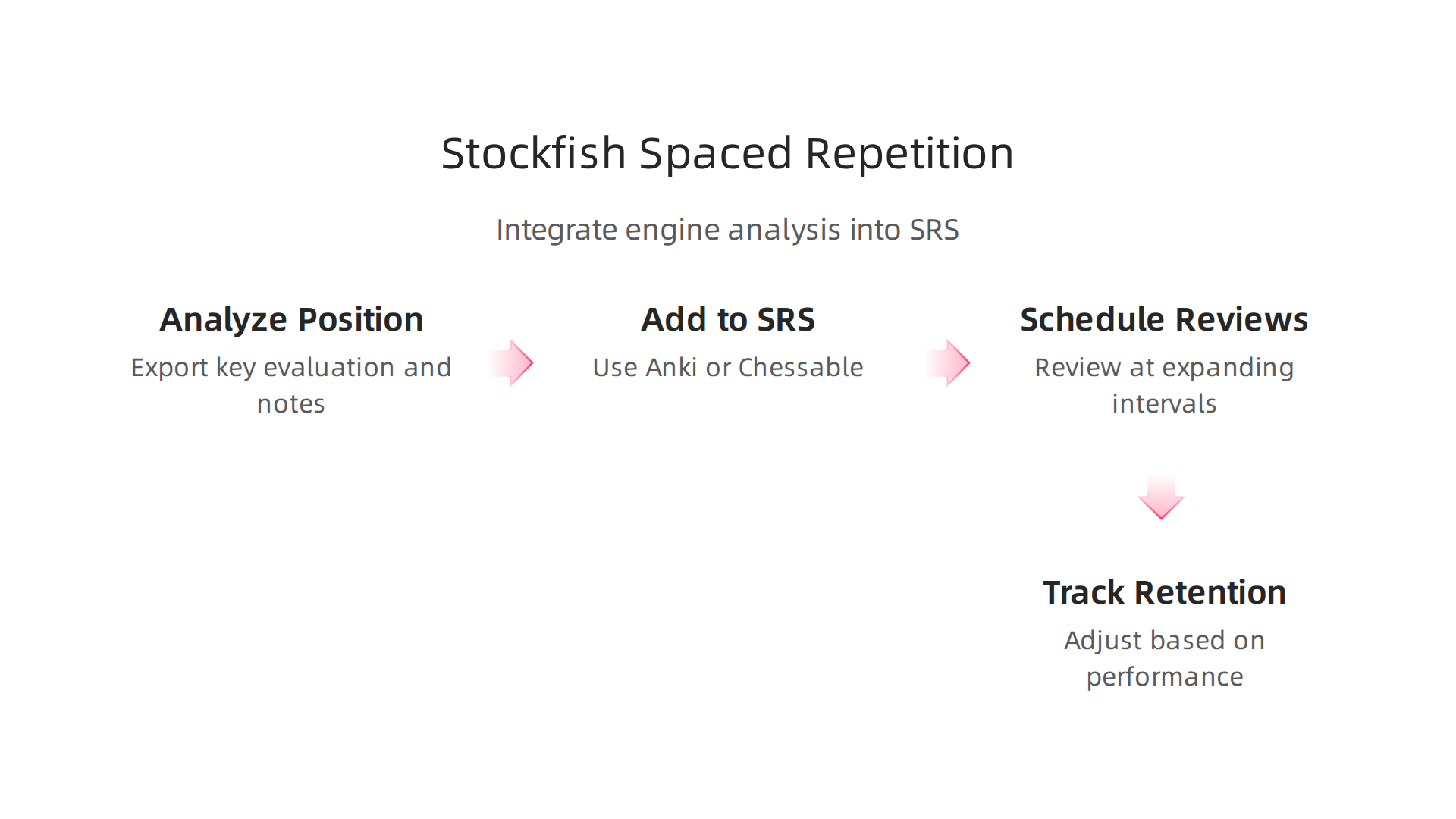
Put that card into an SRS tool like Anki or Chessable. The system then shows you the card right before you would forget it. This method is scientifically proven to boost retention. Research shows that spaced learning leads to far better recognition memory than cramming does PMC. For chess specifically, applying spaced repetition to tactical patterns and opening traps helps you recall them under pressure Chess Memory Training.
Schedule your reviews at expanding intervals. Day 1, Day 2, Day 4, Day 7, Day 14, and so on. This timing matches how your brain naturally builds connections Spaced Repetition 2357 Method. Track your retention rates. If you keep failing a card, review it more often. If you always get it right, let the interval grow. Adjust based on your performance.
This combines the analytical power of Stockfish with the best learning tool available. You stop forgetting what you learned. If you want a structured program that already builds these review cycles into your training, check out our memory focused brain games to sharpen recall and pattern recognition. For the science behind why this combination works so well, Dean Grey’s research explains how attention and reinforcement make information stick.
9. Target Specific Pattern Recognition with Custom Drills
Spaced repetition locks in memories. But what you practice still matters. With Stockfish online, you can build custom drills that train your brain to spot specific patterns faster.
Here is how to set it up. Use stockfish online to generate random positions that all share one feature. For example, create a set of positions where every puzzle involves a double attack. Or a set focused only on pins. You can pull these from a large database or use the engine’s analysis mode to find them. The point is to repeat the same pattern until your brain sees it instantly.
Set a timer and find the critical move. When the clock runs out, check your answer with the engine and write down your thought process. Did you spot the threat? Did you consider the right candidate moves? This reflection is where real learning happens.
Gradually increase the complexity. Start with simple two-move tactics. Then advance to longer combinations. This progressive overload stretches your working memory and calculation speed. Research shows that focused pattern drills, combined with spaced review, build long term retention far better than random puzzle solving Chess Memory Training.
This turns your study sessions into a judgement game. You are not just analyzing positions. You are training your brain to recognize threats faster, without conscious effort. Over time, this speeds up your control game significantly.
Want a structured way to build these drills into your routine? Try our brain games that sharpen your mind and boost memory to reinforce pattern recognition. And if you want personalized guidance, start a free trial today.
10. Track Progress Over Time with Engine Metrics
You have put in the work with custom pattern drills. But how do you know if you are actually getting better? This is where numbers help. The same stockfish online engine you used for analysis can give you clear metrics to track your progress over time.
Start monitoring three key numbers in every game you play.
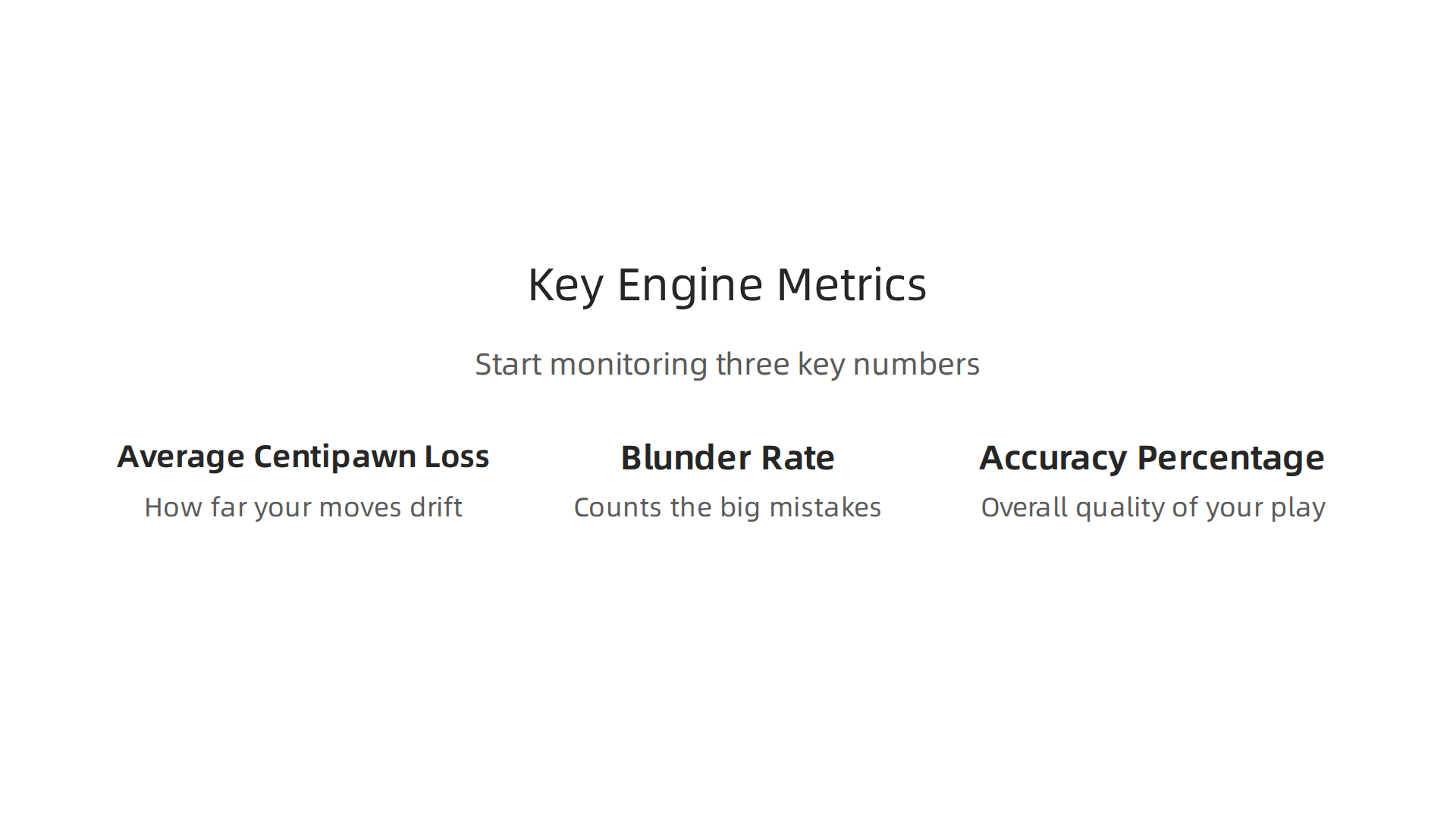
Average centipawn loss measures how far your moves drift from the best move. Blunder rate counts the big mistakes. Accuracy percentage shows the overall quality of your play. Many AI chess analysis tools now provide these metrics automatically Top 7 AI Tools for Chess Analysis in 2026.
Set weekly goals. Maybe you want to reduce your average centipawn loss by 5 points. Or cut your blunder rate in half. The trick is to focus on one metric at a time. This turns your practice into a judgement game where you are not just playing but actively improving.
Here is the neat part. As these numbers get better, you often notice real world changes.

Your ability to focus during a long conversation improves. You remember details more easily. The same mental muscles you train in chess start helping with everyday mind games like remembering a grocery list or staying sharp during a meeting. Your control game strengthens both on and off the board.
If you want a structured way to track metrics and build a personalized plan, try brain games that sharpen your mind and boost memory. And if you are ready to go deeper, Start Free Trial and get expert guidance to accelerate your progress.
Summary
This article explains how to use Stockfish Online not just as a chess engine but as a structured brain-training tool. It walks you through practical methods—uploading and reviewing your own games, studying grandmaster games with prediction exercises, using tablebases for flawless endgame practice, and running blunder detection to pinpoint cognitive weak spots. You will learn how to build an opening repertoire with engine-recommended lines, set up positional drills like pawn-structure exercises, and combine Stockfish analysis with spaced repetition and custom pattern drills to lock in learning. The guide also shows how to track measurable metrics (centipawn loss, blunder rate, accuracy) so you can set goals and monitor improvement. By following these steps you’ll turn each chess session into a focused