

Introduction
Do you ever feel like your brain is running on low battery? You are not alone. Many adults today struggle with constant information overload, short attention spans, and trouble remembering important details. It can feel frustrating when you know you are capable of more but your mind just won’t cooperate.
Here is the good news. Control and judgement games are not just fun. They are scientifically proven to enhance cognitive functions like memory and focus. Research from the MIT Miller Lab shows that training on a game called NeuroRacer produced long lasting improvements in cognitive abilities for older adults aged 65 to 80. Another study in the PMC journal found that action video game training may hold promise as a cognitive intervention with the potential to enhance daily functioning. These are not simple puzzles. They are structured brain workouts.
Of course, not every brain game is equal. Some experts at Harvard point out that evidence for many apps is limited. That is why this article focuses on games backed by real research. Games like chess through Stockfish online, spy games that test your judgement, and other control games that sharpen your decisions.
In 2026, you have more tools than ever to train your brain. The key is knowing which ones actually work. This article explores the best control and judgement games supported by science and shows you how to fit them into your daily routine. If you want to improve your memory and focus without wasting time on gimmicks, you are in the right place.
Let us start with the first step: training your attention. Your memory can only be as strong as your ability to focus. If you are ready to build that foundation, Train Attention First with a simple exercise that takes just a few minutes each day. For a deeper look at how different games boost brain power, check out our guide on brain games for adults backed by science to sharpen memory and focus.
What Are Control and Judgement Games?
Let us get clear on one thing before we go further. Not every game that claims to be good for your brain actually is. The ones that work have a very specific job. They train something called cognitive control.
Cognitive control is a fancy term for a simple skill. It is your brain’s ability to guide your actions toward a goal. It helps you ignore distractions and switch focus when you need to. Research shows that cognitive control is a basic building block for many other mental skills.
A control game is designed to exercise this exact ability. These games force you to stop an impulse and shift your attention instead. That makes them different from standard puzzles. A crossword puzzle asks you to recall facts. A control game asks you to manage conflicting information and make smart choices under pressure.
Here is a classic example. The Stroop test shows you the word "blue" written in red ink. Your first urge is to read the word "blue." But the game asks you to name the color of the ink, which is red. You have to stop one habit and act on another. That is judgement in action.
Another simple example is Simon Says. You only follow an instruction if the leader says "Simon says" first. If they say "jump" without saying "Simon says," you must hold still. You are literally practicing self control.
Then there are deeper strategy games. If you play chess against Stockfish online , you practice planning ahead and adapting to new threats. Strategy games like StarCraft also work this way. According to a 2026 research guide on video game training, action and strategy games can improve attention and multitasking skills.
Even a good spy game works. You watch for a specific signal and only react to that. You ignore everything else. That trains your selective focus.
These games are distinct from simple brain teasers because they target executive functions. Executive functions are the high level skills that help you organize, plan, and pay attention. A judgement game asks you to evaluate a situation quickly and choose the right move. That is a workout for your brain.

If you want to build these skills, start with the basics. You can Train Attention First with a simple exercise that takes just a few minutes each day. Then, to find more games that sharpen these skills, check out these cool games to play that actually boost your brain power.
Key Types of Control Games
You now know the basic idea. But what does a control game look like in practice? Let us break down the main types.
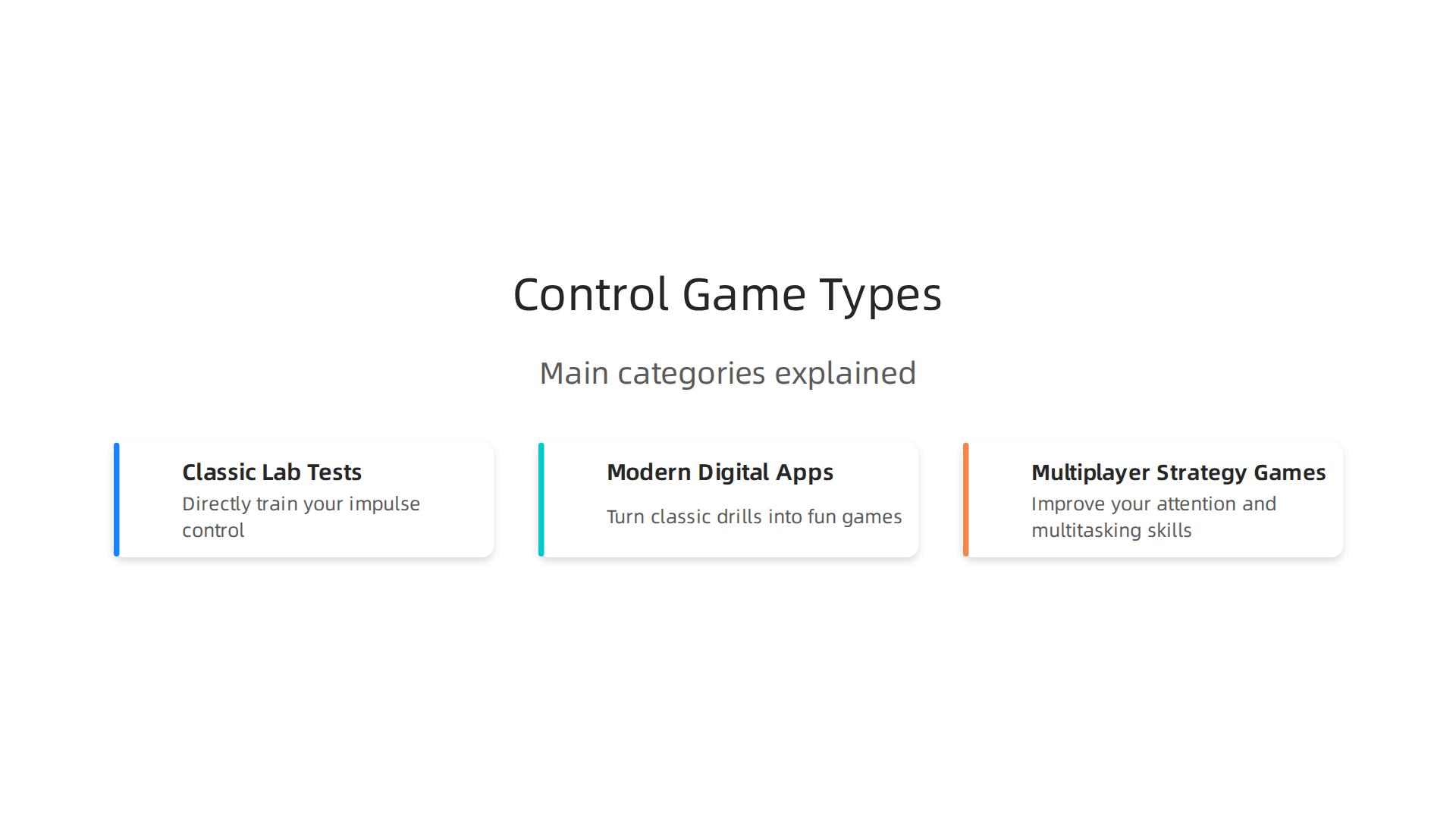
Classic Lab Tests (Flanker and Go/No-Go)
The simplest control games come straight from science labs. A Flanker task asks you to focus on a central arrow while ignoring the arrows around it. A Go/No-Go task asks you to press a button for one signal but hold back for another. These drills directly train your impulse control. Research shows that cognitive control is a basic skill that helps you perform many other mental tasks.
Modern Digital Apps (BrainHQ)
You do not need a lab today. Apps like BrainHQ turn those classic drills into fun games you can play on your phone.
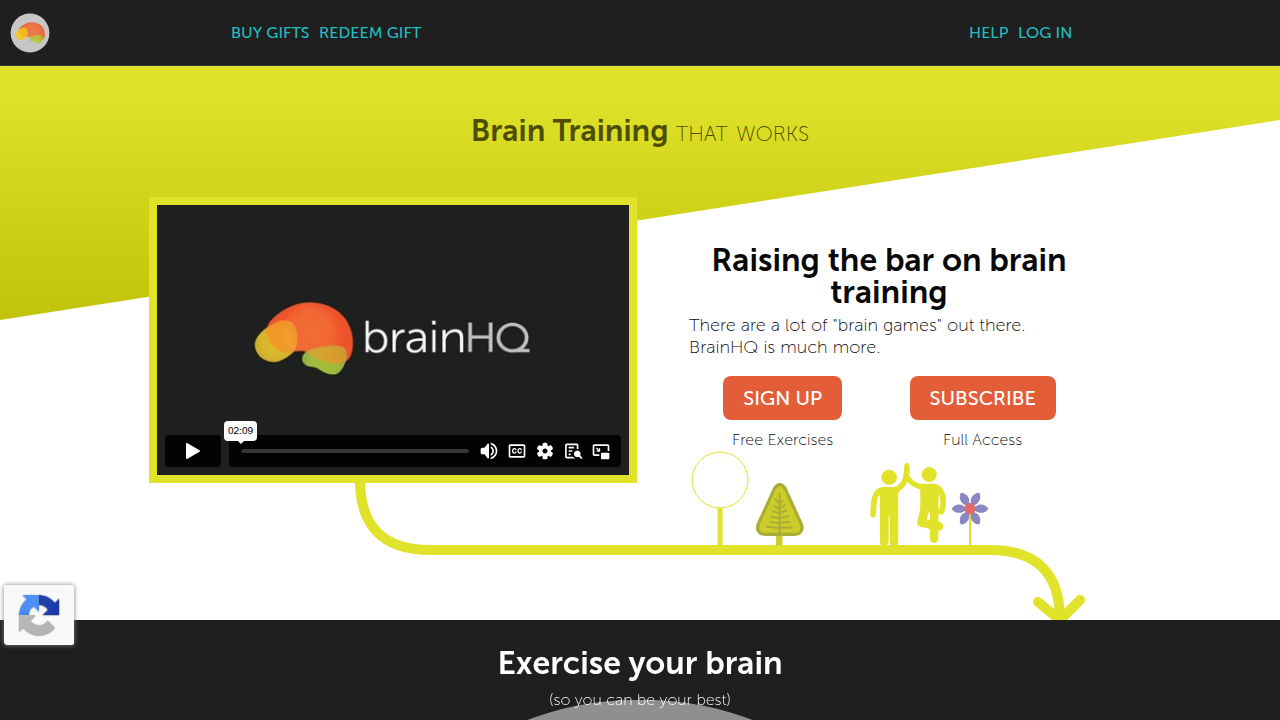
They adapt to your skill level. Studies show that these brain training games can have a real positive impact on cognitive function.
Multiplayer Strategy Games
Do not forget regular video games. Fast paced action and strategy games force you to manage resources and ignore distractions. According to a 2026 research guide, these games improve your attention and multitasking skills.
If you enjoy word puzzles, check out these brain games for adults backed by science for another angle on focus training.
Where should you start? The first step is strengthening your attention. You can Train Attention First with a simple exercise that builds the foundation for all other control games.
The Neuroscience of Strategic Play
Now that you have seen the different types of control games, you might wonder what is actually happening inside your head when you play one. It is not just fun. Your brain is changing in real time, and the science behind it is pretty amazing.
Your Brain’s Command Center
The star of the show is a part of your brain called the prefrontal cortex. Think of it as your brain’s command center. It handles focus, planning, and the ability to stop yourself from doing something impulsive. When you play a judgement game or any fast-paced control game, your prefrontal cortex works hard to ignore distractions and make smart choices. Neuroimaging studies confirm that training on tasks like Go/No-Go directly involves this brain region and is crucial for overall cognitive control [source: PMC article].
Why Winning Feels So Good
Here is the cool part. When you succeed in a game (like making the right call in a spy game or beating a tough opponent using stockfish online to analyze your next move), your brain releases a chemical called dopamine. Dopamine makes you feel good. It tells your brain, "Hey, that was great. Let’s do it again." This reward system reinforces learning and keeps you motivated to keep training. Without it, getting better at anything would feel like a chore.
Your Brain Can Grow Stronger
This is the most exciting bit. Your brain is not stuck the way it is. It can change and grow. This is called neuroplasticity. When you practice a control game regularly, your brain literally strengthens the connections in your control networks. A systematic review on Sudoku solving shows consistent engagement of frontoparietal control networks, which are the same networks linked to working memory and executive function [source: Frontiers article]. The more you practice, the stronger and faster those connections get. Your brain adapts to make you better at the task. Research into neuroplasticity confirms that the prefrontal cortex is the key area for this kind of flexible adaptation [source: Pubmed article].
This means every time you sit down for a focused session of a brain game, you are building a stronger, more efficient brain. This is not just theory. This is the science of how you can actively improve your focus and cognitive strength.
If you want to start building your mental command center, the first step is sharpening your attention. You can Train Attention First with a simple exercise that builds the foundation for all other brain training.
Brain Regions Involved
Your prefrontal cortex is not working alone. Two other key players help you stay sharp during any control game.
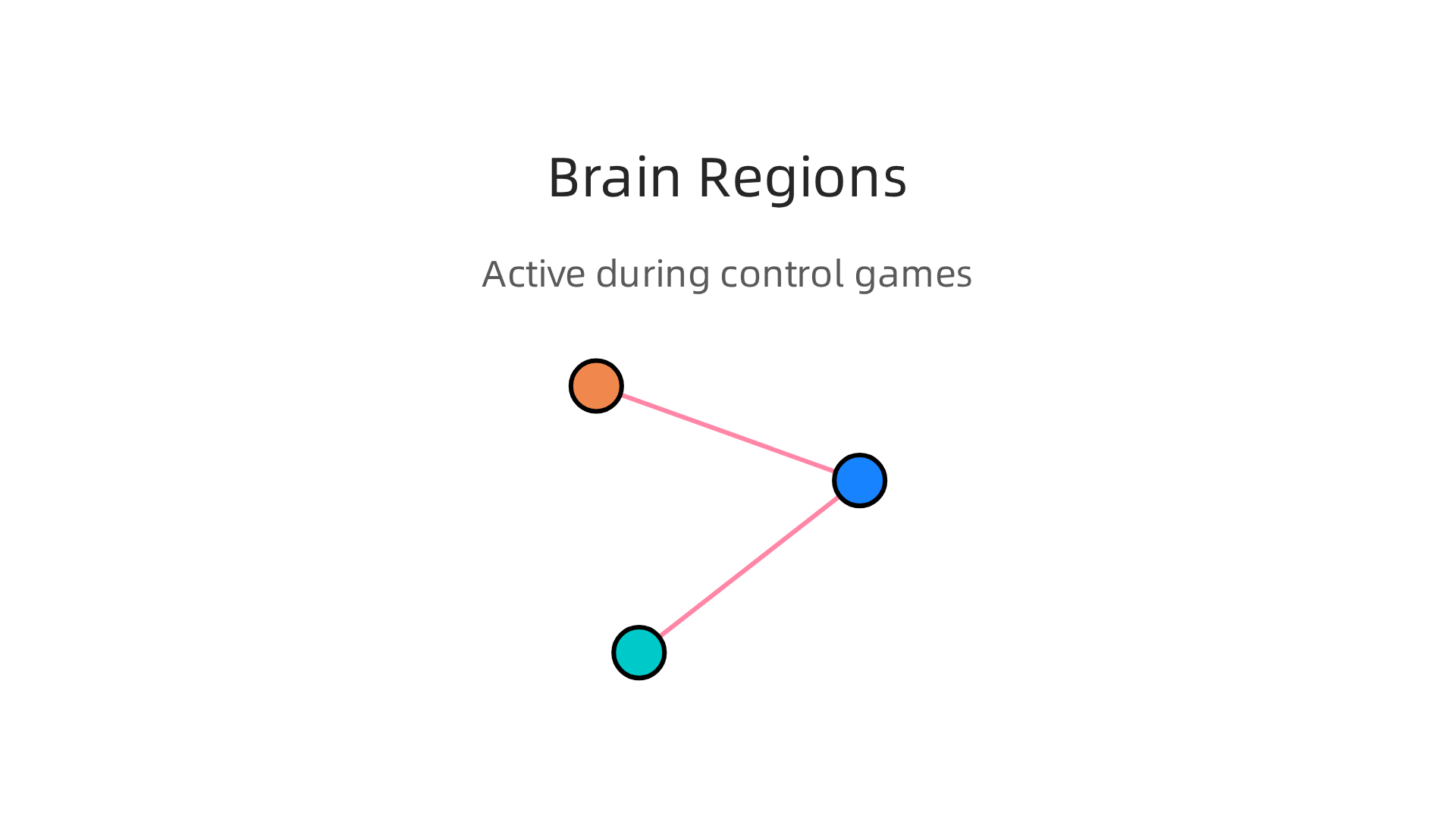
The Spotter: Anterior Cingulate Cortex
Your anterior cingulate cortex acts like a built-in spotter. It watches for mistakes. When you make the wrong call in a spy game or slip up in a judgement game, this region lights up. It says "Oops, pay attention." This error detection helps you adjust fast and get better over time. Studies show that video game training activates this area and improves how your brain handles cognitive control [source: Frontiers article].
The Gatekeeper: Basal Ganglia
Your basal ganglia handle response selection and inhibition. Think of them as a gatekeeper. They help you pick the right action and stop the wrong one. When you need to block a distraction or hold back an impulse, your basal ganglia step in. Research into neuroplasticity confirms that consistent training strengthens these hidden but crucial circuits [source: Sciety article].
The Highways: White Matter
Here is something cool. With practice, the white matter in your brain actually improves. White matter is like the wiring that connects different brain regions. Faster connections mean quicker thinking and better focus. Every time you play a control game, you are building stronger highways in your brain.
Want to give all these brain regions a real workout? Try playing a few rounds of cool games to play that actually boost your brain power.
Ready to start strengthening your mental command center? The best first step is training your attention. Train Attention First with a simple exercise that builds the foundation for all other brain training.
Proven Benefits for Memory and Attention
So we have seen how your brain lights up during a control game. But does that actually help you in real life? The short answer is yes. And the research to back it up keeps growing.
Your Working Memory Gets Stronger
Working memory is like your mental sticky note. It holds small bits of information so you can use them right away. Think about remembering a phone number long enough to dial it. That is working memory. And here is the good news. A 2025 meta-analysis found that brain training games, including the kind of control game we are talking about, can boost working memory in a meaningful way [source: PMC study]. The effect is real. Your brain learns to juggle more pieces of information at once. That helps with everything from following a recipe to solving a tough problem at work.
Your Focus Lasts Longer
Have you ever noticed how your mind drifts after a few minutes of reading? That is your sustained attention running low. A 2026 study showed that digital cognitive training games improved visuospatial attention in people with mild cognitive impairment [source: JMIR study]. But you do not need a diagnosis to benefit. Playing a focused judgement game or a fast-paced spy game trains your brain to lock in for longer periods. You get better at ignoring distractions. You learn to switch between tasks without losing your place.
Real World Gains
This is the part most people want to hear. Does all this clicking and thinking actually help you in daily life? Yes. Research has shown that computerized cognitive training improves both attention and working memory in children with ADHD [source: UC Davis article]. Better attention means better reading comprehension. Better working memory means you can follow a conversation more easily. It means you miss fewer details during a meeting. A 2025 meta-analysis also confirmed moderate improvements in working memory from cognitive training [source: ADHD Evidence blog].
These benefits are not locked inside a video game. They travel with you. You become sharper at work.

You get better at learning new things. You feel less frustrated when you need to focus.
Want to explore more brain friendly activities? Check out brain games for adults backed by science that build these same skills.
Start With a Simple Step
Here is the thing. You do not need to play complex games to see results. The most important skill to train first is your attention itself. Once your attention is strong, everything else follows more easily.
Memory improves when attention has direction. Train Attention First with a simple exercise that builds the foundation for all other brain training.
Evidence from Peer-Reviewed Studies
You might wonder if those benefits in the last section are just from small or weak studies. That is a fair question. So let us look at what the bigger research says.
A Large Look at the Data
A 2025 meta-analysis pulled together findings from many studies on brain training games source: PMC study. The goal was simple. See if these games actually improve cognitive functioning and processing speed. The results were clear. Playing a well designed control game led to real gains in attention and working memory. The effect sizes were moderate, meaning the improvements were not tiny. They were meaningful.
Better Than Placebo Games
Here is an important detail. Some critics say any improvement comes from just doing something mentally active. Maybe it is the effort, not the game itself. But randomized controlled trials have answered this question. When researchers compared a real control game to a placebo game that looked similar but offered no real challenge, the real game won every time. One 2026 study on digital cognitive training for people with mild cognitive impairment showed measurable gains in visuospatial attention compared to a control group source: JMIR study. The same pattern shows up in studies with children who have ADHD. Computerized cognitive training improved both attention and working memory scores more than non training activities source: UC Davis article.
Not Every Game Works the Same
This is where things get honest. The research also shows that results vary from person to person. Some studies found bigger gains than others. A 2025 meta-analysis confirmed moderate improvements in working memory from cognitive training source: ADHD Evidence blog. But not every participant improved the same amount. Why? Because brain training is not one size fits all. The heterogeneity in results tells us that tailored training matters more than just playing any game.
A judgement game that tests your decision making will train different skills than a spy game that asks you to track moving targets. And using stockfish online to play chess at a high level builds strategic thinking in a way that a simple reaction game cannot.
The takeaway is simple. The science supports brain training. But the game you choose and how you train matters a lot. If you want reliable results, pick a control game with a clear structure and a real challenge.
Want to explore more games that match this standard? Check out cool games to play that actually boost your brain power for ideas that fit the research.
Start With What Matters Most
Still, the strongest foundation for any brain training is your ability to focus. Without that, even the best game will not help much.
Memory improves when attention has direction. Train Attention First with a simple exercise that builds the foundation for all other brain training.
Control Games for Different Age Groups
Not every control game works the same for every person. That is the honest truth. A game that helps a student remember formulas might bore a professional. And a game that challenges a retiree might feel too slow for a teenager. The research shows that tailoring your training to your age and goals matters a lot. Here is how to pick the right fit.
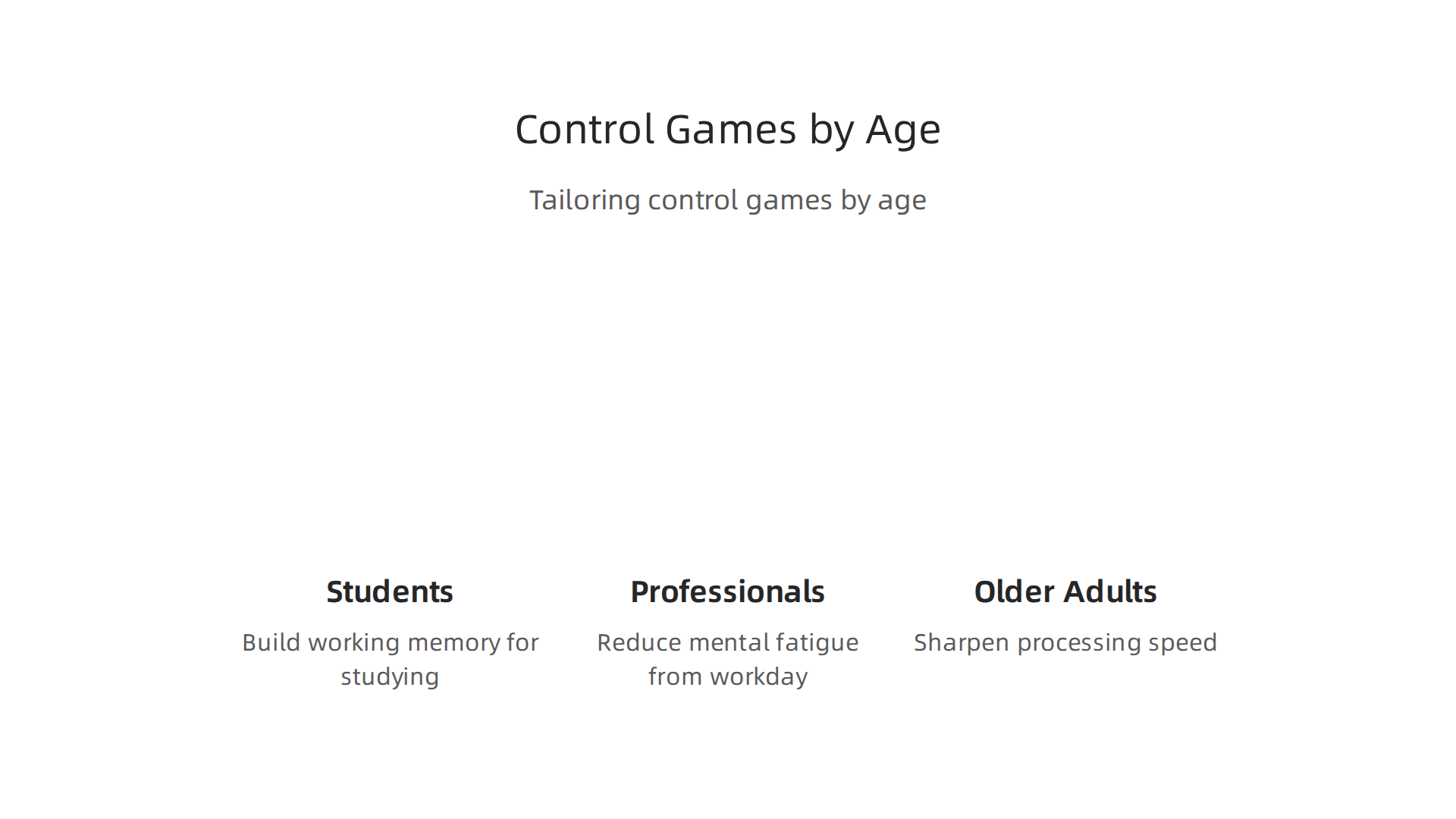
Students Build Working Memory for Studying
If you are a student, your brain is likely overloaded with facts, deadlines, and exam pressure. A good control game can help you hold more information in your head at once. Studies show that action video game training can enhance daily cognitive functioning and help with learning new material source: PMC article. The key is picking games that force you to track multiple items at the same time. A spy game that asks you to remember faces, locations, and codes trains your working memory directly.
Students who play the right brain games can pay attention better, process information faster, and retain more of what they learn source: Child Mind Institute. But the game has to be a real control game, not just a casual time waster. Look for structured challenges that push you just past your comfort zone.
Professionals Reduce Mental Fatigue
Your workday probably involves long stretches of focus, multitasking, and decision making. That drains your mental energy fast. A judgement game that tests your ability to make quick decisions under pressure can actually reduce cognitive fatigue over time. How? By training your brain to filter out distractions and stay sharp longer.
Professionals who train with focused brain games show better concentration and less mental burnout during the workday source: CommonSpirit Health. Games that require strategic thinking work especially well here. If you enjoy chess, playing with stockfish online forces you to plan several moves ahead, which strengthens executive function.
That skill carries directly into managing projects and solving problems at work.
For more ideas, check out brain games for adults backed by science that are designed to keep your mind fresh during a busy schedule.
Older Adults Sharpen Processing Speed
As we age, processing speed naturally slows down. But here is the good news. A well designed control game can reverse some of that decline. The famous NeuroRacer study tested adults aged 65 to 80. After training on a custom control game, they showed lasting improvements in cognitive abilities and multitasking skills source: MIT Miller Lab. That is remarkable because these gains lasted long after the training ended.
For older adults, the best games focus on visuospatial attention and quick decision making. A spy game that requires tracking moving targets helps maintain reaction time. A judgement game that asks you to weigh options quickly strengthens executive function. Brain games designed for critical thinking and problem solving can also protect against age-related cognitive changes source: CommonSpirit Health.
One important note. Not everyone benefits the same way. Some people show strong gains while others show less transfer source: UC Riverside. The difference often comes down to how engaged you are with the training. Games that feel boring or repetitive will not help much. Pick a control game that actually interests you.
For all age groups, the strongest foundation is your ability to focus. Without that, even the best game falls short. Train Attention First with a simple exercise that builds the foundation for all other brain training.
For Students and Professionals
Students and professionals share one big problem. Your brain gets overloaded every single day. For students, it is exam pressure, memorizing facts, and switching between classes. For professionals, it is meetings, deadlines, and constant multitasking. A good control game trains your brain to handle that load better.
Let us start with students. One of the most studied brain training tasks is the dual n-back. It asks you to remember a sequence of sounds and a sequence of visual positions at the same time. That sounds simple, but it forces your working memory to stretch. Research shows that action video game training can enhance daily cognitive functioning and help with learning new material source: PMC article. Students who use this kind of training can pay attention better, process information more quickly, and retain more of what they learn source: Child Mind Institute. The key is adaptive difficulty. The game has to get harder as you improve. If it stays the same, your brain stops growing.
For professionals, the goal is different. You do not need to memorize a textbook. You need to stay sharp during long work hours and make fewer mistakes. A judgement game that tests quick decision making under pressure can reduce mental fatigue over time. Professionals who use focused brain games show better concentration and less burnout during the workday source: CommonSpirit Health. Games like stockfish online force you to plan several moves ahead, which strengthens executive function directly. That skill carries into managing projects, solving problems, and staying productive.
Here is the thing. Adaptive difficulty is not optional. It is the difference between growing your brain and wasting your time. A control game that always stays at the same level will not push your brain to form new connections. Look for games that adjust to your performance and keep you just past your comfort zone.
Memory improves when attention has direction. Train Attention First with a simple exercise that builds the foundation for all other brain training.
Interested in more options? Check out these brain games for adults backed by science that are designed to keep your mind fresh.
Practical Tips for Daily Training
Here is a simple truth that most people miss. Short sessions every day do way more for your brain than long sessions once a week. Research from 2026 shows that consistency is the strongest predictor of sticking with any training habit source: NIH study. That means 15 minutes of a control game each morning will rewire your brain faster than a two hour marathon on Saturday.

So how do you build a routine that actually lasts?
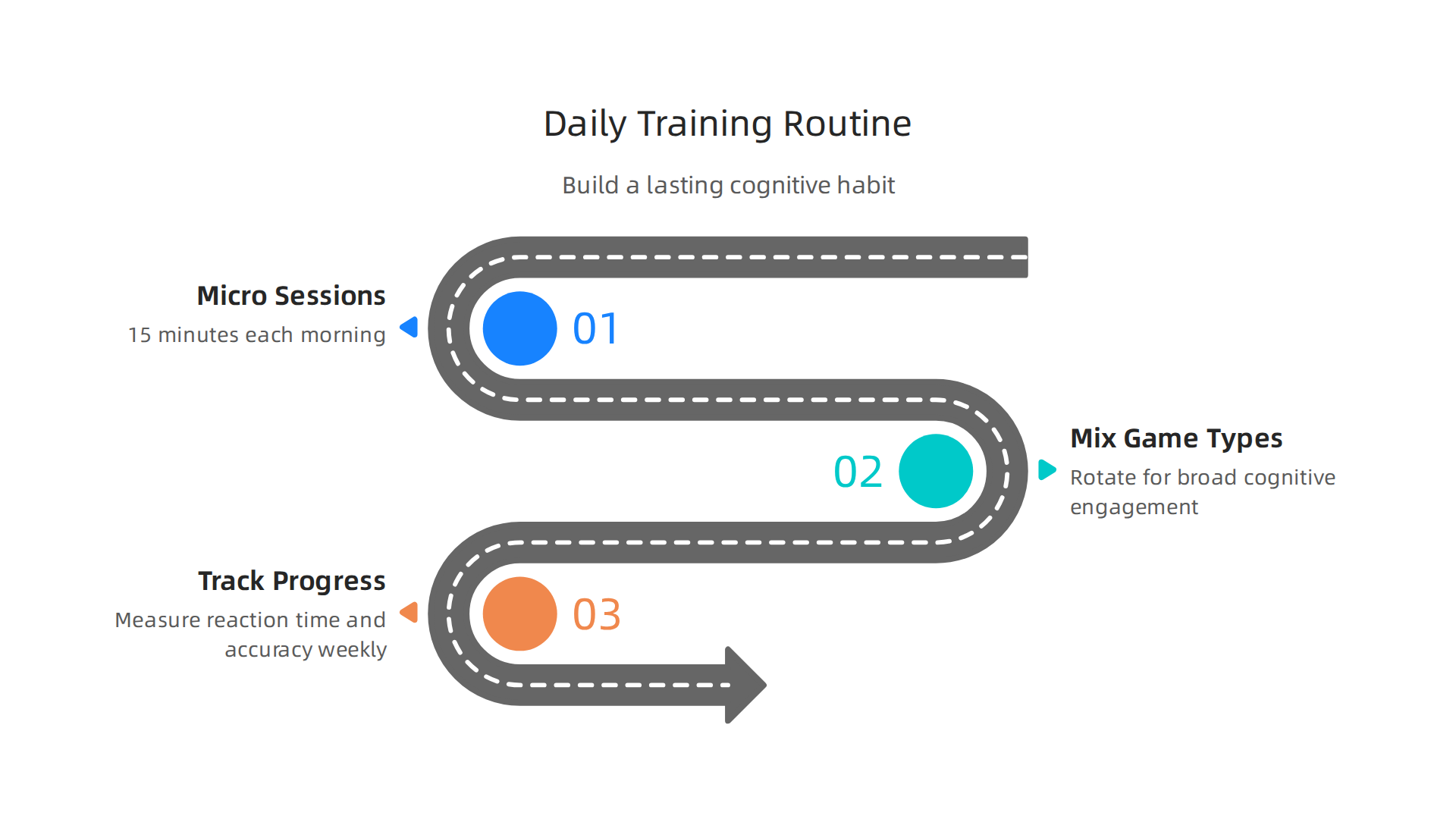
Start with micro sessions. Pick one judgement game like a stockfish online challenge and play it for 15 minutes right after you wake up or during your lunch break. The key is to attach it to an existing habit so it becomes automatic. Just five weeks of consistent cognitive training may protect your thinking skills for up to two decades according to recent findings source: ScienceDaily. That is a huge return for a tiny daily investment.
Next, mix up your game types for broad cognitive engagement. Do not play the same spy game every day. Rotate between a memory task, a speed based challenge, and a strategic planning game. New experiences in your daily routine actually improve mood and overall brain health source: Brandeis University. Variety keeps your brain forming fresh connections instead of going on autopilot.
Finally, track your progress with real metrics. Do not just guess if you are getting better. Measure your reaction time and accuracy each week. Cognitive speed training has been linked to lower dementia risk over the long term source: Johns Hopkins. When you see your numbers improve, that feedback keeps you motivated to stay consistent.
Try starting with these unblocked games that train your brain to build a varied daily practice.
Memory improves when attention has direction. Train Attention First with a simple exercise that builds the foundation for all other brain training.
Building a Routine and Measuring Progress
So you know what to do. Short sessions, mix up your games, track your numbers. Now let’s talk about turning that into a real routine that you can measure and stick with for the long haul.
Start with a baseline.
Do not just jump in blind. Take a free online cognitive assessment to measure your current reaction time and accuracy. This gives you a clear starting point. A 2026 study on goal setting found that people who create specific action plans are much more likely to stick with their training over time source: JMIR. You cannot see how far you have come if you do not know where you started.
Lock in a specific time every day.
Your brain builds habits through repetition. Pick one time slot for your control game or judgement game and treat it like a non negotiable appointment. Maybe it is right after your morning coffee. Maybe it is during your lunch break. Research shows that daily consistency is the strongest predictor of forming a lasting habit source: NIH. When you stop deciding when to train, the training just happens.
Use simple tools to track your wins.
Do not rely on how you feel. Feelings are unreliable. Use a habit tracker or a simple notebook to log your daily scores from your stockfish online challenge or your spy game session. Watching your numbers improve over weeks is incredibly motivating. Plus, cognitive speed training has been linked to lower dementia risk over the long term source: Johns Hopkins. Every rep counts.
Memory improves when attention has direction. Train Attention First with a simple exercise that builds the foundation for all other brain training.
Summary
This article explains how control and judgement games—designed to train cognitive control and executive function—can improve attention, working memory, and decision making. It reviews the main types of effective games (lab tasks, adaptive apps, action and strategy titles like chess with Stockfish, and spy-style selective-attention tasks), summarizes the neuroscience behind gains (prefrontal cortex, anterior cingulate, basal ganglia, and white matter), and surveys peer‑reviewed evidence showing meaningful, if variable, benefits across ages. The piece also shows how to pick age-appropriate games, build a short daily routine with adaptive difficulty, and measure progress with simple metrics. Readers will learn which games have scientific support, how to avoid low-value apps, and practical steps to make brain training a sustainable habit.